
Research publication · Aeronautical non-destructive testingInspection of dielectric, layered, polymer, composite, and manufactured structures without destructive sampling. Non-Destructive Testing: measurement approach and use cases Work begins with the material and the decision that the measurement... More
Aeronautics composite material inspection with a terahertzTerahertz radiation is electromagnetic energy commonly associated with frequencies around 0.1 to 10 THz, between microwaves and infrared, where many materials reveal distinctive propagation, absorption, and imaging behavior. More time-domain spectroscopy system
Composite aircraft structures are light and mechanically efficient, but their layered construction can hide foreign inclusions, moisture, debonds and delaminations. TerahertzTerahertz radiation is electromagnetic energy commonly associated with frequencies around 0.1 to 10 THz, between microwaves and infrared, where many materials reveal distinctive propagation, absorption, and imaging behavior. More radiation offers contact-free inspection of many non-metallic materials, with each time-domain waveform carrying information about interfaces beneath the surface. This study evaluates that capability on aeronautical glass-fibre and carbon-fibre composites. It compares a laboratory reference instrument with a mobile reflection-mode system developed in the European DOTNAC project, while documenting the strong material-dependent limits on penetration.
Featured visual: Contextual research figure from âTerahertzTerahertz radiation is electromagnetic energy commonly associated with frequencies around 0.1 to 10 THz, between microwaves and infrared, where many materials reveal distinctive propagation, absorption, and imaging behavior. More waves for contactless control and imaging in aeronautics industryâ. It illustrates a closely related terahertzTerahertz radiation is electromagnetic energy commonly associated with frequencies around 0.1 to 10 THz, between microwaves and infrared, where many materials reveal distinctive propagation, absorption, and imaging behavior. More topic and is not a figure from the publication discussed on this page. Source publication.

Visuals are drawn from the Airtable research archive. Figure numbering, rights and interpretation should be checked against the original publication before republication outside this site.
Two time-domain systems for composite inspection
The laboratory platform used an indium-arsenide surface emitter and a low-temperature-grown gallium-arsenide photoconductive receiver pumped by an 800 nm titanium-sapphire laser. The terahertzTerahertz radiation is electromagnetic energy commonly associated with frequencies around 0.1 to 10 THz, between microwaves and infrared, where many materials reveal distinctive propagation, absorption, and imaging behavior. More path was enclosed in dry air to reduce atmospheric water absorption. A 10 Hz mechanical delay modulation produced 20 temporal traces per second. During raster scanning, each position retained the full waveform rather than a single intensity value, allowing reflections to be separated by arrival time and frequency-domain information to be calculated later.
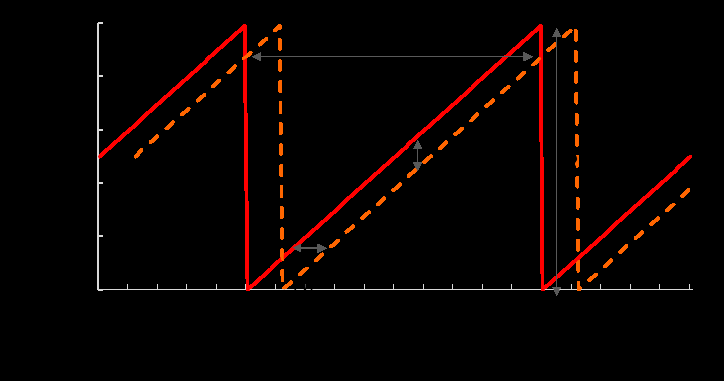
The mobile DOTNAC instrument used electronically controlled optical sampling. Two fibre lasers at 1560 nm, operating near 74.5 MHz with approximately 100 fs pulses, were phase locked; modulating one repetition rate swept the pump-probe delay without a mechanical translation stage. The system recorded a 100 ps trace in about 10 ms, corresponding to a 100 Hz trace rate. Fibre-coupled sensor heads worked in specular reflection at roughly 10 degrees incidence and could be positioned several metres from the laser unit. A multi-axis scanner was envisaged to follow panels and more complex shapes.
The portable architecture was designed to improve access and acquisition speed, but the paper does not present it as a certified maintenance tool. The laboratory system retained advantages in controlled alignment and image quality, while the mobile system tested whether meaningful defect contrast survived in a more deployable arrangement.
What the waves reveal in GFRP and CFRP
The sample set included solid glass-fibre-reinforced plastic, sandwich panels with foam or honeycomb cores, and carbon-fibre-reinforced plastic. Some specimens contained controlled inserts, water or impact damage; others represented manufacturing-related conditions such as debonding, delamination, porosity or coating anomalies. This variety was essential because “composite” does not describe a single electromagnetic material.
GFRP was comparatively transparent below about 1 THz. Surface and buried interfaces produced separated echoes in the time trace, and the delay between echoes could be converted into depth when the refractive index was known. Foreign materials, delaminations and moisture altered reflection amplitude or introduced additional delayed peaks. The measurements showed useful contrast for accessible defects, but absorption increased with frequency and depth. Features several millimetres below the surface could become weak or disappear, depending on laminate construction and defect type.
CFRP behaved differently because conducting carbon fibres reflect and attenuate the field. Penetration into the laminate was therefore limited. TerahertzTerahertz radiation is electromagnetic energy commonly associated with frequencies around 0.1 to 10 THz, between microwaves and infrared, where many materials reveal distinctive propagation, absorption, and imaging behavior. More inspection remained useful for coatings and near-surface conditions on a carbon-fibre substrate, but it could not be treated as a general volumetric probe of thick CFRP. Polarization also mattered: transmission through aligned fibres depended on whether the field was parallel or perpendicular to them, much like a wire-grid polarizer. Controlling polarization could improve contrast or provide information about fibre orientation, but it did not remove the underlying conductivity limit.
Across the tested samples, the mobile system reproduced several forms of defect contrast observed with the slower reference platform. Its faster trace acquisition and remote heads supported the feasibility of mobile scanning, while the reference system offered finer spatial sampling and a controlled benchmark. These are comparative research results, not measured probabilities of detection for an industrial acceptance standard.
Industrial significance without overstating maturity
Time-domain terahertzTerahertz radiation is electromagnetic energy commonly associated with frequencies around 0.1 to 10 THz, between microwaves and infrared, where many materials reveal distinctive propagation, absorption, and imaging behavior. More inspection is especially well matched to layered, dielectric structures because a single pixel can contain depth-resolved echoes as well as spectral information. Reflection geometry allows access from one side, an important practical requirement for many aircraft components. The method is non-ionizing and does not require direct acoustic coupling. At the same time, water absorption, carbon-fibre conductivity, surface shape, layer thickness and available source power constrain what can be seen.
The paper therefore positions THz-TDS as complementary to established non-destructive testingInspection of dielectric, layered, polymer, composite, and manufactured structures without destructive sampling. Non-Destructive Testing: measurement approach and use cases Work begins with the material and the decision that the measurement... More methods such as ultrasonics and thermography. It may contribute information on dielectric inclusions, moisture or coatings that another modality sees differently, while other techniques remain necessary for deep or conductive structures. No claim is made that the demonstrator replaced qualified inspection procedures or achieved production throughput.
DOTNAC brought together universities, metrology institutes, technology companies, NDT specialists and aerospace organizations across several European countries. That breadth allowed the study to connect optical design with representative specimens and deployment constraints. The strongest outcome is a carefully bounded feasibility result: mobile reflection-mode THz-TDS can detect selected defects in selected aeronautical composites, provided that material absorption and conductivity are treated as central design parameters rather than afterthoughts.
Bibliographic reference
Recommended citation: Ospald, F., Zouaghi, W., Beigang, R., Matheis, C., Jonuscheit, J., Recur, B., Guillet, J.-P., Mounaix, P., Vleugels, W., Venegas Bosom, P., Vega Gonzalez, L., Lopez, I., Martinez Edo, R., Sternberg, Y., & Vandewal, M. (2013). Aeronautics composite material inspection with a terahertzTerahertz radiation is electromagnetic energy commonly associated with frequencies around 0.1 to 10 THz, between microwaves and infrared, where many materials reveal distinctive propagation, absorption, and imaging behavior. More time-domain spectroscopy system. Optical Engineering, 53(3), 031208. https://doi.org/10.1117/1.OE.53.3.031208
Publisher: SPIE. Airtable record: recmt5rzgJBjDeMFT.