
TerahertzTerahertz radiation is electromagnetic energy commonly associated with frequencies around 0.1 to 10 THz, between microwaves and infrared, where many materials reveal distinctive propagation, absorption, and imaging behavior. More waves can be understood as a kind of invisible light located between two better-known regions of the electromagnetic spectrum: infrared radiation and microwaves. They belong to the same physical family as visible light, radio waves, X-rays, and ultraviolet radiation. What makes them special is their intermediate position: they are situated between the optical world, where waves are often described in terms of light and photons, and the electronic world, where waves are commonly generated and detected using antennas and high-frequency circuits.
In simple terms, terahertzTerahertz radiation is electromagnetic energy commonly associated with frequencies around 0.1 to 10 THz, between microwaves and infrared, where many materials reveal distinctive propagation, absorption, and imaging behavior. More radiation lies in a transition zone between heat-related infrared radiation and the microwave radiation used in applications such as radar, wireless communications, and microwave ovens. Because of this position, terahertzTerahertz radiation is electromagnetic energy commonly associated with frequencies around 0.1 to 10 THz, between microwaves and infrared, where many materials reveal distinctive propagation, absorption, and imaging behavior. More waves combine some properties of both domains. Like microwaves, they can penetrate many non-metallic and non-polar materials such as paper, plastics, ceramicsCeramics applications with terahertz Terahertz and millimeter-wave technologies offer promising non-destructive tools for the characterization and inspection of ceramic materials. Their sensitivity to dielectric properties, internal interfaces, porosity, and structural... More, textiles, foams, and dry wood. Like infrared radiation, they can also interact with molecular vibrations and other material-specific resonances. This makes them useful for imaging, spectroscopy, and non-destructive testingInspection of dielectric, layered, polymer, composite, and manufactured structures without destructive sampling. Non-Destructive Testing: measurement approach and use cases Work begins with the material and the decision that the measurement... More.
The terahertzTerahertz radiation is electromagnetic energy commonly associated with frequencies around 0.1 to 10 THz, between microwaves and infrared, where many materials reveal distinctive propagation, absorption, and imaging behavior. More range is generally defined as the part of the electromagnetic spectrum located between infrared and microwave radiation. It corresponds to wavelengths from about 3 mm to 100 µm. In terms of frequency, this range extends approximately from 100 GHz to 30 THz. This region is often called the âterahertzTerahertz radiation is electromagnetic energy commonly associated with frequencies around 0.1 to 10 THz, between microwaves and infrared, where many materials reveal distinctive propagation, absorption, and imaging behavior. More gapâ because, for a long time, it was difficult to generate and detect terahertzTerahertz radiation is electromagnetic energy commonly associated with frequencies around 0.1 to 10 THz, between microwaves and infrared, where many materials reveal distinctive propagation, absorption, and imaging behavior. More waves efficiently. Electronic sources were traditionally limited at very high frequencies, while optical sources were not always well suited for this intermediate spectral range.
At a frequency of 1 THz, the wavelength is about 300 µm, the period of the electromagnetic oscillation is 1 ps, and the photon energy is approximately 4.135 meV. These values illustrate the specific nature of terahertzTerahertz radiation is electromagnetic energy commonly associated with frequencies around 0.1 to 10 THz, between microwaves and infrared, where many materials reveal distinctive propagation, absorption, and imaging behavior. More radiation: its photons have much lower energy than visible or X-ray photons. As a consequence, terahertzTerahertz radiation is electromagnetic energy commonly associated with frequencies around 0.1 to 10 THz, between microwaves and infrared, where many materials reveal distinctive propagation, absorption, and imaging behavior. More radiation is generally considered non-ionizing, meaning that it does not have enough photon energy to directly break chemical bonds or ionize atoms.
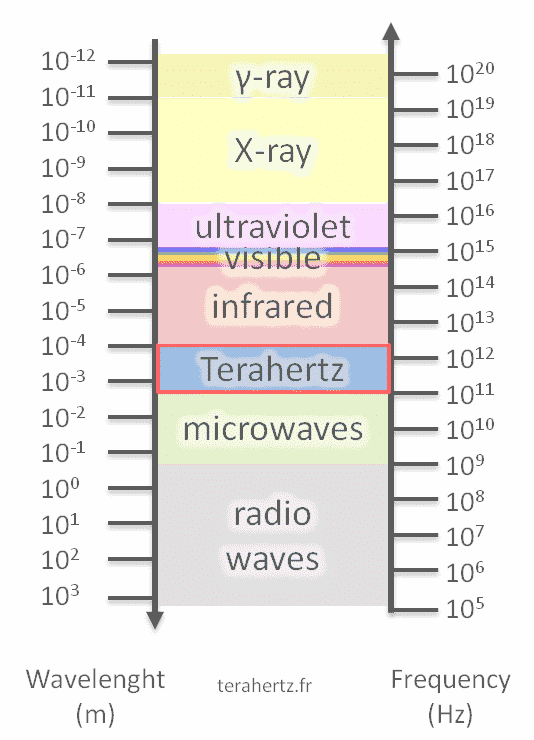
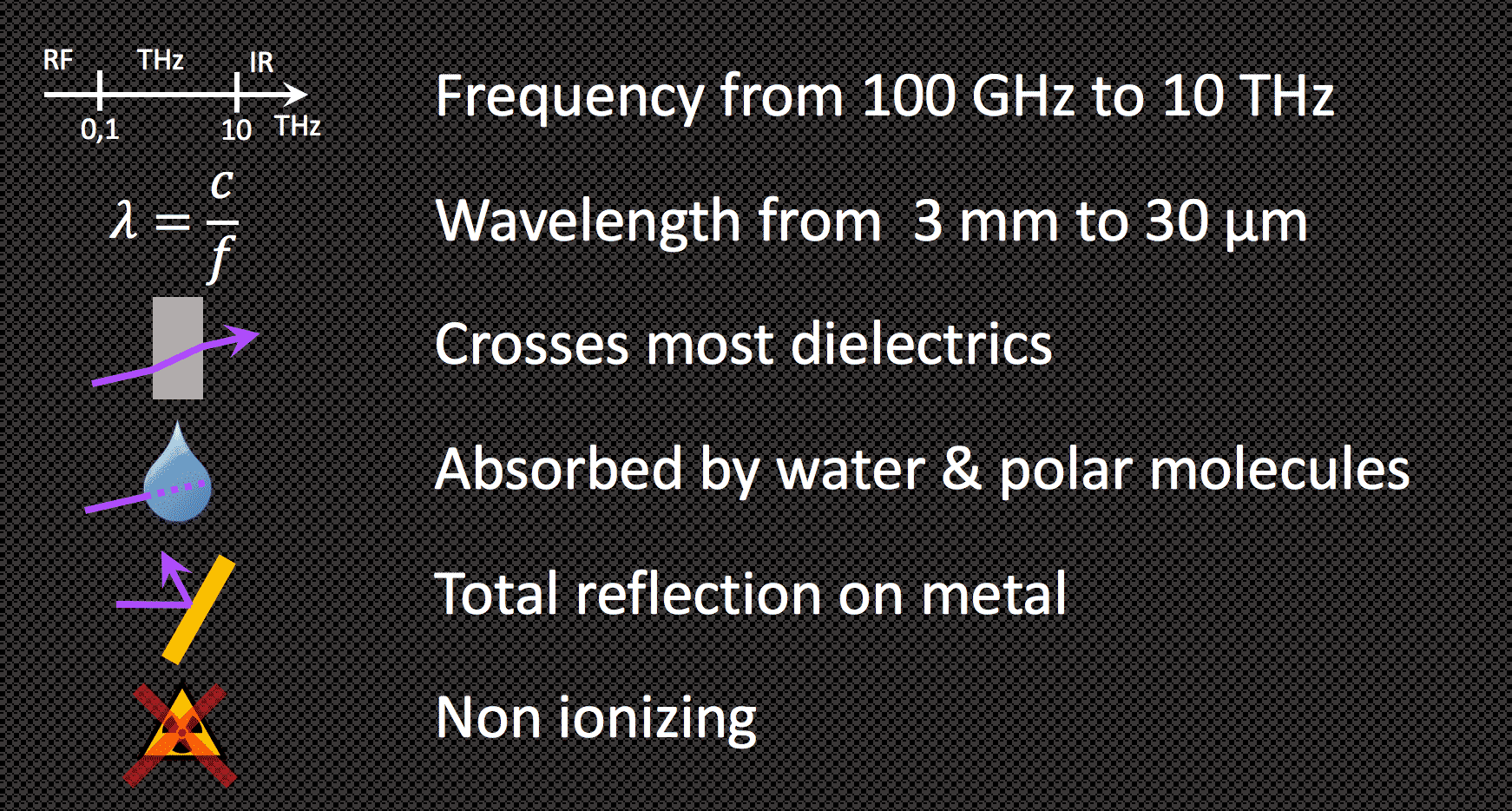
The main properties of THz are non-ionizing, good penetration in a wide variety of materials (plastic, wood, composite material, clothes, paper, ceramicsCeramics applications with terahertz Terahertz and millimeter-wave technologies offer promising non-destructive tools for the characterization and inspection of ceramic materials. Their sensitivity to dielectric properties, internal interfaces, porosity, and structural... More, etc), except conducting materials (ex: metal and water). Several molecules have spectral fingerprint in the terahertzTerahertz radiation is electromagnetic energy commonly associated with frequencies around 0.1 to 10 THz, between microwaves and infrared, where many materials reveal distinctive propagation, absorption, and imaging behavior. More frequency band. TerahertzTerahertz radiation is electromagnetic energy commonly associated with frequencies around 0.1 to 10 THz, between microwaves and infrared, where many materials reveal distinctive propagation, absorption, and imaging behavior. More waves are particularly interesting because they can provide information that is difficult to obtain with conventional optical, infrared, microwave, or X-ray techniques. For example, they can reveal hidden layers inside materials, detect defects, measure thicknesses, identify certain chemical compounds, or analyze multilayer structures. This explains their growing use in fields such as security screening, cultural heritage analysis, pharmaceutical inspection, electronics packaging, material characterization, and biomedicalTerahertz and millimeter-wave technologies offer promising non-ionizing tools for biomedical tissue analysis, particularly for breast cancer research. Their sensitivity to water content, tissue structure, and dielectric contrast can help distinguish... More research.
In summary, terahertzTerahertz radiation is electromagnetic energy commonly associated with frequencies around 0.1 to 10 THz, between microwaves and infrared, where many materials reveal distinctive propagation, absorption, and imaging behavior. More waves occupy a unique spectral region between microwaves and infrared radiation. Their wavelengths, frequencies, photon energies, and interaction mechanisms give them original properties that make them valuable for both imaging and spectroscopy. Although the terahertzTerahertz radiation is electromagnetic energy commonly associated with frequencies around 0.1 to 10 THz, between microwaves and infrared, where many materials reveal distinctive propagation, absorption, and imaging behavior. More domain was historically difficult to access, recent progress in sources, detectors, and measurement systems has made it an increasingly important tool for scientific and industrial applications.
Is terahertz radiation dangerous? Effects of terahertz radiation.
Regulation limits from microwaves and infrared
The terahertzTerahertz radiation is electromagnetic energy commonly associated with frequencies around 0.1 to 10 THz, between microwaves and infrared, where many materials reveal distinctive propagation, absorption, and imaging behavior. More region is between the radio frequency region and infrared. Both the IEEE RF safety standard [1] and the ANSI Laser safety standard [2] have limits into the terahertzTerahertz radiation is electromagnetic energy commonly associated with frequencies around 0.1 to 10 THz, between microwaves and infrared, where many materials reveal distinctive propagation, absorption, and imaging behavior. More region, but both safety limits are based on extrapolations. The ICNIRP recommends that between 10 GHz and 300 GHz, the power density related to occupational exposure should be less than 50 W.m-2, while the general public is limited to 10 W.m-2. Beyond 300 GHz, the limit for skin exposures of less than 10 seconds in the far infrared is, in terms of radiance, H = 20000 t^1/4 J.m-2 (t in seconds). This limit is not specific to the professional environment. Regarding the IEEE, the power density between 30 and 100 GHz is limited to 10 W.m-2. Between 100 and 300 GHz, this power density is limited according to the following formula: (90 fG â 7000) / 200 W.m-2 (fG being the frequency in GHz). Similarly, this limit is not specific to the professional environment [3].
Which kind of effects of terahertz radiation?
It is expected that effects on tissues are thermal in nature and, therefore, predictable by conventional thermal models. Research is underway to collect data to populate this region of the spectrum and validate safety limits. To understand the interaction between terahertzTerahertz radiation is electromagnetic energy commonly associated with frequencies around 0.1 to 10 THz, between microwaves and infrared, where many materials reveal distinctive propagation, absorption, and imaging behavior. More waves and the living, it must be taken into account that terahertzTerahertz radiation is electromagnetic energy commonly associated with frequencies around 0.1 to 10 THz, between microwaves and infrared, where many materials reveal distinctive propagation, absorption, and imaging behavior. More waves are strongly absorbed by polar molecules such as water. As a result, the power of a terahertzTerahertz radiation is electromagnetic energy commonly associated with frequencies around 0.1 to 10 THz, between microwaves and infrared, where many materials reveal distinctive propagation, absorption, and imaging behavior. More wave is reduced by 99% after 500 μm of skin [4]. By the way, most terahertzTerahertz radiation is electromagnetic energy commonly associated with frequencies around 0.1 to 10 THz, between microwaves and infrared, where many materials reveal distinctive propagation, absorption, and imaging behavior. More sources are (unfortunately) low power. The power required to achieve thermal effects are difficult to achieve for conventional laboratory systems. The question of the safety of terahertzTerahertz radiation is electromagnetic energy commonly associated with frequencies around 0.1 to 10 THz, between microwaves and infrared, where many materials reveal distinctive propagation, absorption, and imaging behavior. More waves is still relevant and is the subject of research in laboratories all over the world.
References
[1] IEEE C95.1â2005, IEEE Standard for Safety Levels With Respect to Human Exposure to Radio Frequency Electromagnetic Fields, 3 kHz to 300 GHz
[2] ANSI Z136.1â2007, American National Standard for Safe Use of Lasers
[3] https://www.sfrp.asso.fr/
[4] A.J. Fitzgerald et al. Catalogue of Human Tissue Optical Properties at TerahertzTerahertz radiation is electromagnetic energy commonly associated with frequencies around 0.1 to 10 THz, between microwaves and infrared, where many materials reveal distinctive propagation, absorption, and imaging behavior. More Frequencies. Journal of Biological Physics 129: 123â128, 2003