
Research publication · Automated terahertzTerahertz radiation is electromagnetic energy commonly associated with frequencies around 0.1 to 10 THz, between microwaves and infrared, where many materials reveal distinctive propagation, absorption, and imaging behavior. More phase retrieval
An algorithm of unordered wavefront propagation in terahertzTerahertz radiation is electromagnetic energy commonly associated with frequencies around 0.1 to 10 THz, between microwaves and infrared, where many materials reveal distinctive propagation, absorption, and imaging behavior. More phase retrieval with dense multiplane data acquisition
Phase retrieval converts a series of measured intensity patterns into an estimate of the complex electromagnetic field. In terahertzTerahertz radiation is electromagnetic energy commonly associated with frequencies around 0.1 to 10 THz, between microwaves and infrared, where many materials reveal distinctive propagation, absorption, and imaging behavior. More imaging, that phase can carry quantitative information about thickness and surface relief that an ordinary intensity image does not preserve. Multiple-plane algorithms are attractive because diffraction between planes supplies additional constraints, but their practical performance depends on two linked decisions: how the detector is moved during acquisition and which recorded planes are used during reconstruction. A dense dataset contains more information, yet selecting an effective propagation sequence from hundreds of closely spaced images can itself become a time-consuming numerical task.
This study joins two approaches intended to remove those bottlenecks. The on-the-go, or OTG, acquisition method records diffraction patterns while the detector moves continuously, avoiding repeated stopping and averaging at a series of manually defined positions. Randomly ordered Single-Beam Multiple-Intensity Reconstruction, or R-SBMIR, then propagates the wavefront estimate between measurement planes in a changing order. The stochastic sequence is designed to reduce the sensitivity of conventional SBMIR to a particular plane spacing and to use the diversity available in a large dataset without first running a separate search for the best subset.
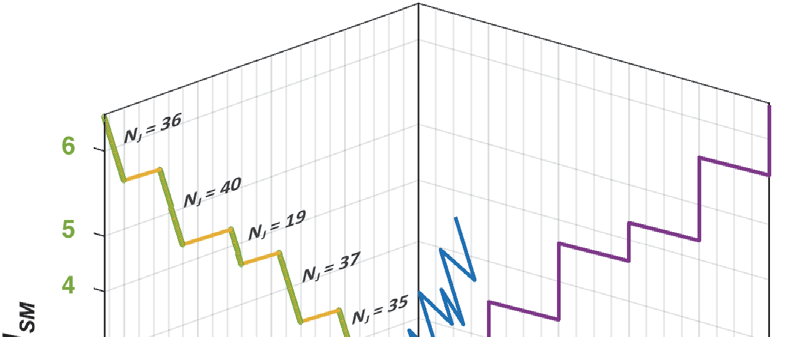
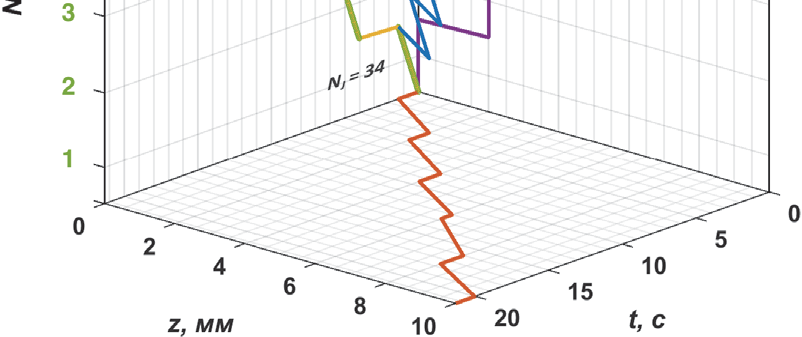
Featured visual: Image 1 from the Airtable record associated with this publication. Consult the original paper for the authoritative figure caption and interpretation. Source publication.
Visuals are drawn from the Airtable research archive. Figure numbering, rights and interpretation should be checked against the original publication before republication outside this site.
Dense acquisition without stop-and-go positioning
The experiment uses a quantum cascade laser emitting at 2.5 THz, corresponding to a wavelength of 119.91 micrometres. A 288 by 384 microbolometer array with a 50 micrometre pixel pitch records the diffraction field. At this wavelength, the system is suited to test features on the scale of a few hundred micrometres. The object is a plastic card carrying embossed elements, including an identification code and a stylized arrow. Those two regions provide different combinations of fine detail and phase contrast for assessing the reconstruction.
In a conventional stop-motion sequence described for comparison, the detector is positioned at a small number of axial locations and several frames may be collected for averaging before it moves again. Six distributions across a 10 mm interval required about 22 seconds in the reported comparison. OTG instead moves the detector at a constant 10 mm per second while the camera records at 25 frames per second. It therefore acquires 25 diffraction patterns across the same 10 mm interval in approximately one second, with a nominal spacing of 400 micrometres.
For the object regions studied in the paper, acquisition begins approximately 11.9 mm and 11.4 mm from the respective features. The resulting datasets contain around 500 intensity distributions with the 400 micrometre longitudinal step. Continuous motion simplifies the mechanics and produces a dense sampling of the evolving diffraction field. It also creates a new computational issue: adjacent patterns may differ only slightly, so propagating sequentially between near-identical planes does not always inject enough new information into the phase estimate.
Why random propagation order changes the reconstruction
Standard SBMIR begins with an estimated complex field, propagates it between detector planes through the angular-spectrum method and replaces the calculated amplitude at each plane with the square root of the measured intensity. The phase is retained and refined over repeated cycles. When the axial step is poorly matched to the diffraction behavior, successive amplitude constraints can be too similar. The authors show this problem for 20 distributions separated by the minimum 400 micrometre step: conventional SBMIR produces non-uniformities in the reconstructed amplitude and phase and may stagnate rather than approach a stable solution.
Finding a better conventional sequence requires numerical trials with different plane counts and spacings. That optimization partly cancels the operational advantage of recording a dense OTG dataset. R-SBMIR changes the order in which the estimated field travels between selected planes. Over many propagation steps, the reconstruction encounters both small and larger axial separations. Pairs whose diffraction patterns contain more distinct spatial information contribute to updating the phase, while the influence of any one unfavorable sequence is reduced.
Applied to the embossed code and arrow, the randomly ordered method produces clearer phase contrast and sharper feature boundaries than the poorly configured sequential case. The paper’s contribution is not a claim that randomness creates information absent from the measurements. Rather, it provides a practical way to exploit the information distributed across densely recorded planes without preselecting a single optimal spacing. The result supports a more automated pipeline in which the experiment collects broadly and the algorithm determines varied propagation paths during reconstruction.
Automation potential and present limits
The combined OTG and R-SBMIR workflow addresses a recurring systems problem in computational imaging: acquisition parameters and reconstruction parameters cannot be optimized independently. Continuous capture supplies many planes quickly, while stochastic propagation makes that abundance useful. For industrial inspection, such a workflow could reduce setup time when repeated measurements involve objects with different feature sizes or diffraction behavior. It may also help research systems in which detector travel is easier to automate than careful plane selection.
The demonstration remains a controlled phase-imaging experiment on embossed plastic. It does not establish real-time reconstruction, and the hundreds of recorded planes create processing and storage costs even when acquisition is fast. Robustness must be quantified under lower signal-to-noise ratios, calibration errors, motion jitter and more complex three-dimensional objects. The resolution visible in one test target should not be generalized to every material or depth, because wavelength, detector sampling, numerical aperture and propagation distance all contribute to the final image.
The work brings together terahertzTerahertz radiation is electromagnetic energy commonly associated with frequencies around 0.1 to 10 THz, between microwaves and infrared, where many materials reveal distinctive propagation, absorption, and imaging behavior. More source and detector expertise, experimental imaging and computational holography across research teams in France and Russia. Further collaboration could focus on reducing the number of planes after acquisition, defining reliable convergence criteria and benchmarking processing time on representative hardware. Within those boundaries, the study offers a coherent route toward phase-retrieval instruments that demand less manual tuning while preserving the quantitative value of a complex-field reconstruction.
Bibliographic reference
Recommended citation: Tsiplakova, E. G., Chopard, A., Balbekin, N. S., Smolyanskaya, O. A., Perraud, J.-B., Guillet, J.-P., Mounaix, P., & Petrov, N. V. (2023). An algorithm of unordered wavefront propagation in terahertzTerahertz radiation is electromagnetic energy commonly associated with frequencies around 0.1 to 10 THz, between microwaves and infrared, where many materials reveal distinctive propagation, absorption, and imaging behavior. More phase retrieval with dense multiplane data acquisition. Computer Optics, 47(6), 901-912. https://doi.org/10.18287/2412-6179-CO-1253
Publisher: Samara National Research University. Airtable record: recuzS1Isih914dQ8.