
Research publication · TerahertzTerahertz radiation is electromagnetic energy commonly associated with frequencies around 0.1 to 10 THz, between microwaves and infrared, where many materials reveal distinctive propagation, absorption, and imaging behavior. More imaging for paintings
TeraPulse Lx for terahertzTerahertz radiation is electromagnetic energy commonly associated with frequencies around 0.1 to 10 THz, between microwaves and infrared, where many materials reveal distinctive propagation, absorption, and imaging behavior. More imaging of painting on canvas
Can a terahertzTerahertz radiation is electromagnetic energy commonly associated with frequencies around 0.1 to 10 THz, between microwaves and infrared, where many materials reveal distinctive propagation, absorption, and imaging behavior. More time-domain system locate writing concealed behind a painted canvas when the letters cannot be inspected directly? This conference paper studies that question with a deliberately constructed test object based on a nineteenth-century portrait. Restorers added coloured signatures to the reverse, then covered them with further paint so that the relief and visible information were hidden. Reflection measurements made from the front with a TeraPulse Lx instrument recovered the positions of the signatures most clearly around 0.5 THz. The experiment demonstrates localization through a complex layer stack, but it did not produce a consistently legible transcription of every letter and should not be read as universal proof of material identification.
Layered paintings are difficult electromagnetic objects. A conventional radiograph or infrared reflectogram can expose features hidden from visible light, yet the resulting image may superimpose several depths and materials. TerahertzTerahertz radiation is electromagnetic energy commonly associated with frequencies around 0.1 to 10 THz, between microwaves and infrared, where many materials reveal distinctive propagation, absorption, and imaging behavior. More time-domain spectroscopy records the electric field as a function of delay. Reflections returning from interfaces at different optical depths can therefore be examined in time as well as frequency. Pigments and binders also have different dielectric responses, offering a second source of contrast. In practice, thin layers, rough canvas, scattering and overlapping echoes make separation imperfect, especially when the beam has crossed several painted surfaces before reaching the feature of interest.
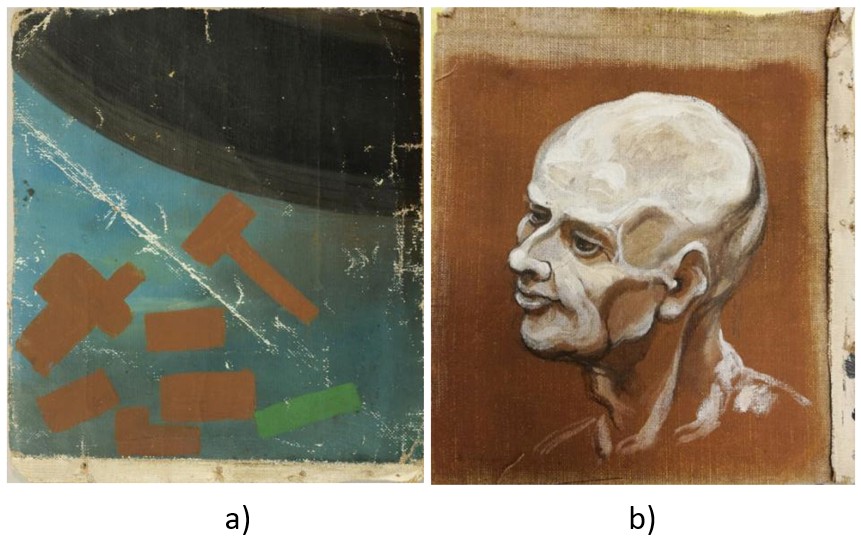
The international team built a 21 by 22 cm model containing the irregularities expected in a real work rather than using a simple flat polymer stack. The front carried an existing portrait and background. On the back, a red-brown ground, a painted head and several signatures in different colours were added; a thick brown layer concealed them, and one signature received an additional green covering. The radiation consequently encountered front paint, canvas and multiple reverse-side layers. Because the location and construction sequence were known, the object provided a controlled way to compare the terahertzTerahertz radiation is electromagnetic energy commonly associated with frequencies around 0.1 to 10 THz, between microwaves and infrared, where many materials reveal distinctive propagation, absorption, and imaging behavior. More result with ground truth while retaining the complexity of artist materials.
Featured visual: Image 1 from the Airtable record associated with this publication. Consult the original paper for the authoritative figure caption and interpretation. Source publication.
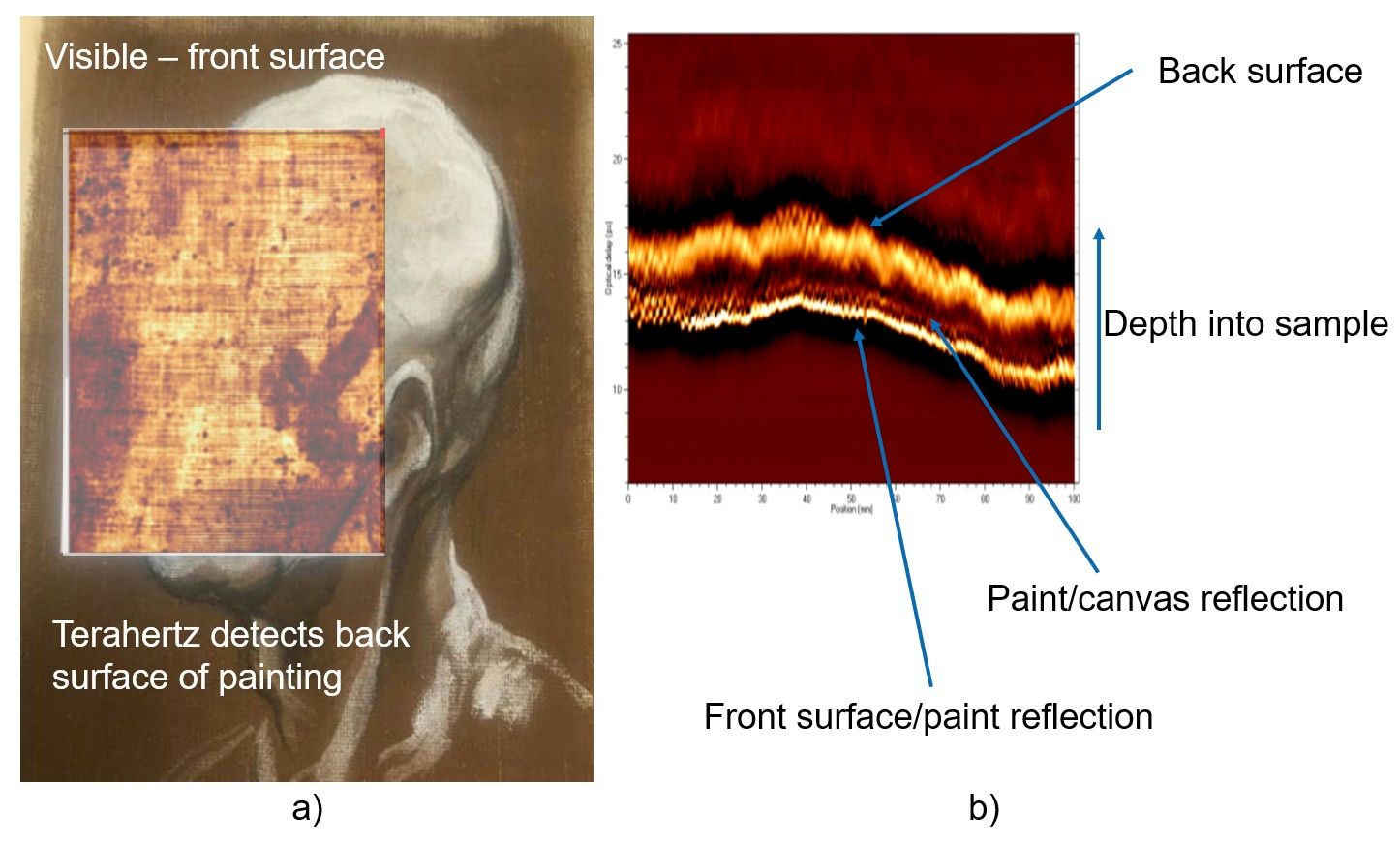
Visuals are drawn from the Airtable research archive. Figure numbering, rights and interpretation should be checked against the original publication before republication outside this site.
Scanning a five-layer canvas in reflection
The TeraPulse Lx is a broadband pulsed system covering approximately 0.06 to 6 THz with a quoted peak dynamic range above 95 dB. For this experiment it was arranged in reflection and mounted on a gantry that raster-scanned the painting. The nominal spatial sampling could be set between 0.25 and 0.50 mm, and the reported scan rate was about 16 seconds per square centimetre. At each position, the instrument recorded a waveform containing the return from the surface and delayed contributions from deeper interfaces. The front-side geometry is important: access to the back of an original painting may be restricted, so the test asked the field to cross the canvas before reaching the hidden marks.
Rather than relying on a single peak in the time trace, the researchers examined frequency-domain amplitude and optical-delay maps. Contrast varies with frequency because each paint formulation and interface changes absorption, reflection and phase differently. Around 0.5 THz, the images gave the clearest spatial correspondence with the buried signatures. Their locations could be distinguished beneath the covering layers, even though the visible surface no longer disclosed them. The authors’ more difficult objective, reading the signatures clearly through all paint, background and canvas layers, remained unresolved. This distinction between locating a feature and deciphering it is central to the evidence.
The signal cannot be assigned only to pigment chemistry. Thickness, surface relief, binder, canvas weave and the sequence of dielectric boundaries all contribute to a reflected waveform. Although the covering paint reduced visible topographic clues, a complete analysis of an unknown artwork would still need to determine whether contrast came from a hidden mark, a local change in coating thickness or another structural feature. The controlled sample makes the demonstration credible, but its known geometry also makes interpretation easier than it would be on an undocumented painting.
What the demonstration offers to conservation research
The result supports terahertzTerahertz radiation is electromagnetic energy commonly associated with frequencies around 0.1 to 10 THz, between microwaves and infrared, where many materials reveal distinctive propagation, absorption, and imaging behavior. More time-domain imaging as a complementary method for paintings on canvas. It can survey a relatively large area without sampling the material, and its depth-dependent information can guide a conservator toward zones worth examining by radiography, infrared, microscopy or chemical analysis. The experiment is especially relevant to reverse-side inscriptions, restoration marks or buried compositional elements that are covered by materials transparent enough at sub-terahertz frequencies. It does not show that every pigment stack will transmit the field, nor that the system can determine authorship or chronology from an image.
Several practical limits follow from the acquisition. A scan speed of 16 seconds per square centimetre becomes substantial over a full painting. Lateral resolution remains tied to wavelength, optics and stand-off, so thin strokes may merge. Echoes from closely spaced interfaces can overlap in time, while strongly absorbing pigments or moisture can prevent access to deeper layers. The test object’s planar support and known construction do not reproduce cracks, deformations, stretcher geometry or environmental constraints encountered in a museum. These factors would need controlled evaluation before a routine conservation protocol could be defined.
The study also illustrates the value of choosing analysis frequency after collecting a broadband waveform. A fixed-frequency image might miss a feature that becomes visible elsewhere in the spectrum. At the same time, selecting 0.5 THz because it maximized contrast in this object does not make that value optimal for all paintings. Reference samples prepared with historically relevant pigments and binders could help relate contrast to known layer combinations, while repeat scans could quantify sensitivity to distance, orientation and ageing.
The collaboration connected a museum, photonics laboratories and an instrument manufacturer. That combination made it possible to design a meaningful mock-up, acquire it with a commercial system and interpret the data in a heritage context. The verified achievement is modest but useful: hidden signatures were spatially located through the layered canvas from the front side, although their detailed shapes were not always readable. As a result, the paper provides a practical starting point for non-contact surveys rather than an automated means of reconstructing every concealed image.
Bibliographic reference
Recommended citation: Sirro, S., Odlyanitskiy, E., Portieri, A., Taday, P., Arnone, D. D., Guillet, J.-P., & Smolyanskaya, O. (2021). TeraPulse Lx for terahertzTerahertz radiation is electromagnetic energy commonly associated with frequencies around 0.1 to 10 THz, between microwaves and infrared, where many materials reveal distinctive propagation, absorption, and imaging behavior. More imaging of painting on canvas. Journal of Physics: Conference Series, 1866(1), 012004. https://doi.org/10.1088/1742-6596/1866/1/012004
Publisher: IOP Publishing. Airtable record: recqsmQA6WexjEBAo.