
Research publication · Sustainable mobile learning
Sustainability of mobile educational resources in electrical engineering
A mobile learning resource can remain pedagogically useful while becoming technically impossible to install. Operating systems change, application stores revise their requirements, software frameworks disclose security vulnerabilities and the grant that paid for initial development comes to an end. For educators, sustainability therefore concerns much more than the environmental impact of digital technology. It also involves the human capacity to maintain a resource, its accessibility to successive student cohorts and the ability to adapt content without rebuilding the application around every new platform generation.
This article draws on eight years of experience with mobile resources for electrical-engineering students at the University of Bordeaux. It compares three development routes: platform-specific native applications, hybrid applications assembled from web technologies, and progressive web apps, or PWAs. The evidence includes the development and distribution of a Karnaugh-map application, a set of web-based tutorials and interactive resources, and PWA implementations connected to institutional teaching. Rather than naming one universally superior technology, the study shows that reach, technical capability and maintainability pull the design decision in different directions.
Featured visual: Image 1 from the Airtable record associated with this publication. Consult the original paper for the authoritative figure caption and interpretation. Source publication.
Visuals are drawn from the Airtable research archive. Figure numbering, rights and interpretation should be checked against the original publication before republication outside this site.
Three ways to place engineering content on a phone
Native development gives an application direct access to the operating system and device functions. It can provide the most complete integration with a smartphone, but Android and iOS normally require different languages, tools and release processes. For a teacher whose main expertise is electronics rather than software engineering, that duplication raises the entry cost and creates two maintenance obligations. Native development can be justified when the learning activity depends on sensors or platform features that web technologies cannot expose reliably, but it is the least accessible route for a small teaching team.
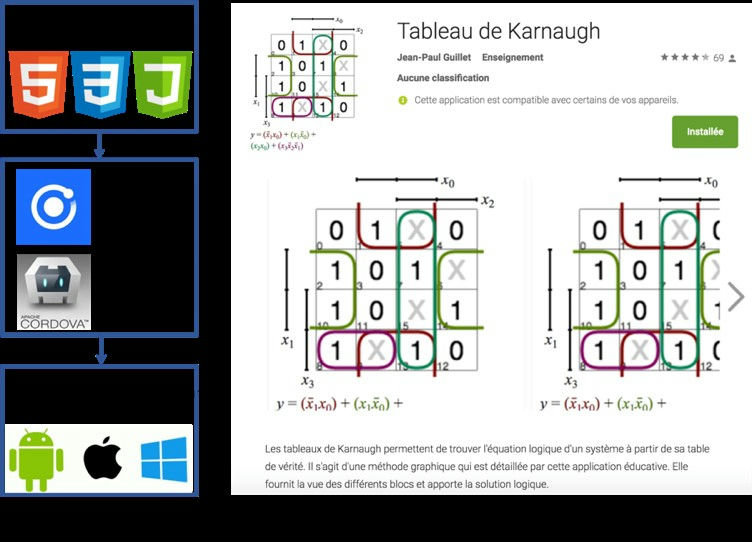
Hybrid frameworks such as Apache Cordova, formerly PhoneGap, reuse HTML, CSS and JavaScript inside a mobile wrapper. This allows existing web skills and educational content to be carried into an app distributed through a store. The Karnaugh-map solver discussed in the paper was developed with this approach in 2014. It gives students a graphical representation of simplified Boolean expressions so they can compare their manual work with a visual solution. Store publication made the application discoverable well beyond its original course: analytics recorded more than 40,000 installations outside France and about 2,000 in France. Spanish and Portuguese store descriptions were associated with increased uptake in Latin America.
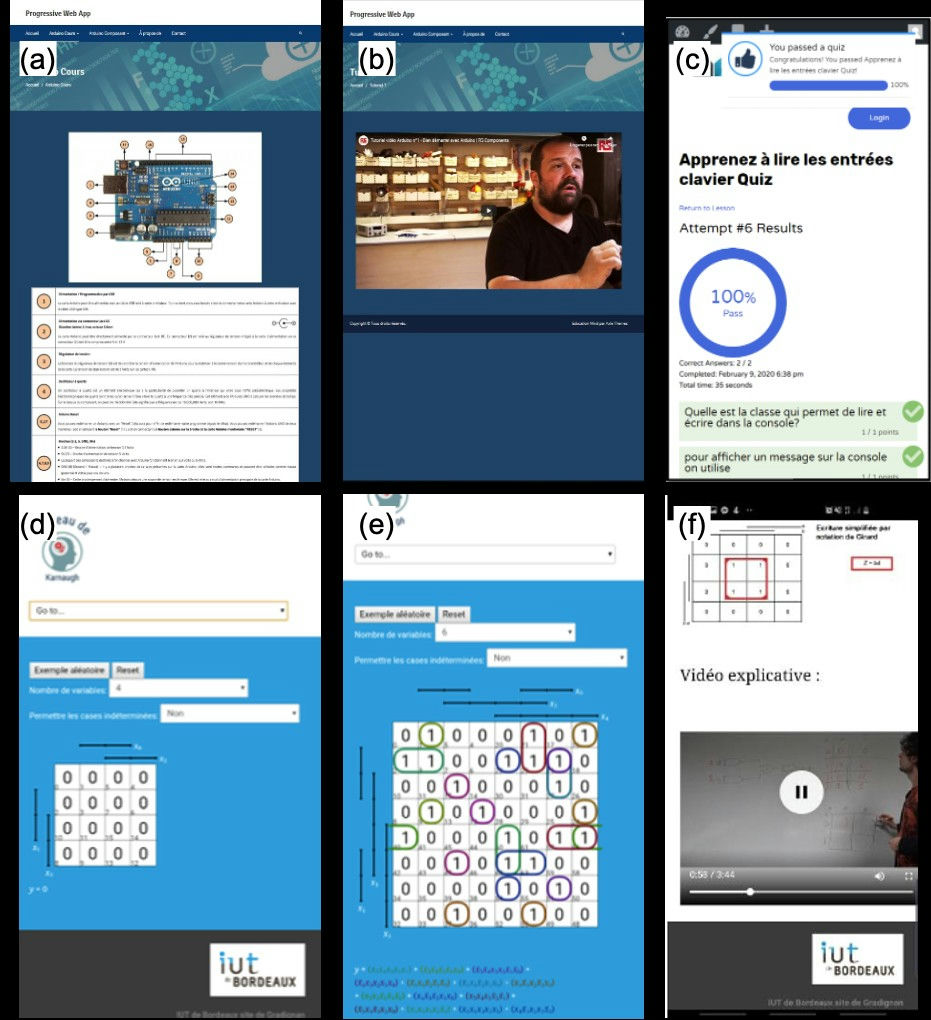
Progressive web apps take a different path. A PWA is delivered from the web but can be installed on a device, can use a manifest to present itself like an application and can rely on a service worker for offline access. HTTPS is part of that architecture. The projects described in the article include microcontroller and Arduino tutorials, videos created with students, Karnaugh-map tools, quizzes and a WordPress learning environment using LifterLMS. More than ten applications were developed over the period, either by the teacher or with third-year students. The resources were intended particularly for reinforcement outside formal class time, including travel or home study.
Distribution and maintenance are separate outcomes
The Karnaugh application’s installation figures demonstrate the distribution power of an app store, not necessarily the durability of the software underneath it. A hybrid application still depends on its framework, plugins, signing process and store policies. When those layers require security or compatibility updates, an educator must release a new build. The Karnaugh application was automatically removed from Google Play in 2018 after it was no longer updated. Its educational concept remained relevant, but the delivery mechanism had reached the end of its maintained life.
The PWAs followed the opposite pattern. Distribution through personal websites and university MOOCs produced only a few dozen installations, mostly among learners who had been told directly that the resources existed. Search visibility and store discovery were therefore much weaker in this experience. Yet maintenance could be simpler because a centrally deployed web update reaches users without a new binary installation. A PWA written directly in HTML, CSS and JavaScript may need relatively little framework maintenance, while one built on WordPress and plugins inherits the update cycle of that content-management system. The term PWA alone does not remove maintenance; it changes where maintenance occurs and who can perform it.
This distinction matters for evaluating educational technology. Download counts can show reach but do not measure learning, and a resource that remains online is not automatically pedagogically effective. The article is a longitudinal return of experience rather than a controlled comparison of student outcomes. It identifies practical effects of technical choices, institutional dissemination and developer skills. More systematic evaluation would need comparable learner groups, usage analytics that respect privacy, measures of conceptual progress and an account of which students are excluded by device, connectivity or accessibility constraints.
A decision based on pedagogy and institutional capacity
The most durable choice is the one a teaching organization can realistically support. Native or hybrid apps may be appropriate when broad public distribution, offline packaging or deeper device integration is essential and when recurrent technical maintenance is funded. PWAs are well suited to rapid prototyping, cross-device access and centrally managed course resources, especially when the audience is already connected through a class or institutional portal. Their weaker initial discoverability can be addressed through course integration and communication, but it should be anticipated rather than treated as a technical failure.
The study also suggests a collaborative model. Students can participate in creating tutorials and applications, turning development into a learning activity, while instructional designers and institutional IT teams can help separate durable content from replaceable delivery code. Open formats, documented ownership and a maintenance plan should be decided when a project begins, not after its first release. This is particularly important in electrical engineering, where the subject matter evolves alongside the devices used to teach it.
By translating an eight-year experience into explicit trade-offs, the article provides educators with a grounded basis for choosing a mobile format. It does not promise that one architecture will remain permanent. Instead, it reframes sustainability as the capacity to preserve pedagogical value through inevitable technical change, with development ambition matched to available skills, expected audience and long-term institutional responsibility.
Bibliographic reference
Recommended citation: Guillet, J.-P. (2024). Durabilité des ressources pédagogiques sur support mobile en génie électrique. Ãtudes & Pédagogies. https://doi.org/10.20870/eep.2024.7913
Language of the source publication: French. This editorial article is an English account of the study. Publisher: Universite de Bordeaux. Airtable record: recxpwm5JKrR7Uqpp.