
Research publication · TerahertzTerahertz radiation is electromagnetic energy commonly associated with frequencies around 0.1 to 10 THz, between microwaves and infrared, where many materials reveal distinctive propagation, absorption, and imaging behavior. More tissue phantoms
Using soy protein in the three-component phantom for breast cancer mimicking
Biological specimens are difficult to preserve, transport and reproduce across terahertzTerahertz radiation is electromagnetic energy commonly associated with frequencies around 0.1 to 10 THz, between microwaves and infrared, where many materials reveal distinctive propagation, absorption, and imaging behavior. More laboratories. A tissue phantom addresses that problem by providing a stable material whose measured optical properties resemble a selected biological reference. This study replaces gelatin with soy-protein isolate in mixtures of water and vegetable oil, then compares their terahertzTerahertz radiation is electromagnetic energy commonly associated with frequencies around 0.1 to 10 THz, between microwaves and infrared, where many materials reveal distinctive propagation, absorption, and imaging behavior. More absorption coefficient and refractive index with previously measured adipose, fibrous and malignant human breast tissues. The outcome is a set of candidate recipes for instrument testing and method development. The phantoms reproduce selected dielectric behavior over a limited band; they are not tumors, do not reproduce cellular pathology and cannot validate a clinical cancer-detection system on their own.
The choice of soy protein responds to practical weaknesses observed in earlier gelatin mixtures. Gelatin phantoms can be fragile, vulnerable to microbial degradation and easily damaged during measurement. Soy protein can bind both water and fat and has a complete amino-acid composition, although its molecular sequences and higher-order structures differ from animal proteins. The paper uses “quasi-bioidentical” in this limited compositional sense. It should not be interpreted as biological equivalence to breast tissue.
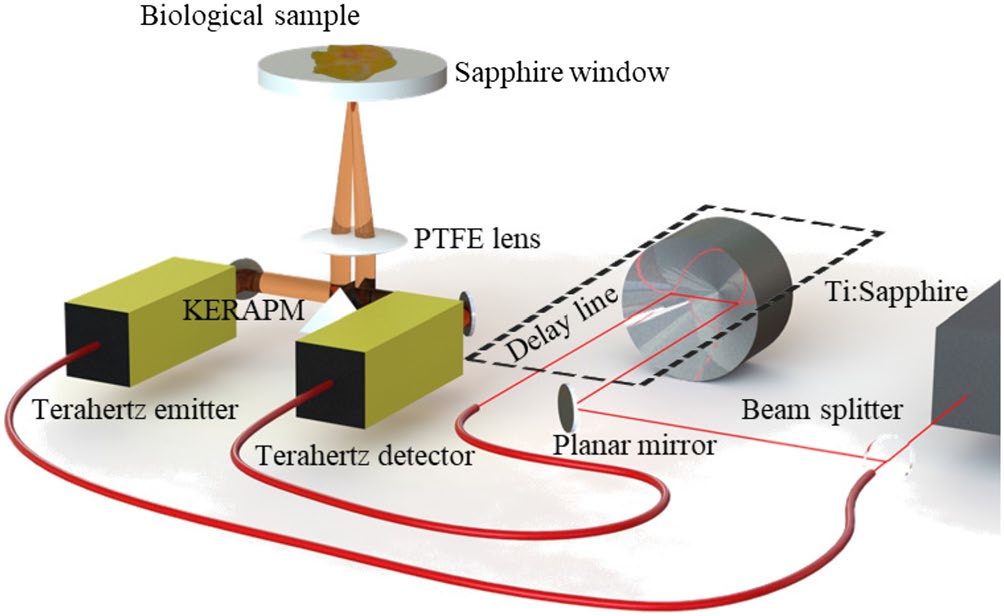
Featured visual: Contextual research figure from âTerahertzTerahertz radiation is electromagnetic energy commonly associated with frequencies around 0.1 to 10 THz, between microwaves and infrared, where many materials reveal distinctive propagation, absorption, and imaging behavior. More refractive index-based morphological dilation for breast carcinoma delineationâ. It illustrates a closely related terahertzTerahertz radiation is electromagnetic energy commonly associated with frequencies around 0.1 to 10 THz, between microwaves and infrared, where many materials reveal distinctive propagation, absorption, and imaging behavior. More topic and is not a figure from the publication discussed on this page. Source publication.

Visuals are drawn from the Airtable research archive. Figure numbering, rights and interpretation should be checked against the original publication before republication outside this site.
Preparing water, protein and oil reference materials
The team used commercial soy-protein isolate as the protein component and refined sunflower oil as the fat component. An immersion homogenizer produced the emulsions. Three two-component samples contained protein and oil at mass ratios of 25/75, 50/50 and 75/25. Five three-component samples kept soy protein at 13% while varying water and oil: 65/13/22, 62.5/13/24.5, 60/13/27, 67.5/13/19.5 and 70/13/17, expressed as water/protein/fat percentages by mass.
The materials were prepared at ITMO University and measured about seven days later after storage between approximately 6 and 20 degrees Celsius. TerahertzTerahertz radiation is electromagnetic energy commonly associated with frequencies around 0.1 to 10 THz, between microwaves and infrared, where many materials reveal distinctive propagation, absorption, and imaging behavior. More time-domain spectroscopy was performed at the IMS laboratory in Bordeaux with a TeraPulse 4000 system in reflection. The sample was placed against a 1.04 mm silicon window whose terahertzTerahertz radiation is electromagnetic energy commonly associated with frequencies around 0.1 to 10 THz, between microwaves and infrared, where many materials reveal distinctive propagation, absorption, and imaging behavior. More refractive index was taken as 3.5. One hundred waveforms were averaged at each measurement point. Instrument settings were chosen to match earlier measurements of excised human breast tissue so that the optical quantities could be compared on a consistent basis.
The system generated pulses over a broad nominal range, while the reported phantom analysis focused on 0.2-1.0 THz and examined 0.4-0.6 THz more closely. From the reflected time-domain data, the researchers retrieved absorption coefficient and refractive index. Those two properties matter together: matching only attenuation while missing phase velocity would give an incomplete representation of how a terahertzTerahertz radiation is electromagnetic energy commonly associated with frequencies around 0.1 to 10 THz, between microwaves and infrared, where many materials reveal distinctive propagation, absorption, and imaging behavior. More pulse interacts with the reference material.
The design intentionally varies a small number of ingredients rather than reproducing the full biochemical and structural complexity of a breast specimen. Water strongly affects terahertzTerahertz radiation is electromagnetic energy commonly associated with frequencies around 0.1 to 10 THz, between microwaves and infrared, where many materials reveal distinctive propagation, absorption, and imaging behavior. More loss, oil supplies a lower-loss lipid-like component, and protein helps form and stabilize the emulsion while shifting the dielectric response. By scanning composition, the study asks which recipes approach reference curves for three broad tissue classes.
Property matching without claiming biological equivalence
Among the two-component mixtures, the 50/50 protein-oil sample showed an absorption coefficient close to the adipose-tissue reference, while the 25/75 mixture gave the closest refractive-index behavior for adipose tissue. This split result illustrates why a phantom recipe should not be selected from one optical quantity alone. It also indicates that the simple mixtures did not reproduce every target property simultaneously.
For the three-component materials, the 65/13/22 water/protein/fat recipe approached the fibrous-tissue absorption curve. The 62.5/13/24.5 and 67.5/13/19.5 recipes were the closest to the malignant-tissue reference in both absorption coefficient and refractive index over the emphasized band. The authors therefore identified these two mixtures as candidate cancer-tissue phantoms for terahertzTerahertz radiation is electromagnetic energy commonly associated with frequencies around 0.1 to 10 THz, between microwaves and infrared, where many materials reveal distinctive propagation, absorption, and imaging behavior. More experiments. Their compositions were also broadly consistent with the direction of earlier water-gelatin-oil phantom studies, despite the different protein source.
“Cancer mimicking” here refers to agreement between selected bulk optical curves and a previously measured tissue reference. The samples contain no cells, extracellular matrix, vasculature or histological boundaries. They do not reproduce the natural heterogeneity of an excised specimen, and the comparison does not establish that every tumor shares one dielectric spectrum. Temperature, emulsion stability, storage time, surface contact and preparation repeatability may all influence the result. The paper reports samples measured after about one week, not a quantified multi-month stability program.
These limits do not diminish the practical role of a phantom. A repeatable material can help laboratories compare instruments, test retrieval algorithms and study how noise or geometry affects measured contrast without consuming biological tissue. It can also provide a controlled inclusion for imaging experiments. Before serving as a standard, however, the recipe would need batch-to-batch statistics, dimensional and thermal characterization, longer aging tests and measurements across multiple systems.
The France-Russia collaboration is particularly relevant because it links material preparation to the same Bordeaux measurement protocol used for the biological reference. Future work could compare plant- and animal-derived proteins and fats at equal proportions, as the authors suggest, or use regression to tune recipes against a defined target spectrum. Such optimization should retain independent validation samples to avoid selecting a composition that matches only one noisy reference curve.
The study provides a compact, plant-derived route to terahertzTerahertz radiation is electromagnetic energy commonly associated with frequencies around 0.1 to 10 THz, between microwaves and infrared, where many materials reveal distinctive propagation, absorption, and imaging behavior. More breast-tissue phantoms and identifies compositions that approximate three reference tissue responses under the reported conditions. Its contribution is to measurement science and experimental reproducibility. It neither demonstrates tumor detection nor supports a clinical claim; instead, it supplies controlled materials that may help future imaging systems be evaluated before they are tested on heterogeneous ex vivo tissue.
Publication and citation
Recommended citation: Cassar, Q., Lykina, A. A., Lepeshkin, A. I., Baranenko, D. A., Kravtsenyuk, O. V., Mounaux, P., Guillet, J.-P., & Smolyanskaya, O. A. (2020). Using soy protein in the three-component phantom for breast cancer mimicking. Journal of Physics: Conference Series, 1537(1), 012019. https://doi.org/10.1088/1742-6596/1537/1/012019
Publisher: IOP Publishing. Airtable record: recfQlc1PuPpIIWBf.