
Research publication · Computational terahertzTerahertz radiation is electromagnetic energy commonly associated with frequencies around 0.1 to 10 THz, between microwaves and infrared, where many materials reveal distinctive propagation, absorption, and imaging behavior. More imaging
Propagation beam consideration for 3D THz computed tomography
Computed tomography is often introduced through an ideal ray: a narrow beam crosses an object along a straight line, and the detector records a line integral. A focused terahertzTerahertz radiation is electromagnetic energy commonly associated with frequencies around 0.1 to 10 THz, between microwaves and infrared, where many materials reveal distinctive propagation, absorption, and imaging behavior. More beam does not behave that way. Its intensity is Gaussian across the beam, its waist has a finite size, and diffraction changes that size as the beam propagates. This paper asks what happens when those physical facts are included in a three-dimensional THz tomography pipeline. The answer is demonstrated in simulation and experiment: using the measured beam in the forward model and reconstruction reduces blur and improves the fidelity of recovered structures.
Featured visual: Image 1 from the Airtable record associated with this publication. Consult the original paper for the authoritative figure caption and interpretation. Source publication.
Visuals are drawn from the Airtable research archive. Figure numbering, rights and interpretation should be checked against the original publication before republication outside this site.
Why an X-ray-style ray model is insufficient
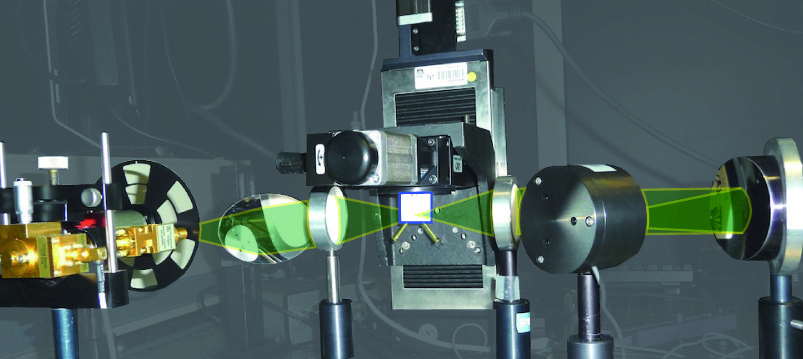
The experimental platform operated at 240 GHz with approximately 0.3 mW from a Gunn-diode source. A horn, an off-axis parabolic mirror and a focusing lens formed the illumination, while the sample was translated in two axes and rotated for projection acquisition. Beam mapping with a pyroelectric detector showed a circular profile with a full width at half maximum near 2 mm at the waist. The width was therefore comparable to structural details the tomography sought to recover.
The authors describe the field with the standard Gaussian propagation law. The radius grows away from the waist according to the Rayleigh range, and the on-axis intensity falls as the energy spreads. A detector measurement is consequently a weighted contribution from a finite volume, not the attenuation along an infinitesimal line. Neglecting that weighting broadens edges in the sinogram and introduces a mismatch between the physical acquisition and the mathematical projector used during reconstruction.
A forward simulator was built to include the measured waist and its evolution with distance. For every projection angle, the ideal attenuation map was combined with the spatial beam distribution. This generated synthetic data that reproduced the convolution imposed by the optical system. The approach also allowed a controlled comparison with ground-truth objects, something that is impossible when only an experimental sample is available.
Embedding propagation in reconstruction
Three reconstruction families were studied: back-projection of filtered projections, the simultaneous algebraic reconstruction technique and ordered-subsets expectation maximization. Their conventional forms assume idealized projection values. In the optimized versions, the Gaussian beam is included in the forward and backward operations. For back-projection, beam blur is compensated with a Wiener-type deconvolution. For the iterative algorithms, each predicted projection is generated with the beam convolution before it is compared with measured data.
Tests on a synthetic object containing four metallic bars made the effect measurable. When Gaussian acquisition data were reconstructed with an ideal ray model, structural-similarity scores fell to roughly 0.94-0.95 from values near unity on ideal data. Incorporating beam propagation restored scores to approximately 0.97-0.99 and narrowed the reconstructed bar profiles. The optimized SART result produced particularly sharp cross-sections in the comparisons reported. These figures indicate an improvement relative to the chosen phantom and acquisition model; they are not universal performance guarantees for every material or scanner.
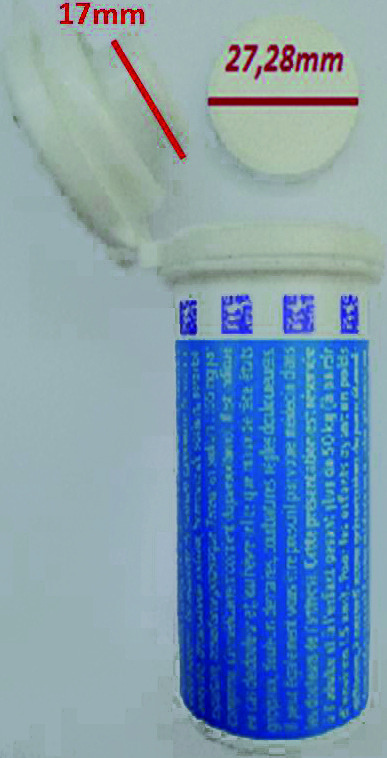
The method was then applied to measurements of a medicine box containing a tablet. Cross-sections and volume renderings produced with beam-aware processing showed a cleaner interface between the tablet and its packaging, with less apparent thickening from the system point-spread function. The experiment verifies that the correction is useful beyond synthetic data, while remaining a non-clinical demonstration on a packaged object. It makes no claim about diagnosis, patient imaging or medical decision-making.
Importance for quantitative THz tomography
The study’s central contribution is not a new source or a new detector. It is a more faithful contract between hardware and software. Once the measured field distribution is represented in the projector, iterative reconstruction can ask whether a candidate volume would produce the signal actually seen by the instrument. This is especially important in THz imaging, where wavelengths are long enough for diffraction and finite beam width to be visible at the scale of the target.
The same reasoning also improves experimental planning: a simulated acquisition can expose insufficient sampling, an oversized waist or an unfavorable object position before a lengthy rotational scan is started.
There are practical costs. Beam-aware iterations require more computation, the beam must be characterized, and the model remains an approximation. Lens aberrations, detector aperture, scattering, refraction at complex surfaces and frequency dependence can introduce effects beyond a simple circular Gaussian. Strongly absorbing objects may also yield incomplete projections that no propagation correction can recover. The paper therefore supports improved reconstruction under characterized conditions, not unrestricted imaging through arbitrary materials.
The work joins optical and THz expertise at LOMA with image reconstruction and computational geometry expertise at LaBRI. That collaboration is visible in the complete workflow: experimental beam measurement, physical simulation, algorithm modification, quantitative comparison and real-object validation. For non-destructive testingInspection of dielectric, layered, polymer, composite, and manufactured structures without destructive sampling. Non-Destructive Testing: measurement approach and use cases Work begins with the material and the decision that the measurement... More, cultural heritage or material analysis, the lesson is broadly useful: reconstruction quality depends on modeling the actual wave and instrument, not merely applying an X-ray algorithm to terahertzTerahertz radiation is electromagnetic energy commonly associated with frequencies around 0.1 to 10 THz, between microwaves and infrared, where many materials reveal distinctive propagation, absorption, and imaging behavior. More data.
Bibliographic reference
Recommended citation: Recur, B., Guillet, J.-P., Manek-Hönninger, I., Delagnes, J.-C., Benharbone, W., Desbarats, P., Domenger, J.-P., Canioni, L., & Mounaix, P. (2012). Propagation beam consideration for 3D THz computed tomography. Optics Express, 20(6), 5817. https://doi.org/10.1364/OE.20.005817
Publisher: Optica Publishing Group. Airtable record: recKLldi5xdZ2l2ss.