
Noise in a terahertzTerahertz radiation is electromagnetic energy commonly associated with frequencies around 0.1 to 10 THz, between microwaves and infrared, where many materials reveal distinctive propagation, absorption, and imaging behavior. More scanner is not always an unstructured veil spread evenly over an image. When detector fluctuations are correlated over time, the order in which a raster scan is acquired can reorganize that noise into rings, lines or grain-like features after tomographic reconstruction. This study examines that connection for continuous-wave terahertzTerahertz radiation is electromagnetic energy commonly associated with frequencies around 0.1 to 10 THz, between microwaves and infrared, where many materials reveal distinctive propagation, absorption, and imaging behavior. More computed tomography and shows why the acquisition trajectory must be considered part of the imaging model.
Featured visual: Image 1 from the Airtable record associated with this publication. Consult the original paper for the authoritative figure caption and interpretation. Source publication.
Visuals are drawn from the Airtable research archive. Figure numbering, rights and interpretation should be checked against the original publication before republication outside this site.
Why slow detector fluctuations become spatial artifacts
TerahertzTerahertz radiation is electromagnetic energy commonly associated with frequencies around 0.1 to 10 THz, between microwaves and infrared, where many materials reveal distinctive propagation, absorption, and imaging behavior. More tomography often uses thermal or rectifying detectors because they can operate at room temperature and can be integrated into relatively direct continuous-wave systems. Their output, however, contains low-frequency components that change slowly compared with the pixel acquisition rate. In a conventional image these fluctuations may appear as stripes. In tomography, the same temporally ordered variations enter a sinogram and are redistributed by back-projection. The final artifact can resemble a real circular boundary or a repeated internal structure.
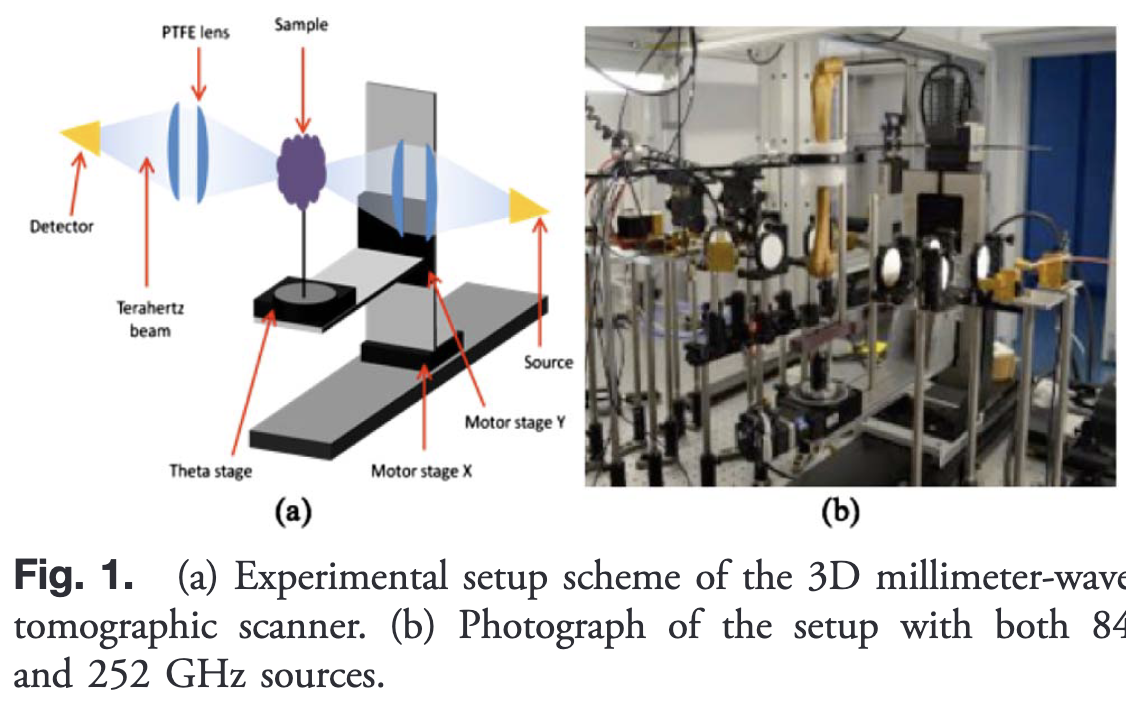
The authors studied a scanner centered at 252 GHz. An 84 GHz Gunn source and frequency multiplication supplied approximately 14 mW, while PTFE optics formed the beam. A mechanical chopper operated at 25 Hz and a lock-in amplifier demodulated the detector signal. The work considered noise behavior associated with a pyroelectric detector and a Schottky diode. In the pyroelectric case, Johnson, voltage, current and temperature-fluctuation contributions were discussed, with the low-frequency rise being especially important when the transmitted signal becomes weak.
Real detector noise was recorded for 10,000 seconds at a sampling rate of 0.5 Hz and compared with numerically generated pink noise. The correspondence in their power spectra gave the authors a realistic time series that could be inserted into simulated acquisition sequences. This is a key strength of the method: the reconstructed artifacts were not inferred from a generic white-noise assumption but from fluctuations measured on the imaging system.
Two scan orders, two different fingerprints
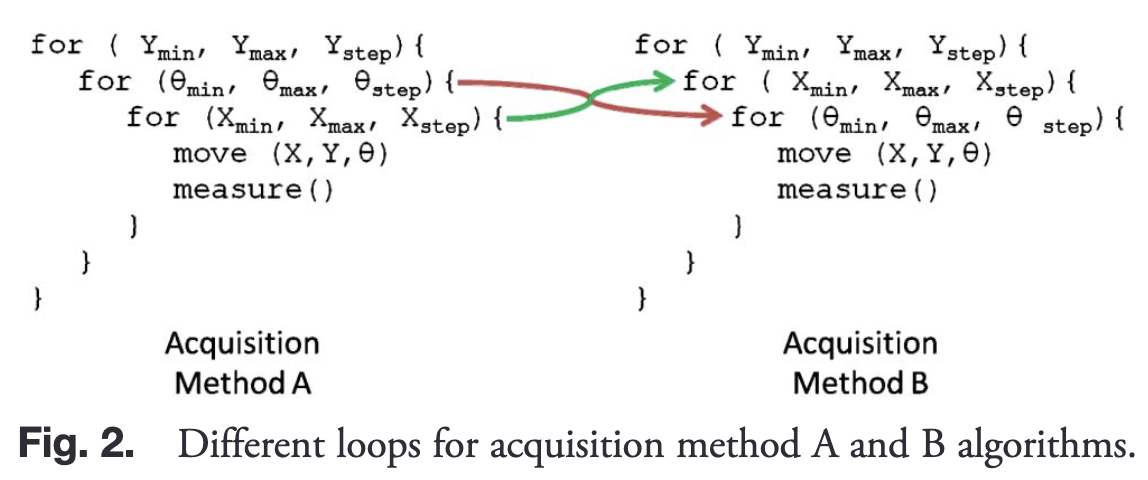
The experiment compared two ways of ordering position and angle. In one sequence, the system scanned the spatial coordinate across a projection before advancing to the next rotation angle. In the other, it acquired all angles for a fixed spatial coordinate before moving to the next position. Both schemes can contain exactly the same number of measurements and the same overall noise power. What changes is the location assigned to each successive noise sample in the sinogram.
To make the consequences visible, the team added the measured noise patterns to projections of a 256 by 256 pixel Shepp-Logan phantom. Thirty-six views covered 180 degrees, and reconstructions were evaluated at signal-to-noise ratios of 0, 3 and 10 dB. Filtered back-projection transformed line-oriented sinogram disturbances from the first acquisition order into pronounced circular structures. The alternative order distributed the disturbance in a more spot-like or grainy pattern. At the lowest signal-to-noise ratios, fine phantom features disappeared and contrast became unreliable under both conditions, but the visual failure modes were different.
Two additional geometries showed why there is no single scan order that is always preferable. For an object with cylindrical symmetry, ring artifacts can be especially misleading because they overlap the very structures under inspection. The angle-first sequence preserved the overall geometry more clearly in that case. For a checkerboard object containing several attenuation levels, the other order retained contrast more effectively, whereas the spot-like pattern blurred local gray-level differences. The appropriate trajectory therefore depends on whether the inspection task prioritizes boundary shape, internal contrast or resistance to a particular artifact morphology.
Consequences for reliable THz tomography
The publication makes an important distinction between reducing noise and controlling how noise is encoded. Averaging, modulation and detector design can lower its magnitude, but acquisition scheduling can also prevent slowly varying errors from aligning with the structures that matter most. This is particularly relevant for opaque or strongly absorbing samples, where the detected signal approaches the background and a visually convincing artifact may otherwise be mistaken for an inclusion or layer.
Recording stationary noise before a scan can therefore serve a second purpose beyond routine detector qualification. It can be propagated through candidate trajectories and reconstruction algorithms to predict which artifact family is most likely to appear before valuable specimen time is committed.
For non-destructive evaluation, that distinction is practical. A pipe, ceramic vessel or concentric polymer assembly presents a different reconstruction risk from a planar lattice or a component with abrupt local changes. Planning the scan with prior knowledge of likely geometry can improve interpretability without changing the source or detector. The paper does not claim that scan ordering alone solves low-signal terahertzTerahertz radiation is electromagnetic energy commonly associated with frequencies around 0.1 to 10 THz, between microwaves and infrared, where many materials reveal distinctive propagation, absorption, and imaging behavior. More tomography; rather, it provides evidence that acquisition, noise characterization and reconstruction must be designed together.
The work reflects collaboration between terahertzTerahertz radiation is electromagnetic energy commonly associated with frequencies around 0.1 to 10 THz, between microwaves and infrared, where many materials reveal distinctive propagation, absorption, and imaging behavior. More instrumentation, numerical simulation and image reconstruction. Its conclusions are grounded in measured noise and controlled phantoms, not in a field qualification campaign. Further development could combine noise-aware iterative reconstruction, optimized angular sampling and adaptive scan trajectories. Such extensions would be valuable where acquisition time is limited and the cost of a false structural indication is high.
Publication details and citation
Recommended citation: Guillet, J. P., Recur, B., Balacey, H., Bou Sleiman, J., Darracq, F., Lewis, D., & Mounaix, P. (2015). Low-frequency noise effect on terahertzTerahertz radiation is electromagnetic energy commonly associated with frequencies around 0.1 to 10 THz, between microwaves and infrared, where many materials reveal distinctive propagation, absorption, and imaging behavior. More tomography using thermal detectors. Applied Optics, 54(22), 6758. https://doi.org/10.1364/AO.54.006758
Record ID: recbo4wSnDukLMX2m
Research themes: detector noise, scan ordering, sinograms, filtered back-projection, continuous-wave terahertzTerahertz radiation is electromagnetic energy commonly associated with frequencies around 0.1 to 10 THz, between microwaves and infrared, where many materials reveal distinctive propagation, absorption, and imaging behavior. More tomography.