

Research publication · Multi-beam sub-terahertz antennas
SubTHz Fully-Metallic Geodesic Luneburg Lens Antenna
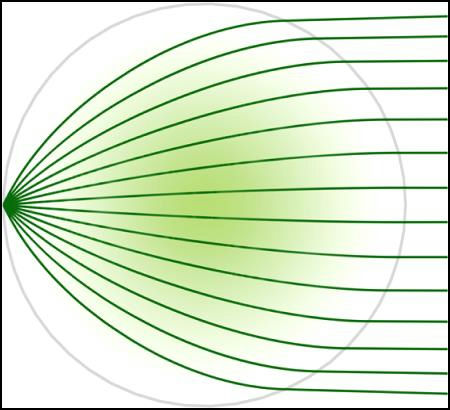
Sub-terahertz radars and communication links require high gain, but directing that gain electronically can demand a large phased array, many active channels and careful thermal management. A Luneburg lens offers another route. Its ideal refractive-index distribution focuses incoming waves onto the opposite edge and can form different beams when different feed points are excited. At millimetre and sub-terahertz wavelengths, a geodesic implementation replaces a graded dielectric with a shaped metallic parallel-plate structure whose physical path length reproduces the required electromagnetic delay.
This paper designs, manufactures and measures a fully metallic geodesic Luneburg lens antenna for 128-132 GHz. Three feeds produce beams at broadside and approximately plus or minus 40 degrees. The lens profile is folded so its height is only 38.7% of the reference Rinehart-Luneburg geometry, and electromagnetic-bandgap structures suppress leakage around a deliberately retained assembly gap. Measurements show a realized gain near 21 dB for all three ports across the operating band, with beam directions and sidelobe behavior close to simulation. The result demonstrates a compact passive multi-beam component rather than continuously steerable electronic scanning.
Featured visual: Image 1 from the Airtable record associated with this publication. Consult the original paper for the authoritative figure caption and interpretation. Source publication.
Visuals are drawn from the Airtable research archive. Figure numbering, rights and interpretation should be checked against the original publication before republication outside this site.
Folding a Luneburg optical path into metal
A classical Luneburg lens uses a radial refractive-index gradient. In the geodesic version, the wave travels between conducting surfaces whose separation and curvature create equivalent path lengths. The authors formulate a super-elliptical height profile and smooth it with splines to reduce abrupt metallic transitions that would reflect power. Folding the profile lowers the structure while preserving the focusing relationship. The manufactured lens has a 25 mm radius, about 10.8 wavelengths at 130 GHz, and a 0.5 mm parallel-plate height in the relevant waveguide region.
Three laterally displaced feeds couple energy into the lens. The central port forms the 0-degree beam, while the outer ports form the two off-axis beams. Linear flares transform the guided quasi-TEM field toward the radiating aperture. Simulations predict isolation below -30 dB between ports and input reflection below -15 dB over the design band. The passive geometry means beam selection is achieved by choosing a feed; the device does not interpolate continuously between directions unless it is combined with an additional switching or feeding network.
Manufacturing at 130 GHz makes tiny separations electromagnetically significant. Instead of assuming perfectly closed contact between the two metal halves, the design includes a 0.03 mm air gap. Periodic hole-based, glide-symmetric electromagnetic-bandgap structures are placed along the feed to stop modes that could leak through that gap. A 20 mm simulated feed section transmits more than 80% of the power in the studied band despite the clearance. This is an engineering choice for tolerance management: the EBG does not remove dimensional errors, but it makes one expected assembly imperfection less damaging.
Simulated and measured three-beam performance
The two aluminium blocks are CNC machined, aligned with precision screws and gold coated to reduce conductor loss and oxidation. Full-wave simulation gives aperture efficiency above 57% across 128-132 GHz. Simulated total and radiation efficiencies are around 80%, and the predicted peak realized gain is approximately 22.5 dB for the central feed and 22 dB for the side feeds. Patterns at 128, 130 and 132 GHz keep the side beams near plus and minus 40 degrees, with scan loss below 0.3 dB and sidelobes below -14 dB.
Anechoic-chamber measurements confirm the intended operating band and beam geometry. The measured port reflections remain below approximately -15 dB, and the three realized gains are around 21 dB across the band. The measured patterns follow the simulated steering angles and general sidelobe structure. The lower measured gain is attributed to surface roughness, fabrication tolerances and measurement uncertainty, all of which have increasing influence as wavelength decreases. Agreement is therefore strong enough to validate the design principle while still exposing the performance cost of real manufacturing.
The reported 4 GHz band is narrow relative to some broadband radar or communication systems, and three fixed beams do not provide the flexibility of a dense phased array. The prototype also needs a practical method for connecting or switching the feeds in an operational front end. Thermal behavior, environmental stability, production repeatability and packaging are outside the measurements described here. Scaling beyond 300 GHz is geometrically plausible, but roughness, coating quality, gap control and metrology become more demanding rather than automatically preserving the 130 GHz performance.
Applications and the next integration questions
The antenna is relevant where a small set of high-gain directions is sufficient, including sector selection, multi-beam radar, point-to-point links and experimental imaging. Passive lens beamforming can reduce the number of active phase-control elements, while the metallic construction avoids dielectric loss and material dispersion inside a bulk graded-index lens. Whether it outperforms another antenna architecture will depend on bandwidth, scan coverage, volume, feed loss and the electronics available to select beams.
The work combines geodesic-lens design, electromagnetic-bandgap engineering, precision fabrication and sub-terahertz measurement through collaboration involving KTH Royal Institute of Technology, INSA Rennes, the University of Bordeaux and the European Space Agency. Future development could examine wider-band matching, additional feed positions, integrated switches and manufacturing statistics across several units. Comparisons under a common system specification would also clarify the trade-off between this passive multi-beam approach and electronically steered arrays.
Within the stated frequency window, the prototype establishes that a folded, fully metallic geodesic Luneburg lens can retain stable high-gain beams while accommodating a deliberate assembly gap. That measured result is the paper’s strongest contribution: it moves the concept from an ideal high-frequency geometry to a manufactured component whose tolerance strategy is part of the electromagnetic design.
Bibliographic reference
Recommended citation: Castillo-Tapia, P., Yang, S., Palomares-Caballero, A., Guillet, J.-P., Fonseca, N. J. G., & Quevedo-Teruel, O. (2025). SubTHz Fully-Metallic Geodesic Luneburg Lens Antenna. IEEE Transactions on TerahertzTerahertz radiation is electromagnetic energy commonly associated with frequencies around 0.1 to 10 THz, between microwaves and infrared, where many materials reveal distinctive propagation, absorption, and imaging behavior. More Science and Technology, 15(3), 514-518. https://doi.org/10.1109/TTHZ.2025.3548452
Publisher: IEEE. Airtable record: recB0aSaHKHYtJRm1.