
Research publication · Room-temperature terahertzTerahertz radiation is electromagnetic energy commonly associated with frequencies around 0.1 to 10 THz, between microwaves and infrared, where many materials reveal distinctive propagation, absorption, and imaging behavior. More sensors
Room temperature thermopile THz sensor
TerahertzTerahertz radiation is electromagnetic energy commonly associated with frequencies around 0.1 to 10 THz, between microwaves and infrared, where many materials reveal distinctive propagation, absorption, and imaging behavior. More detectors often force a compromise between sensitivity, operating temperature, response speed and ease of integration. This study investigates a deliberately simple option: a microfabricated thermopile that works at room temperature. A patterned titanium grid absorbs incident radiation and heats a thin membrane; six thin-film thermocouples convert the resulting temperature difference into a voltage. The device was designed around 3 THz but characterized at 0.3 THz because of available test equipment. The reported measurements are therefore best read as a validation of the architecture and its limitations, not as proof of optimized 3 THz performance.
Featured visual: Image 1 from the Airtable record associated with this publication. Consult the original paper for the authoritative figure caption and interpretation. Source publication.
Visuals are drawn from the Airtable research archive. Figure numbering, rights and interpretation should be checked against the original publication before republication outside this site.
A grid absorber integrated with a thermopile
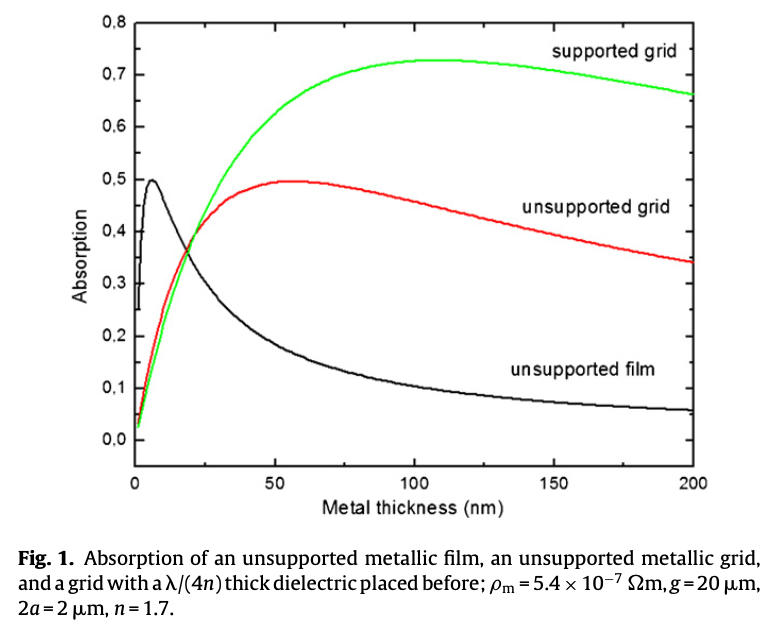
The absorber design builds on the equivalent-resistivity model developed for metallic grids. Patterning a conductor into narrow tracks raises the effective sheet resistance without requiring an extremely thin, difficult-to-control continuous film. For the prototype, the titanium grid used a 20 micrometre pitch and 2 micrometre line width. It occupied a circular silicon-dioxide membrane about 3 mm in diameter, supported by a much thicker silicon frame. The membrane reduces heat flow from the active area to the substrate while preserving enough mechanical support for fabrication and handling.
The nominal operating frequency was 3 THz, corresponding to a free-space wavelength near 0.1 mm. A dielectric SU-8 layer was incorporated to protect the membrane and enhance absorption through interference at the design frequency. The model predicted approximately 73% absorption under those conditions. At the 0.3 THz measurement frequency, the same layer was no longer a quarter-wave matching layer, and measured absorption was closer to 50%. This frequency distinction explains why the experiment does not directly reach the modeled optimum.
Six titanium-aluminum thermocouples were connected in series. Their measured thin-film Seebeck coefficient was about 7.4 microvolts per kelvin. Series connection multiplies the thermal voltage by the number of junctions, while noise rises more slowly, but additional metal also changes electrical resistance, thermal mass and electromagnetic absorption. The six-junction layout was selected as a fabrication and signal compromise. Titanium served both as one thermocouple material and as the absorber, reducing the number of process steps.
Fabrication and measured response
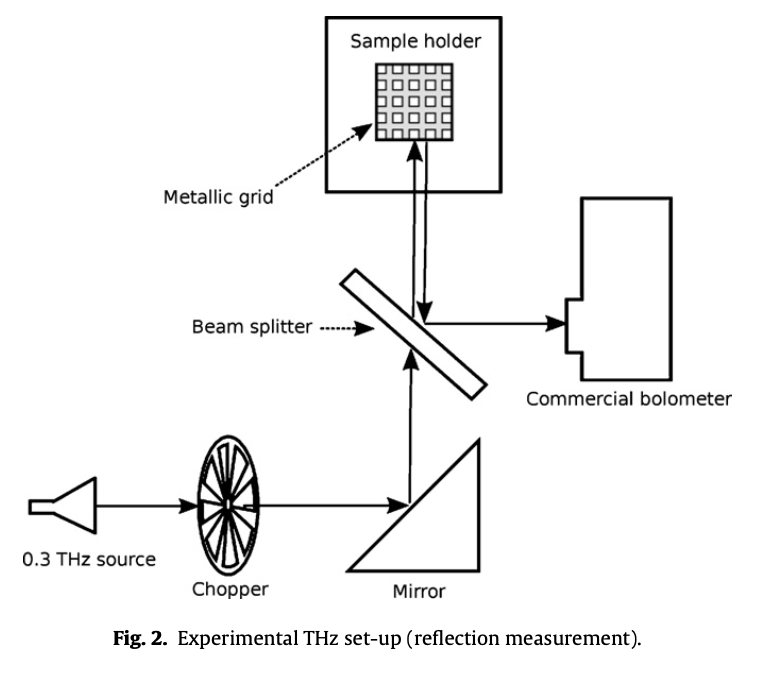
The process combined deep reactive-ion etching, thermal oxidation, metal evaporation and patterned lift-off. The titanium grid and one thermocouple leg were deposited first, followed by aluminum for the complementary legs. The active structure rested on a roughly 1.4 micrometre silicon-dioxide membrane within a 380 micrometre silicon support. SU-8 completed the dielectric and mechanical layer. Separate grid samples were also fabricated so that reflection, transmission and absorption could be measured independently of the thermal detector.
At 0.3 THz, grid measurements agreed reasonably with the multilayer model. Differences were linked to deposited-film resistivity, substrate-thickness variation, incomplete lift-off and imperfect illumination. Subwavelength scaling was examined separately between 900 MHz and 10 GHz using 1 cm and 2 cm grids in a TEM fixture. The inferred equivalent resistivity increased when the overall grid became small relative to wavelength, showing why absorber geometry cannot simply be scaled without electromagnetic re-evaluation.
The sensor’s dynamic response was measured with a mechanically chopped source and lock-in detection. It behaved approximately as a first-order thermal low-pass system. A cutoff near 0.8 Hz corresponded to a time constant of about 200 ms. Finite-element thermal calculations reproduced that scale when convection was represented with a coefficient near 100 W K-1 m-2, suggesting that heat exchange with the surrounding air was a major part of the response.
With the sensor placed 5 mm from a 0.3 THz horn, a measured output of approximately 550 nV at 1 Hz led to a responsivity of 35 nV per W m-2. The voltage noise floor was around 50 nV, corresponding to a minimum detectable power density near 1.4 W m-2 and an electric-field threshold around 23 V m-1. The reported noise-equivalent power, 8 Ã 10-5 W Hz-1/2, was high compared with established far-infrared detectors. A scan of the horn’s H-plane confirmed that the detector responded spatially, but the resulting map also made the substantial noise plainly visible.
A useful prototype with explicit limits
The device demonstrates room-temperature conversion of 0.3 THz radiation into an electrical signal using a compact, microfabricated thermopile. It does not establish a high-sensitivity alternative to cryogenic bolometers, nor does it validate the modeled 3 THz absorption experimentally. Its 200 ms time constant is suitable for slow scans and modulated measurements rather than fast video-rate imaging, and the 3 mm absorber sets a finite spatial sampling area.
The authors identify concrete improvement routes. A titanium/doped-silicon couple had a measured Seebeck coefficient about 25 times that of Ti/Al in their thin-film tests, although it required a more complex process. Reducing dielectric thermal mass and redesigning the grid for smaller dimensions could also improve response or spatial resolution, but those gains were prospective rather than measured in this device.
The collaboration brought together MEMS fabrication, thermal modeling and terahertzTerahertz radiation is electromagnetic energy commonly associated with frequencies around 0.1 to 10 THz, between microwaves and infrared, where many materials reveal distinctive propagation, absorption, and imaging behavior. More instrumentation. Its importance lies in treating the absorber, thermopile and membrane as one coupled system and reporting the unfavorable noise result alongside the successful detection. That transparency makes the paper a practical reference for subsequent room-temperature THz sensor development.
Bibliographic reference
Recommended citation: Ben Mbarek, S., Euphrasie, S., Baron, T., Thiery, L., Vairac, P., Cretin, B., Guillet, J.-P., & Chusseau, L. (2013). Room temperature thermopile THz sensor. Sensors and Actuators A: Physical, 193, 155-160. https://doi.org/10.1016/j.sna.2013.01.014
Publisher: Elsevier. Airtable record: rec7o7V7cnZW3UObY.