
Research publication · Reflection phase retrieval
TerahertzTerahertz radiation is electromagnetic energy commonly associated with frequencies around 0.1 to 10 THz, between microwaves and infrared, where many materials reveal distinctive propagation, absorption, and imaging behavior. More phase retrieval imaging in reflection
Many terahertzTerahertz radiation is electromagnetic energy commonly associated with frequencies around 0.1 to 10 THz, between microwaves and infrared, where many materials reveal distinctive propagation, absorption, and imaging behavior. More detectors measure intensity but do not directly provide the phase needed for quantitative surface topography. Phase retrieval addresses that missing information computationally: intensity patterns are recorded at several propagation distances, and an iterative algorithm searches for a complex field consistent with all of them. This paper implements the method in reflection at 0.287 THz. A high-dynamic-range acquisition formed from two lock-in channels preserves both bright and weak diffracted regions, enabling reconstruction of amplitude and phase. A metallic test object with a known 275 micrometer recess is then converted into a height map. The result is a laboratory demonstration with a 36-hour raster acquisition, not yet a rapid industrial scanner.
Reflection is important because many objects cannot be accessed from both sides or do not transmit at terahertzTerahertz radiation is electromagnetic energy commonly associated with frequencies around 0.1 to 10 THz, between microwaves and infrared, where many materials reveal distinctive propagation, absorption, and imaging behavior. More frequencies. It is also difficult: the return is weakened by the sample reflectivity, a beam splitter and the spreading of diffracted energy. The study treats dynamic range as part of the imaging method rather than a secondary detector specification. Without the low-intensity spatial frequencies, the iterative reconstruction loses information required for a high-numerical-aperture solution.
Featured visual: Image 1 from the Airtable record associated with this publication. Consult the original paper for the authoritative figure caption and interpretation. Source publication.
Visuals are drawn from the Airtable research archive. Figure numbering, rights and interpretation should be checked against the original publication before republication outside this site.
Recording a reflected field across 27 planes
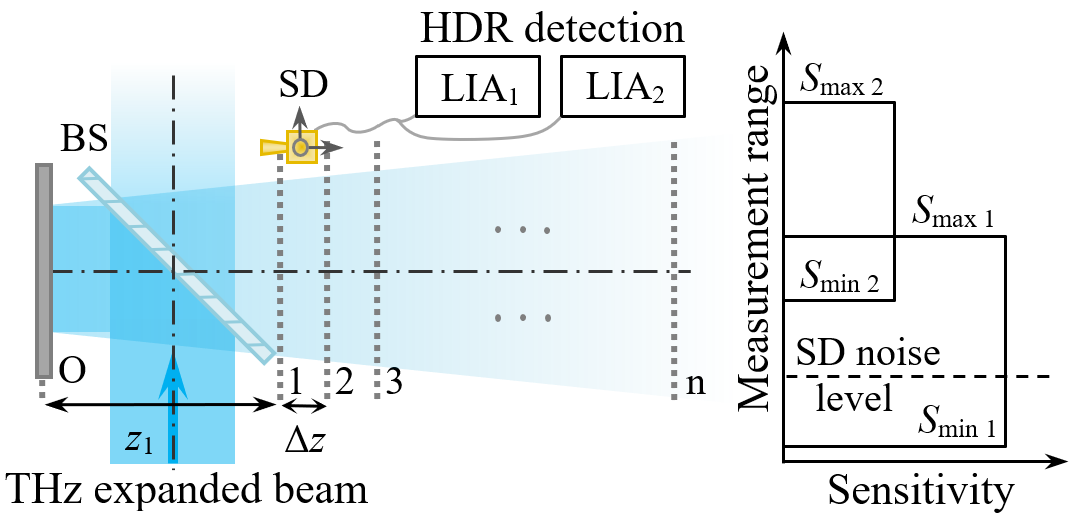
A continuous-wave Gunn-diode source followed by frequency multiplication delivered 14 mW at 0.287 THz, corresponding to a wavelength near 1.045 mm. The beam covered roughly 8 by 8 cm and reached a reflective metal target through a 45-degree beam splitter. The object included recessed Chinese characters, among them the character for “king,” with a reference depth of 275 micrometers. A single-pixel Schottky detector recorded the reflected intensity.
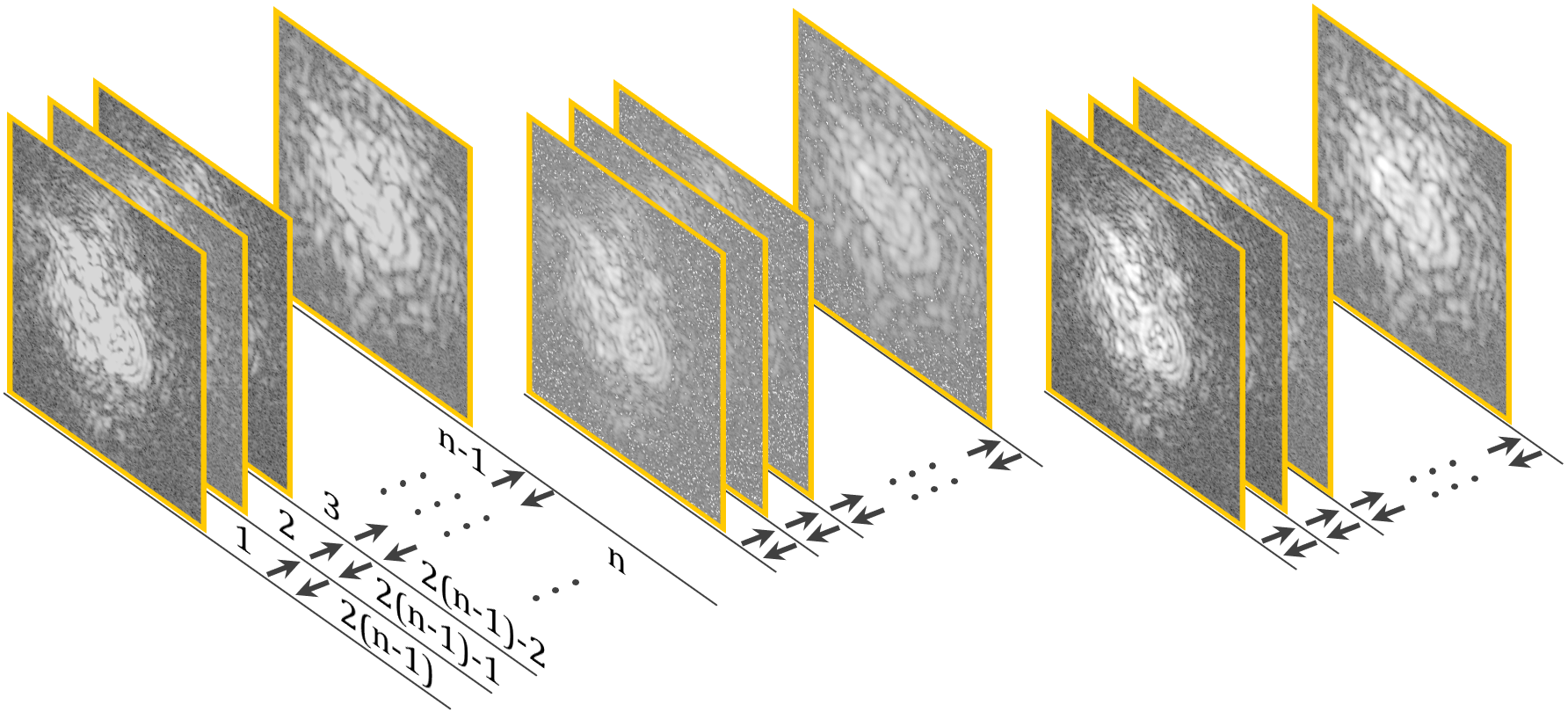
The detector raster-scanned 240 by 240 points at a 0.5 mm pitch. This two-dimensional measurement was repeated at 27 axial planes separated by 5 mm. Because the beam splitter occupied space near the object, the first plane was 83 mm away. Acquiring the complete stack required approximately 36 hours. The large data set supplied the diversity needed by the phase-retrieval algorithm but makes clear why faster hardware is necessary for applications outside a controlled experiment.
One lock-in amplifier could not cover the full intensity range cleanly. A high-sensitivity setting preserved weak diffraction but saturated in the bright center; a lower-sensitivity setting avoided saturation but discarded faint detail. The authors connected the same detector to two lock-in amplifiers operating in complementary ranges. Values from the sensitive channel were retained below 75% of its saturation level and replaced by the lower-gain channel above that threshold. The merged data provided approximately 50 dB of usable dynamic range, compared with about 30 dB for either single-channel acquisition in this configuration.
Reconstruction used a single-beam multiple-intensity algorithm. Starting with a complex-field estimate, the angular-spectrum method propagated it to each measurement plane. At every plane, the calculated amplitude was replaced by the square root of the measured intensity while the current phase was retained. Forward and backward passes through the stack were repeated until a field consistent with the axial measurements emerged. Reconstructions from either lock-in channel alone failed because saturation or insufficient signal corrupted the amplitude constraint; the merged high-dynamic-range stack converged to a more detailed result.
The recovered spatial spectrum corresponded to a numerical aperture near 0.72, greater than that available from the conventional raster-scanned focal-plane comparison discussed by the authors. This is a numerical aperture supported by the measured diffraction field and reconstruction geometry, not an assertion that every object will be resolved identically. Sampling pitch, plane spacing, dynamic range, object reflectivity and convergence all contribute to practical resolution.
Turning reconstructed phase into surface height
Raw phase is not immediately a clean topographic map. The object region was first isolated with a mask derived from amplitude. The reconstructed field was oversampled eightfold, and a synthetic off-axis carrier was introduced to support digital interferometric processing. A further reconstruction corrected global inclination of the target. The system background was estimated from a separate mirror measurement containing a small perturbing bead, smoothed and subtracted from the object phase.
After phase unwrapping and resampling, the surface displacement was calculated from the reflection relationship h = lambda Phi/(4 pi). The resulting map reproduced the 275 micrometer depth of the reference character with quantitative agreement. This validation is stronger than a qualitative image because it tests the phase-to-height conversion against a known feature. It remains a single controlled metallic object with strong reflectivity and a comparatively simple surface.
Several limitations follow directly from the apparatus. The beam splitter reduces available return power and fixes the minimum first-plane distance. Oblique illumination without a splitter could recover power, but it would require projection and tilt corrections. Rastering one detector over 27 planes dominates the 36-hour acquisition time. A matrix detector could record each plane in parallel and reduce the beam footprint, although detector dynamic range, calibration and pixel uniformity would then become central.
For non-destructive testingInspection of dielectric, layered, polymer, composite, and manufactured structures without destructive sampling. Non-Destructive Testing: measurement approach and use cases Work begins with the material and the decision that the measurement... More, quantitative reflection topography could support inspection of accessible surfaces, coatings or structures that do not transmit. Transfer would require representative materials rather than only a metal target, faster acquisition, tolerance to vibration and roughness, and a clear comparison with established metrology. The paper does not report production speed, complex defects or measurement uncertainty across repeated samples, so commercial maturity should not be inferred.
The collaboration connects phase-retrieval expertise from ITMO University with terahertzTerahertz radiation is electromagnetic energy commonly associated with frequencies around 0.1 to 10 THz, between microwaves and infrared, where many materials reveal distinctive propagation, absorption, and imaging behavior. More imaging and instrumentation in Bordeaux. Its key achievement is the full chain: high-dynamic-range intensity acquisition, multi-plane iterative reconstruction, background correction and quantitative height recovery. Future work can distribute those tasks across faster detectors and more efficient reflection geometries while preserving calibration. The study demonstrates that reflection phase retrieval is physically and computationally viable at 0.287 THz; its next challenge is to retain that accuracy with far fewer measurements.
Publication and citation
Recommended citation: Petrov, N. V., Perraud, J.-B., Chopard, A., Guillet, J.-P., Smolyanskaya, O. A., & Mounaix, P. (2020). TerahertzTerahertz radiation is electromagnetic energy commonly associated with frequencies around 0.1 to 10 THz, between microwaves and infrared, where many materials reveal distinctive propagation, absorption, and imaging behavior. More phase retrieval imaging in reflection. Optics Letters, 45(15), 4168-4171. https://doi.org/10.1364/OL.397935
Publisher: Optica Publishing Group. Airtable record: recDZvccTBLtsiRU8.