

Additive manufacturing can produce polymer components with internal channels and complex external forms that are difficult to inspect after fabrication. Because many polymers transmit sub-terahertz radiation, terahertzTerahertz radiation is electromagnetic energy commonly associated with frequencies around 0.1 to 10 THz, between microwaves and infrared, where many materials reveal distinctive propagation, absorption, and imaging behavior. More imaging offers a way to examine such parts without ionizing radiation or destructive sectioning. This study combines broadband material characterization, 300 GHz radiography, iterative tomography and volumetric analysis to evaluate what can be measured in representative additively manufactured objects.
Featured visual: Contextual research figure from âTerahertzTerahertz radiation is electromagnetic energy commonly associated with frequencies around 0.1 to 10 THz, between microwaves and infrared, where many materials reveal distinctive propagation, absorption, and imaging behavior. More Nondestructive Testing with Ultra-Wideband FMCW RadarFMCW radar transmits a continuously swept frequency and measures the beat signal produced by delayed reflections, enabling distance, thickness, and depth-resolved imaging with compact coherent hardware. Moreâ. It illustrates a closely related terahertzTerahertz radiation is electromagnetic energy commonly associated with frequencies around 0.1 to 10 THz, between microwaves and infrared, where many materials reveal distinctive propagation, absorption, and imaging behavior. More topic and is not a figure from the publication discussed on this page. Source publication.
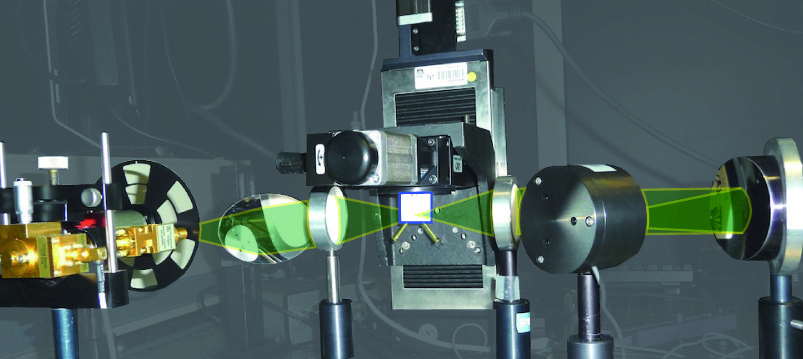
Visuals are drawn from the Airtable research archive. Figure numbering, rights and interpretation should be checked against the original publication before republication outside this site.
Matching the terahertz band to printed polymers
The study focused on polyether ether ketone (PEEK) and polyamide 12 (PA12), two thermoplastics used for demanding printed parts. The sample set included two PEEK lumbar interbody devices and a PA12 multivalve associated with an aircraft cabin-air system. These objects supplied different thicknesses, curvatures and internal structures rather than serving as a complete survey of additive manufacturing processes.
Before tomography, the authors measured the materials with terahertzTerahertz radiation is electromagnetic energy commonly associated with frequencies around 0.1 to 10 THz, between microwaves and infrared, where many materials reveal distinctive propagation, absorption, and imaging behavior. More time-domain spectroscopy. A Ti:sapphire laser delivering 80 fs pulses at 76 MHz drove a broadband system spanning approximately 0.1 to 4.5 THz. Measurements were performed in dry air and averaged 50 times to reduce noise and water-vapor interference. The retrieved refractive indices were approximately 1.58 for PEEK and 1.78 for PA12. Absorption rose with frequency, from roughly 5-10 cm-1 near 0.5 THz to 30-40 cm-1 around 1.25 THz.
That frequency dependence defines a central engineering compromise. Shorter wavelengths can improve spatial resolution, but increasing absorption reduces penetration and dynamic range. For the thicknesses examined here, the material measurements favored operation below about 1 THz. Spectroscopy therefore informed the imaging configuration rather than being treated as a separate characterization exercise.
Tomographic acquisition and measurable geometry
The imaging scanner operated near 300 GHz, corresponding to a free-space wavelength of about 1 mm. A Gunn-diode source delivered 12 mW, and a Schottky detector recorded transmitted intensity after the beam passed through the rotating object. The measured beam profile was Gaussian with a full width at half maximum close to 2 mm. Thirty-six projections were acquired at 5-degree intervals. The complete data collection reported for the objects extended to several hours, showing that this was a laboratory investigation rather than an in-line production system.
Projection data were reconstructed with an Ordered Subsets Convex algorithm adapted to terahertzTerahertz radiation is electromagnetic energy commonly associated with frequencies around 0.1 to 10 THz, between microwaves and infrared, where many materials reveal distinctive propagation, absorption, and imaging behavior. More propagation. The model accounts for the Gaussian beam, reducing some of the blur that would result from assuming infinitely narrow rays. The reconstructed volumes were segmented to separate the object from background and to isolate internal volumes of interest. Surface rendering, skeletonization and caliber measurements then converted voxel data into estimates of lengths, areas and volumes.
The radiographs and volumes revealed internal features in both device families. Ball bearings placed inside the lumbar cages were visible at suitable angles, while the multivalve’s internal organization could be followed in the three-dimensional result. Dimensions extracted from the reconstructions were compared with caliper measurements. Discrepancies increased for features farther from favorable beam conditions and were associated with diffraction, refraction, absorption and sampling. Their scale was generally comparable to the beam diameter or spatial step: about 0.25 mm sampling for the cages and 1 mm for the valve, with a beam width near 2 mm.
These results demonstrate access to internal geometry, but they should not be interpreted as proof that every pore, incomplete fusion zone or dimensional deviation in a printed polymer can be detected. Defect detectability depends on size, orientation, dielectric contrast, path length and reconstruction quality. The paper establishes feasibility on specific parts and provides quantitative comparisons; it does not report an industrial probability-of-detection study or a qualified inspection standard.
Importance for THz non-destructive testing
TerahertzTerahertz radiation is electromagnetic energy commonly associated with frequencies around 0.1 to 10 THz, between microwaves and infrared, where many materials reveal distinctive propagation, absorption, and imaging behavior. More inspection is attractive for additive manufacturing because low-density polymers can present limited absorption contrast to X-rays while remaining accessible to millimeter and terahertzTerahertz radiation is electromagnetic energy commonly associated with frequencies around 0.1 to 10 THz, between microwaves and infrared, where many materials reveal distinctive propagation, absorption, and imaging behavior. More waves. The same measurement can also respond to dielectric variations, interfaces and hidden voids. Unlike contact methods, transmission imaging can survey a volume without coupling fluid, although it requires physical access on both sides and a signal path through the full object.
The work connects several areas of expertise: polymer metrology, broadband spectroscopy, continuous-wave imaging, inverse reconstruction and three-dimensional morphology. The author list includes contributors from measurement and terahertzTerahertz radiation is electromagnetic energy commonly associated with frequencies around 0.1 to 10 THz, between microwaves and infrared, where many materials reveal distinctive propagation, absorption, and imaging behavior. More research environments, supporting a cautious description of the project as a collaborative feasibility study. The available record does not establish production readiness, certification status or a specific commercial implementation.
Future progress would require faster multi-detector acquisition, improved source power, frequency selection adapted to each polymer and an explicit uncertainty model for dimensional measurements. Higher frequencies could sharpen small structures but only where penetration remains adequate. Multi-frequency measurements may help distinguish geometry from material variation. Automated comparison with nominal CAD data would also bring reconstructed volumes closer to quality-control workflows.
The durable conclusion is that terahertzTerahertz radiation is electromagnetic energy commonly associated with frequencies around 0.1 to 10 THz, between microwaves and infrared, where many materials reveal distinctive propagation, absorption, and imaging behavior. More tomography can do more than create qualitative pictures of printed polymers. When spectroscopy guides the operating band and reconstruction is followed by calibrated volume analysis, the method can recover internal form and produce dimensional estimates. Its industrial relevance lies in that combination, provided each future application is validated against its own materials, geometry and defect requirements.
Publication details and citation
Recommended citation: Perraud, J. B., Obaton, A. F., Bou-Sleiman, J., Recur, B., Balacey, H., Darracq, F., Guillet, J. P., & Mounaix, P. (2016). TerahertzTerahertz radiation is electromagnetic energy commonly associated with frequencies around 0.1 to 10 THz, between microwaves and infrared, where many materials reveal distinctive propagation, absorption, and imaging behavior. More imaging and tomography as efficient instruments for testing polymer additive manufacturing objects. Applied Optics, 55(13), 3462. https://doi.org/10.1364/AO.55.003462
Record ID: rec9M5XFuQMK0UTKP
Research themes: additive manufacturing, PEEK, PA12, polymer metrology, terahertzTerahertz radiation is electromagnetic energy commonly associated with frequencies around 0.1 to 10 THz, between microwaves and infrared, where many materials reveal distinctive propagation, absorption, and imaging behavior. More tomography, non-destructive evaluation.