
Research publication · Millimetre-wave and terahertzTerahertz radiation is electromagnetic energy commonly associated with frequencies around 0.1 to 10 THz, between microwaves and infrared, where many materials reveal distinctive propagation, absorption, and imaging behavior. More waveguides
Coupling and Propagation of Sommerfeld Waves at 100 and 300 GHz
A bare metal wire can guide electromagnetic energy without enclosing it in a conventional waveguide. The relevant Sommerfeld wave is radially polarized, travels with a phase velocity close to that of light and places most of its energy in the air surrounding the conductor. Those properties are attractive in the millimetre-wave and terahertzTerahertz radiation is electromagnetic energy commonly associated with frequencies around 0.1 to 10 THz, between microwaves and infrared, where many materials reveal distinctive propagation, absorption, and imaging behavior. More bands, but they create a coupling problem: standard horns and quasi-Gaussian beams are linearly polarized. This paper develops an analytical description of the wire mode, proposes a simple phase plate to bridge the polarization mismatch, and tests propagation at 100 and 300 GHz on tungsten and stainless-steel wires.
Featured visual: Contextual research figure from âContinuousâwave scanning terahertzTerahertz radiation is electromagnetic energy commonly associated with frequencies around 0.1 to 10 THz, between microwaves and infrared, where many materials reveal distinctive propagation, absorption, and imaging behavior. More nearâfield microscopeâ. It illustrates a closely related terahertzTerahertz radiation is electromagnetic energy commonly associated with frequencies around 0.1 to 10 THz, between microwaves and infrared, where many materials reveal distinctive propagation, absorption, and imaging behavior. More topic and is not a figure from the publication discussed on this page. Source publication.
Visuals are drawn from the Airtable research archive. Figure numbering, rights and interpretation should be checked against the original publication before republication outside this site.
Matching a free-space beam to a surface wave
The electromagnetic solution is obtained from the boundary conditions at the cylindrical metal-air interface. Bessel and Hankel functions describe the fields inside and outside the wire, while the complex propagation constant accounts for phase and attenuation. High-precision numerical evaluation is needed because the guided wave is only weakly bound and the losses are small. The calculations show a quasi-transverse-electromagnetic mode whose radial field can extend several wire radii into the surrounding space.
Direct overlap with a linearly polarized Gaussian beam is poor because opposite sides of the radial mode point in opposite transverse directions. A differential phase plate reverses the input phase over one half-plane. After that reversal, the two halves add constructively against the radial mode rather than cancelling. The coupling coefficient is calculated from the normalized overlap between the modified Gaussian field and the exact wire-mode field.
For a tungsten radius of 250 micrometres, the predicted maximum exceeds 30% at both 100 and 300 GHz when the beam waist is chosen appropriately. The optimum is broad rather than critically narrow: more than 80% of the maximum is retained over a large range of waist values. Changing metal from tungsten to gold or stainless steel has only a modest effect on the overlap, although conductivity changes propagation loss. Increasing wire radius shifts the most suitable beam waist because the guided field expands laterally. With joint adjustment of wire and beam dimensions, the calculated peak remains close to 32% over the frequency range considered.
Experimental tests of confinement and attenuation
The continuous-wave apparatus used frequency-multiplied sources at 100 and 300 GHz. Detection was performed with a Schottky diode at 100 GHz and a cryogenic silicon bolometer at 300 GHz. The experiments used 20 cm wire sections, including a tungsten wire with a 250 micrometre radius and a stainless-steel wire with a 400 micrometre radius. Off-axis parabolic mirrors controlled the free-space beam, and the differential phase plate was placed before the wire.
To test whether the transmitted signal really followed the calculated Sommerfeld distribution, a variable iris was centred on the conductor. Closing the iris progressively blocked the field surrounding the wire. Transmission rose toward a plateau as the aperture opened, and the complete curve agreed closely with the radial power obtained by integrating the theoretical mode. Depending on frequency and conductor, most of the field occupied a cylindrical region extending roughly five to nine wire radii. The greater confinement at 300 GHz was also consistent with the model.
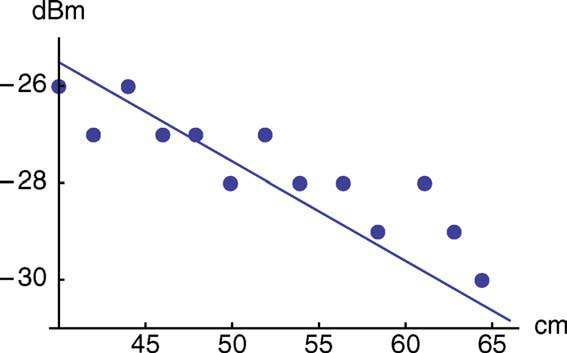
Propagation loss was assessed by shortening a wire from 65 to 40 cm and recording the power change. At 100 GHz, the measured attenuation was 0.13 ± 0.02 dB per centimetre, compared with an ideal calculated value of 0.043 dB per centimetre. Sag and unintended curvature were identified as likely sources of the excess because a weakly bound mode can radiate when the wire bends. A power balance for the complete path gave an experimental coupling efficiency near 23 ± 2%, reasonably close to the theoretical 32% after alignment, beam matching and non-ideal propagation were considered.
Meaning for terahertz routing and probes
The measurements demonstrate three separate points: the phase plate can launch the radial wire mode; the measured transverse confinement follows the exact electromagnetic solution; and the wave can propagate over tens of centimetres with losses that are low enough to measure and diagnose. The study does not show a packaged transmission product or guarantee the same attenuation on arbitrarily shaped wires. Mechanical support, surface condition, bends and transitions remain decisive.
Within a terahertzTerahertz radiation is electromagnetic energy commonly associated with frequencies around 0.1 to 10 THz, between microwaves and infrared, where many materials reveal distinctive propagation, absorption, and imaging behavior. More system, a single wire offers an unusually open guide. Samples or probes can be brought close to the field, and a tapered endpoint can enhance the longitudinal component for near-field measurements. The broad coupling optimum also reduces sensitivity to small beam-waist errors. These features explain why the work connects naturally to wire-based THz microscopy, even though this paper focuses on coupling and propagation rather than on an application image.
The two-author study consolidates theoretical and experimental expertise in guided terahertzTerahertz radiation is electromagnetic energy commonly associated with frequencies around 0.1 to 10 THz, between microwaves and infrared, where many materials reveal distinctive propagation, absorption, and imaging behavior. More waves at the Institut d’Electronique du Sud. Its value lies in the quantitative chain from modal field to coupling coefficient, iris transmission and cut-back loss. That chain makes clear where an ideal Sommerfeld guide succeeds and where an actual wire introduces additional attenuation, providing a grounded basis for later components rather than an unsupported claim of universal low-loss transport.
Bibliographic reference
Recommended citation: Chusseau, L., & Guillet, J.-P. (2011). Coupling and Propagation of Sommerfeld Waves at 100 and 300 GHz. Journal of Infrared, Millimeter, and TerahertzTerahertz radiation is electromagnetic energy commonly associated with frequencies around 0.1 to 10 THz, between microwaves and infrared, where many materials reveal distinctive propagation, absorption, and imaging behavior. More Waves, 33(2), 174-182. https://doi.org/10.1007/s10762-011-9854-x
Publisher: Springer. Airtable record: recIERHqAq6MifjUf.