

Research publication · Heritage materials spectroscopy
TerahertzTerahertz radiation is electromagnetic energy commonly associated with frequencies around 0.1 to 10 THz, between microwaves and infrared, where many materials reveal distinctive propagation, absorption, and imaging behavior. More Spectroscopy and Quantum Mechanical Simulations of Crystalline Copper-Containing Historical Pigments
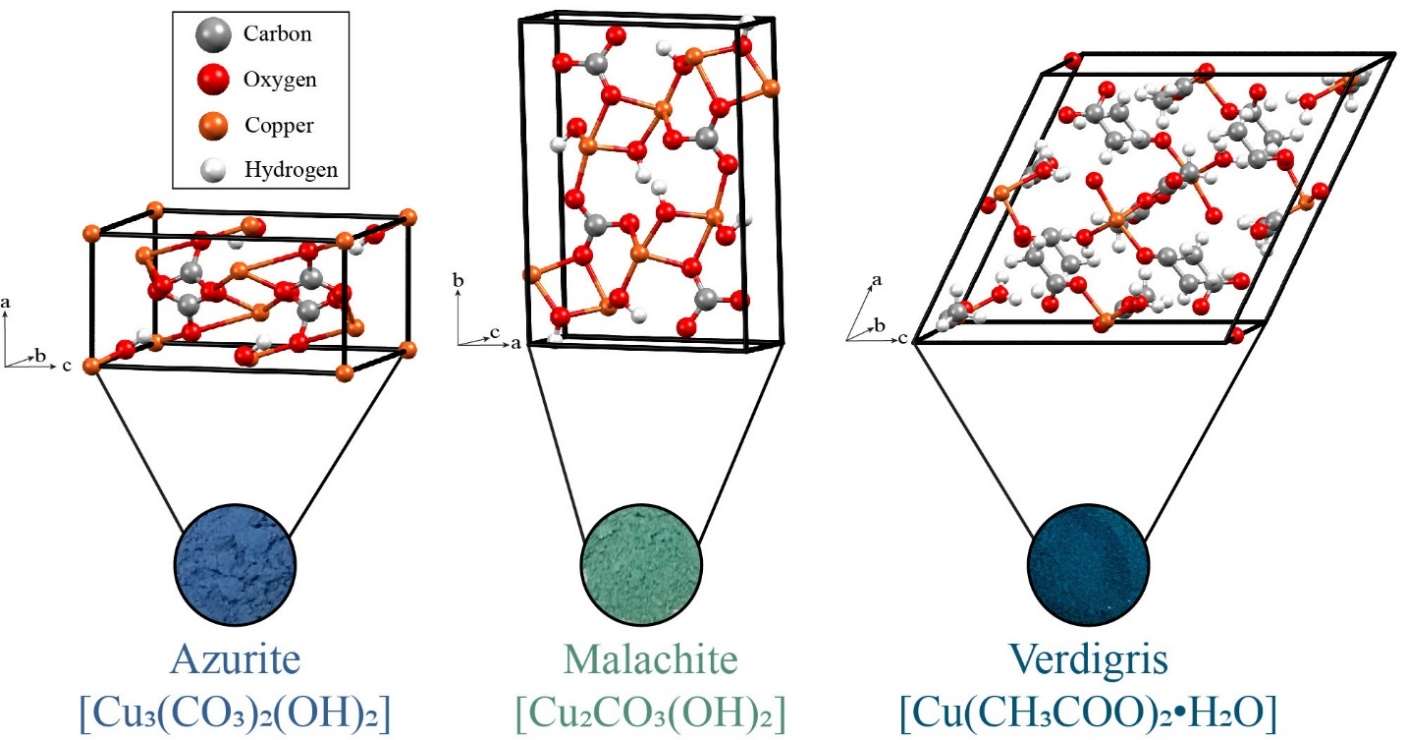
Azurite, malachite and verdigris all contain copper, yet their crystal structures and historical uses are distinct. Elemental analysis can confirm copper without necessarily distinguishing these compounds, while visible appearance may be altered by aging, mixtures or restoration. This study combines terahertzTerahertz radiation is electromagnetic energy commonly associated with frequencies around 0.1 to 10 THz, between microwaves and infrared, where many materials reveal distinctive propagation, absorption, and imaging behavior. More time-domain spectroscopy with solid-state density functional theory to investigate the low-frequency vibrations of the three pigments. The measurements provide experimental fingerprints, and the calculations explain which collective motions produce them. That pairing is important for heritage science: a spectral feature becomes more useful when it can be traced to a physically credible lattice vibration rather than treated as an unexplained database match.
The work is a reference study on prepared pigment pellets, not an in-situ examination of a painting. Its value lies in establishing how closely related copper materials can behave very differently between 0.06 and 3 THz. It also reveals a caution for future identification: absence of a strong band does not mean absence of a pigment. Crystal symmetry can make relevant modes weak in terahertzTerahertz radiation is electromagnetic energy commonly associated with frequencies around 0.1 to 10 THz, between microwaves and infrared, where many materials reveal distinctive propagation, absorption, and imaging behavior. More absorption even when chemically similar compounds show sharp peaks.
Featured visual: Image 1 from the Airtable record associated with this publication. Consult the original paper for the authoritative figure caption and interpretation. Source publication.
Visuals are drawn from the Airtable research archive. Figure numbering, rights and interpretation should be checked against the original publication before republication outside this site.
Matching measured fingerprints to lattice motion
Azurite and malachite powders were obtained as historical-pigment materials, while neutral verdigris was checked by powder X-ray diffraction against the expected hydrated crystal form. Each pigment was ground with high-density polyethylene at 20% by weight and pressed into a 13 mm pellet between 2.7 and 3.5 mm thick. The polyethylene matrix reduces handling difficulties and provides a relatively transparent reference in the terahertzTerahertz radiation is electromagnetic energy commonly associated with frequencies around 0.1 to 10 THz, between microwaves and infrared, where many materials reveal distinctive propagation, absorption, and imaging behavior. More band. Three pellet replicates were measured for each material to examine reproducibility.
Transmission spectra were acquired at 293 K with a TPS Spectra 3000 terahertzTerahertz radiation is electromagnetic energy commonly associated with frequencies around 0.1 to 10 THz, between microwaves and infrared, where many materials reveal distinctive propagation, absorption, and imaging behavior. More time-domain system. Broadband pulses were generated and detected by gallium-arsenide photoconductive antennas driven by an 800 nm, 80 fs laser. The useful range extended from approximately 0.06 to 3.0 THz, with a reported dynamic range near 75 dB. Each waveform covered an 18 ps window sampled every 0.0097 ps, and 100 acquisitions were averaged per pellet. Dividing each sample spectrum by a pure polyethylene reference yielded the absorbance used for comparison with theory.
The quantum-mechanical calculations used the CRYSTAL17 package and the B3LYP functional. Experimental atomic coordinates and unit cells supplied the starting structures, which were optimized under crystal-symmetry constraints. Copper was represented with a POB-TZVP basis and the other elements with triple-zeta valence plus polarization basis sets. The optimized lattice parameters remained within 1.25% of experiment, supporting their use for harmonic vibrational analysis. Infrared intensities were obtained through a Berry-phase treatment, and the team checked longitudinal-transverse phonon splitting; the calculated shifts were no larger than 0.015 THz and therefore did not control the main assignments.
This combined workflow does more than align peak positions. It visualizes the atomic displacements associated with each normal mode and tests the shape of the potential energy surface. A near-parabolic potential supports a harmonic description and a narrow line, whereas a visibly non-parabolic curve helps explain broad or structured absorption. The calculations therefore connect spectrum, crystal packing and intermolecular forces.
Three copper pigments, three terahertz responses
Azurite produced two exceptionally narrow experimental bands at 1.83 and 2.23 THz, equivalent to 61 and 74 cm-1. Their full widths at half maximum were about 0.025 THz. The calculations placed corresponding absorptions at 1.87 and 2.30 THz with the same relative ordering of strength. Mode inspection assigned them primarily to carbonate-group rotations coupled to antiparallel translations of copper-containing layers along the crystal axes. Their calculated potential curves were close to harmonic, consistent with the sharp measured features.
Malachite, despite its chemical relationship to azurite, showed no discernible absorption peak in the measured 0-3 THz range. The simulations did contain carbonate rotational motions, but their predicted infrared intensities were below 1 km mol-1. The different monoclinic packing changes how atomic displacements contribute to the dipole moment, making the modes effectively inactive in this spectral window. This is a substantive result: the featureless spectrum is attributed to symmetry and weak oscillator strength, not automatically to instrumental failure or extreme broadening.
Neutral verdigris displayed a sharp feature near 1.02 THz and a much broader structured region from approximately 1.7 to 2.6 THz. Calculations identified two nearly degenerate low-frequency modes at 1.09 and 1.11 THz involving out-of-phase copper translations. Higher modes combined copper displacement with rotations and torsions of acetate and water groups. Several vibrations overlap around the broader experimental band, and their potential curves depart from a simple harmonic shape. The organic acetate and water components therefore introduce lattice dynamics that differ substantially from the carbonate minerals.
These results provide well-supported reference behavior for pure crystalline samples, but an artwork presents additional layers of complexity. Pigments may be mixed with binders, altered by humidity or chemical aging, present at low concentration, or buried beneath varnish and overpaint. Scattering and thickness also influence a terahertzTerahertz radiation is electromagnetic energy commonly associated with frequencies around 0.1 to 10 THz, between microwaves and infrared, where many materials reveal distinctive propagation, absorption, and imaging behavior. More measurement. The study does not demonstrate automatic identification on an intact object, and a missing malachite band would be especially difficult to use as positive evidence. Reference libraries will need mixtures, binders, degradation products and measurement geometries representative of real heritage objects.
The collaboration joins terahertzTerahertz radiation is electromagnetic energy commonly associated with frequencies around 0.1 to 10 THz, between microwaves and infrared, where many materials reveal distinctive propagation, absorption, and imaging behavior. More spectroscopy and heritage-material expertise with solid-state computational chemistry. That combination makes the assignments more robust and provides a model for extending the work to other pigments. In conservation practice, such data could support non-destructive examination when interpreted alongside X-ray fluorescence, Raman spectroscopy, infrared imaging or sampling-based analysis. It cannot by itself establish the date, authenticity or historical attribution of an artwork; those conclusions require material context and art-historical evidence beyond a spectral match.
The main contribution is thus both practical and conceptual. The spectra distinguish azurite and verdigris under controlled conditions, while theory explains why malachite may remain quiet. More broadly, the paper shows that low-energy vibrations encode crystal symmetry, inorganic layer motion and organic-lattice anharmonicity. A heritage database built on those mechanisms will be more reliable than one that stores peak positions without explaining why they appear.
Publication and citation
Recommended citation: Kleist, E. M., Koch Dandolo, C. L., Guillet, J.-P., Mounaix, P., & Korter, T. M. (2019). TerahertzTerahertz radiation is electromagnetic energy commonly associated with frequencies around 0.1 to 10 THz, between microwaves and infrared, where many materials reveal distinctive propagation, absorption, and imaging behavior. More spectroscopy and quantum mechanical simulations of crystalline copper-containing historical pigments. The Journal of Physical Chemistry A, 123(6), 1225-1232. https://doi.org/10.1021/acs.jpca.8b11676
Publisher: American Chemical Society. Airtable record: rec9lcOKuwT1YZ11V.