
Research publication · Augmented-reality optics education
Reconfigurable and versatile augmented reality optical setup for tangible experimentations
Optics students are often asked to connect three forms of knowledge that appear separately in the classroom: the physical arrangement of lenses, mirrors and polarizers; a mathematical model of wave propagation; and an image or detector trace that results from the experiment. A conventional bench provides tangible manipulation but may hide phase, polarization and optical-path information. A simulation makes those quantities visible but removes the mechanical choices and alignment work through which laboratory intuition develops. HOBIT, the Hybrid Optical Bench for Innovative Teaching and Learning, is designed to keep both sides of that experience in the same workspace.
The platform combines identifiable physical mounts with a real-time simulation and projected augmented-reality overlays. Students can place and rotate components on a table, while software reconstructs the corresponding virtual optical system and displays rays, fields, parameters and detector outputs. The paper describes the hardware, propagation models and teaching aids, then illustrates the concept with interferometry, polarization and spectroscopy configurations. It presents a flexible educational instrument rather than a controlled trial proving a specific learning gain. Its principal contribution is an architecture through which invisible wave-optics quantities can respond immediately to tangible actions.
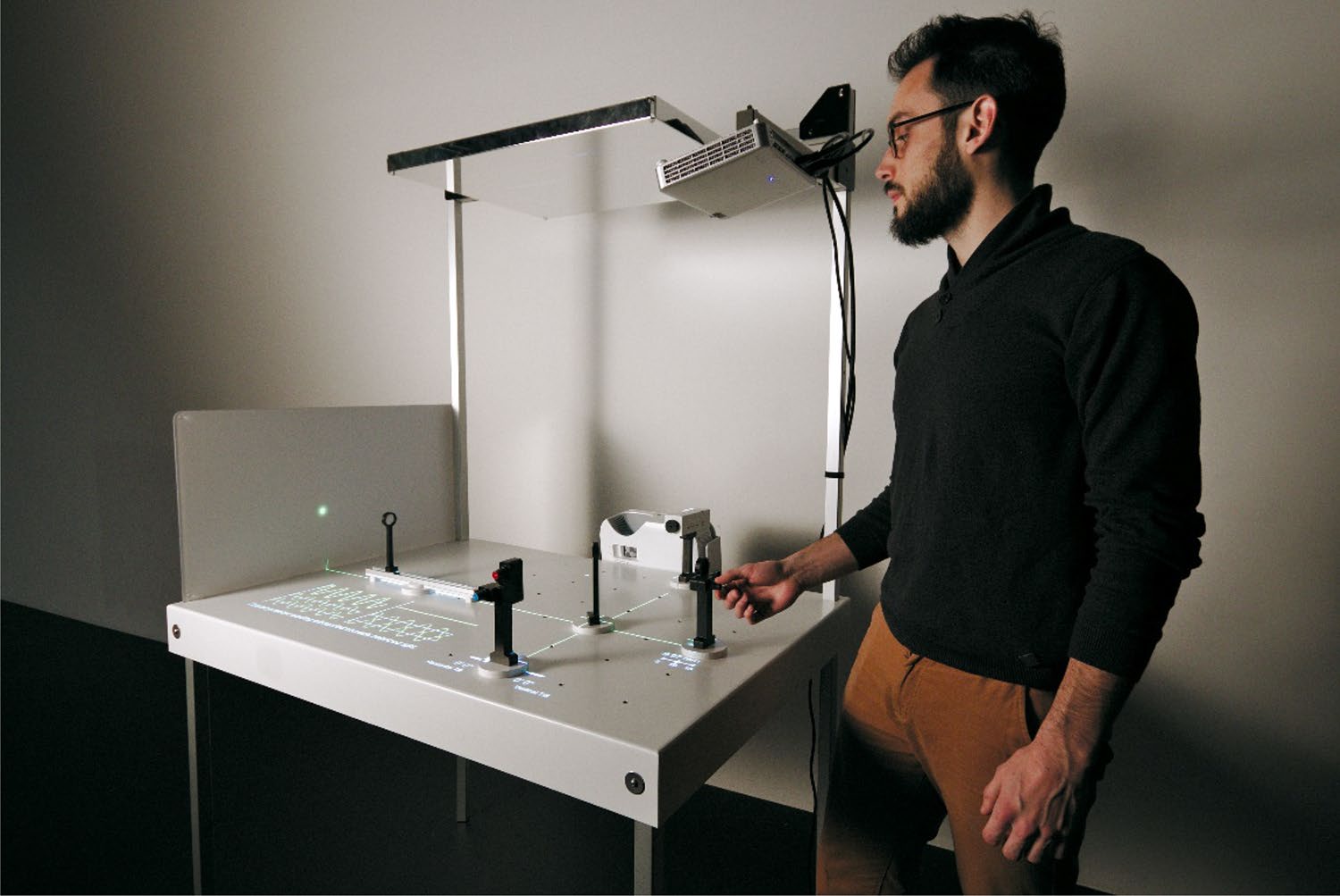
Featured visual: Image 1 from the Airtable record associated with this publication. Consult the original paper for the authoritative figure caption and interpretation. Source publication.
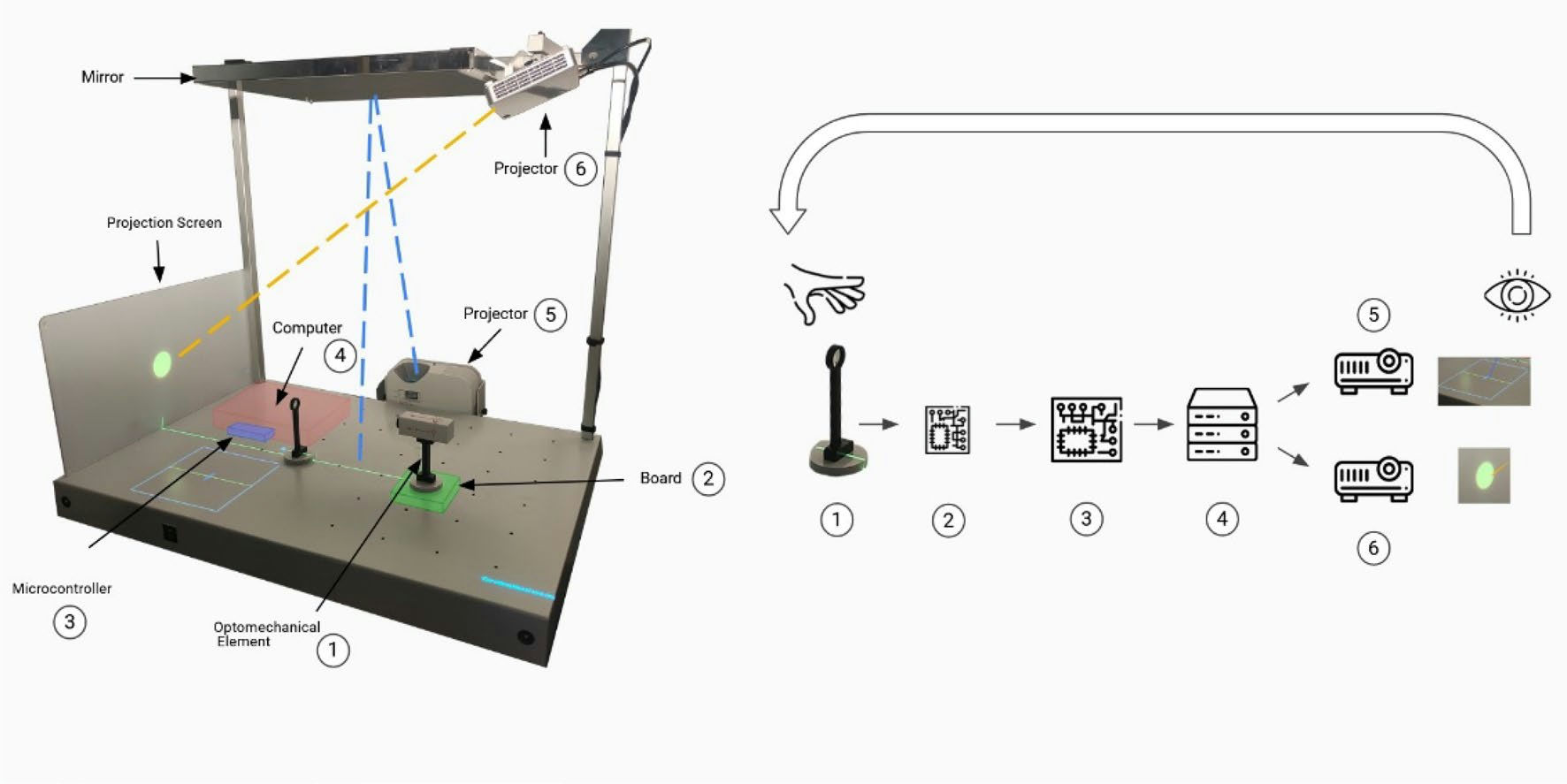
Visuals are drawn from the Airtable research archive. Figure numbering, rights and interpretation should be checked against the original publication before republication outside this site.
A bench that reads its own configuration
The table contains a two-dimensional grid of 34 connection points separated by 12 cm. Each point supplies power and a digital connection to a mounted component, while its labelled location tells the software where the component sits. Magnetic encoders report orientation from minus 90 to plus 90 degrees in 22.5-degree steps for the standard arrangement. The available mechanics include fixed mounts, one-axis translation, two- and three-axis tilt systems, and rotary holders suitable for elements such as polarizers and retarders. This range is intended to reproduce the decisions learners make on a real optical bench rather than reducing the activity to a touchscreen diagram.
Microcontrollers attached to the components send their state over a network beneath the table. With a reported transmission rate of 9,600 kb/s and fewer than ten bytes per sensor, updates arrive in under 10 ms, faster than the visible refresh of the simulation. One projector supplies a 75 by 45 cm vertical display for the resulting optical view, while another projects axes, labels and other augmentations across an approximately 1.2 by 0.8 m tabletop area. The software implementation uses Unity and shader-based rendering, allowing the graphical information to remain aligned with the physical setup as components change.
The platform also includes devices that have no direct equivalent in an ordinary student kit. A transparent virtual sensor can reveal the field at a selected point, and a universal driver can emulate controlled motion of an encoded element. A rail can move a lens for image-plane adjustment. These additions are pedagogical instruments: they make quantities available for investigation without pretending that a projected vector or simulated detector is itself a physical measurement. The distinction between real manipulation and modeled response must remain clear in how an exercise is introduced.
Layering ray, wave and polarization models
HOBIT’s simulation combines several descriptions of light because no single model serves every teaching objective. ABCD transfer matrices handle paraxial ray propagation and Gaussian-beam transformations through an optical chain. A scalar wave layer represents beams as astigmatic Gaussian modes and can account for spectral width and spatial coherence. Polychromatic behavior is produced by evaluating discrete wavelengths across a source spectrum. Jones calculus adds vector polarization effects from retarders, polarizers and reflective elements. Together, these models allow a component movement to affect both the visible path and calculated detector response.
The projected augmentations are configurable. A teacher can show an optical axis and component parameters during initial alignment, then remove part of that support as students become more independent. In an interferometer, the display can relate mirror translation to optical-path difference, phase and fringe evolution. A polarization exercise can render a two- or three-dimensional electric-field vector while intensity changes with component angle. A grating setup can display diffraction orders, blaze angle and spectral intensity. The system’s educational value depends on this selectivity: showing every available quantity at once could replace productive reasoning with visual overload.
The article demonstrates a Michelson interferometer, a polarization bench and a reflection-grating spectrometer. The configurations are reassembled from the same modular platform rather than requiring three dedicated benches. In the interferometer, students can move a mirror and connect fringe changes with a detector trace. In the polarization case, rotating plates and polarizers changes both intensity and the displayed field state. The spectrometer links grating geometry and slit settings to the emerging spectrum. These examples establish functional versatility and responsive visualization, but broader educational evaluation is still needed to determine which overlays improve conceptual understanding for different learner levels.
Educational scope, limitations and future study
A hybrid bench can reduce some practical barriers associated with conventional optics teaching. It can reproduce delicate configurations, avoid exposing beginners to unnecessary laser risk and make a single station serve several experiments. It also introduces dependencies of its own: calibration between projectors and table, maintenance of encoders and electronics, validation of the simulation, and teacher training in choosing appropriate scaffolding. A simulated result can be perfectly repeatable while omitting aberrations, component defects or alignment errors that matter in a research laboratory.
The platform is therefore best understood as a bridge, not a replacement for all physical optics. It supports embodied manipulation while letting learners interrogate quantities that cannot be seen directly. Future educational research could compare guided and reduced-augmentation modes, examine retention and transfer to conventional benches, and test accessibility for students with different visual or motor needs. Technical extensions could add nonlinear, electro-optic or laser-physics components, provided their models and safety assumptions are documented.
HOBIT emerges from collaboration across optics, simulation, human-computer interaction and electrical engineering. That interdisciplinary structure is central to the result: the mechanical interface, numerical model and teaching design must evolve together. The paper offers a concrete foundation on which schools, universities and training teams can study how augmented reality should support experimental reasoning without turning a laboratory into a passive display.
Bibliographic reference
Recommended citation: Bousquet, B., Hachet, M., Casamayou, V., Normand, E., Guillet, J.-P., & Canioni, L. (2024). Reconfigurable and versatile augmented reality optical setup for tangible experimentations. Discover Education, 3(1), 113. https://doi.org/10.1007/s44217-024-00192-w
Publisher: Springer Nature. Airtable record: rec52OjyFHfC0KMg2.