
Research publication · Thermoelectric terahertzTerahertz radiation is electromagnetic energy commonly associated with frequencies around 0.1 to 10 THz, between microwaves and infrared, where many materials reveal distinctive propagation, absorption, and imaging behavior. More detection
Room temperature Si-Ti thermopile THz sensor
This publication sits within a development program for uncooled terahertzTerahertz radiation is electromagnetic energy commonly associated with frequencies around 0.1 to 10 THz, between microwaves and infrared, where many materials reveal distinctive propagation, absorption, and imaging behavior. More thermopiles. The central engineering question is how to combine an efficient patterned absorber with thermocouple materials that generate enough voltage from a very small temperature rise. The documented work compares thin-film thermoelectric couples, models a titanium grid on a suspended membrane and reports the measured baseline of a six-junction room-temperature detector. A crucial distinction runs through the study: the Ti/Al reference architecture supplies the reported detector figures, while titanium with doped silicon offers a much larger measured Seebeck coefficient and motivates the Si-Ti direction identified in the title. The material advantage should not be confused with a demonstrated 25-fold improvement of the complete sensor.
Featured visual: Contextual research figure from âRoom temperature thermopile THz sensorâ. It illustrates a closely related terahertzTerahertz radiation is electromagnetic energy commonly associated with frequencies around 0.1 to 10 THz, between microwaves and infrared, where many materials reveal distinctive propagation, absorption, and imaging behavior. More topic and is not a figure from the publication discussed on this page. Source publication.
Visuals are drawn from the Airtable research archive. Figure numbering, rights and interpretation should be checked against the original publication before republication outside this site.
Connecting absorber design and thermoelectric material
The detector uses a thermal rather than a resonant electronic conversion mechanism. Incident radiation is dissipated in a metallic grid, raising the temperature of the centre of a silicon-dioxide membrane. Thermocouple hot junctions sample that region, while cold junctions remain closer to the silicon support. Their series voltage is proportional to the temperature difference and to the Seebeck coefficient of the material pair.
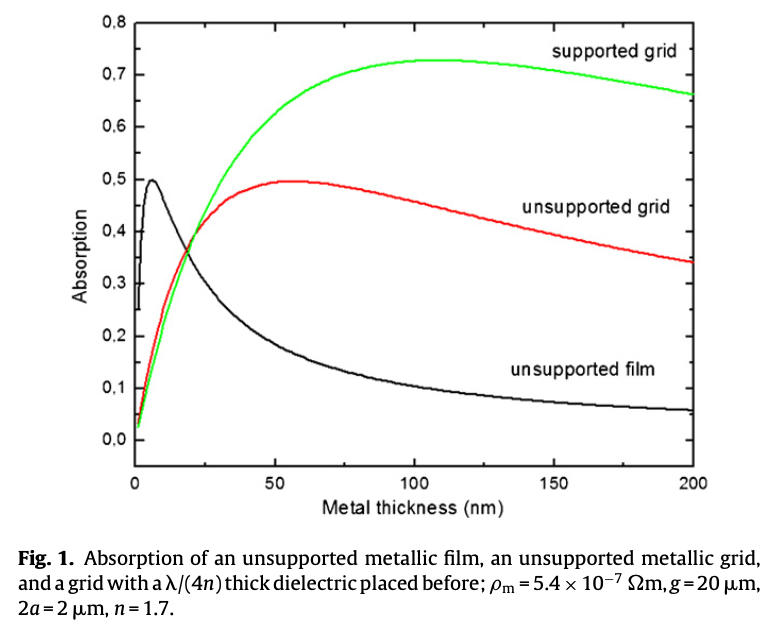
A grid is preferred to a continuous ultrathin film because its effective sheet resistance can be adjusted through geometry. The model treats the patterned titanium as an equivalent layer and includes the dielectric stack and diffraction corrections. For a nominal design frequency of 3 THz, the selected grid pitch was 20 micrometres and its line width 2 micrometres. The active area had a radius of approximately 1.5 mm. A dielectric layer could improve electromagnetic absorption near the design frequency and add mechanical robustness, but it also increased thermal capacity. The design was therefore a compromise among absorption, sensitivity, response time and spatial sampling area.
Thin-film measurements compared Ti/Al, Bi/Cr and Ti/doped-Si couples. The values recorded in the source data were approximately 7.4, 70 and 190 microvolts per kelvin respectively. Doped silicon offered the largest coefficient, about 25 times the Ti/Al result, but it required a more involved fabrication sequence. Bismuth presented patterning and handling difficulties. Ti/Al was consequently used for the simpler reference prototype, with titanium serving both as an absorber and one thermocouple leg.
Microfabrication and characterization
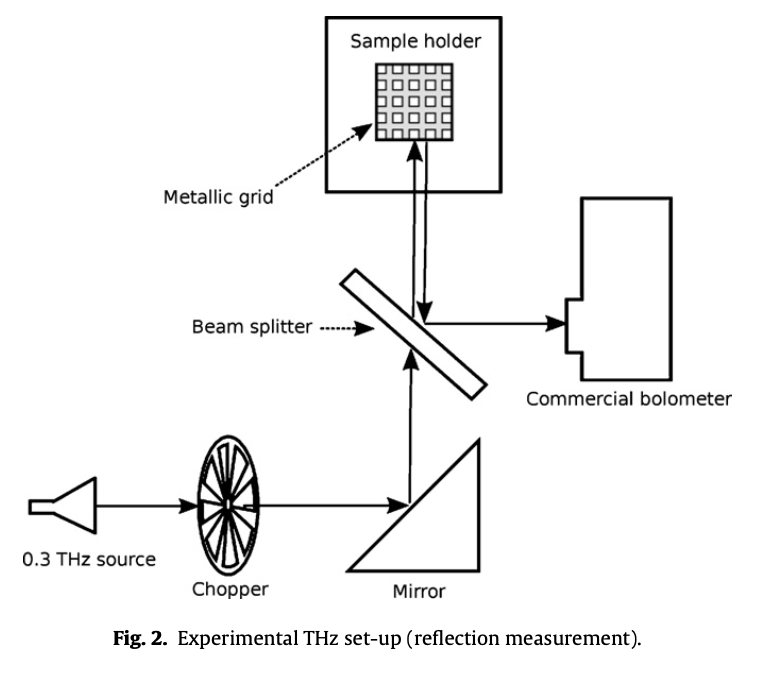
The active structure was formed on a thin SiO2 membrane supported by a silicon ring. Deep reactive-ion etching and oxidation defined the membrane, after which titanium and aluminum layers were patterned to create the grid and six thermocouples connected in series. The geometry increased voltage relative to a single junction while keeping process complexity and metal loading manageable. The absorber model was checked using separate titanium-grid samples through reflection and transmission measurements.
The detector was intended for 3 THz, but available instrumentation limited characterization to 0.3 THz. At the lower frequency, the dielectric thickness no longer supplied the intended quarter-wave condition, so absorption was around 50% rather than the modeled value near 73% at the design point. This does not invalidate thermal detection, but it means that the measured responsivity combines the intrinsic thermopile response with non-optimal coupling.
A chopped source and lock-in amplifier were used to measure dynamics. The response followed a first-order low-pass trend with a cutoff around 0.8 Hz and a time constant close to 200 ms. Finite-element thermal simulations reached a similar value when convection to air was included, indicating that the environment, not only conduction through the membrane, shaped the result.
At 0.3 THz and 1 Hz modulation, the reference device produced about 550 nV under the reported illumination. This corresponded to a responsivity of 35 nV per W m-2. With an output noise threshold around 50 nV, the minimum detectable power density was estimated at 1.4 W m-2, equivalent to an electric field near 23 V m-1. The noise-equivalent power was approximately 8 Ã 10-5 W Hz-1/2, explicitly identified as high. A scanned map of a 0.3 THz horn pattern confirmed detector operation but also showed the noise limitation.
What the Si-Ti direction can reasonably promise
The measured Seebeck coefficient of the Ti/doped-Si couple makes it an attractive route to greater thermoelectric voltage. It is reasonable to expect the coefficient to improve the conversion factor if geometry, thermal conductance and noise remain controlled. It is not reasonable to multiply the Ti/Al detector responsivity by 25 and present that number as a result: contact resistance, silicon processing, added layers, electrical noise and thermal loading can all change in the integrated device.
The work therefore provides a material-selection argument and a validated baseline rather than a fully optimized Si-Ti detector specification. It also shows why smaller pixels are not automatically better. Reducing area improves spatial resolution but lowers captured power; changing the grid size alters equivalent resistivity; and reducing membrane mass can accelerate response while making fabrication more fragile.
The research joins microtechnology, thermometry and terahertzTerahertz radiation is electromagnetic energy commonly associated with frequencies around 0.1 to 10 THz, between microwaves and infrared, where many materials reveal distinctive propagation, absorption, and imaging behavior. More measurement expertise, with contributions spanning FEMTO-ST, the Institut d’Electronique du Sud and Danick Briand’s microsystems experience. Its importance for THz instrumentation is pragmatic: room-temperature detectors can simplify scanning setups, but meaningful progress requires simultaneous control of electromagnetic absorption, thermal isolation, thermoelectric conversion and noise. The paper documents that chain and keeps the proposed higher-Seebeck route distinct from performance already measured.
Bibliographic reference
Recommended citation: Ben Mbarek, S., Euphrasie, S., Baron, T., Thiery, L., Vairac, P., Briand, D., Guillet, J.-P., & Chusseau, L. (2014). Room temperature Si-Ti thermopile THz sensor. Microsystem Technologies, 21(8), 1627-1631. https://doi.org/10.1007/s00542-014-2252-2
Publisher: Springer. Airtable record: recPcvNcsA6Qr916V.