
Research publication · TerahertzTerahertz radiation is electromagnetic energy commonly associated with frequencies around 0.1 to 10 THz, between microwaves and infrared, where many materials reveal distinctive propagation, absorption, and imaging behavior. More imaging for cultural heritage
Characterization of Varnish Ageing and its Consequences on TerahertzTerahertz radiation is electromagnetic energy commonly associated with frequencies around 0.1 to 10 THz, between microwaves and infrared, where many materials reveal distinctive propagation, absorption, and imaging behavior. More Imagery: Demonstration on a Painting Presumed of the French Renaissance
A varnish is only a few micrometres thick, yet its condition can change both the appearance of a painting and the response of an inspection instrument. This study examines that problem on an oil painting made on a copper plate and attributed to the French Renaissance period. The authors combine reflected terahertzTerahertz radiation is electromagnetic energy commonly associated with frequencies around 0.1 to 10 THz, between microwaves and infrared, where many materials reveal distinctive propagation, absorption, and imaging behavior. More time-domain measurements, continuous-wave imaging and an electromagnetic inversion model to estimate the properties of the surface coating and to determine how it affects images formed at different frequencies. The work provides quantitative evidence that the choice of frequency matters: the varnish has little visible influence in the lower-frequency broadband images but becomes an important source of contrast loss at 3.8 THz.
Metal-supported paintings present a distinctive conservation problem. Their copper support is rigid and durable, but the work above it is a heterogeneous stack of paint, possible restoration layers and an ageing protective coating. Ultraviolet fluorescence can help a conservator locate surface interventions, although the observed colour depends on the resin, pigments, contaminants, ageing and imaging conditions. Optical coherence tomography can resolve transparent layers, but a reflective metal support may complicate acquisition and the accessible area is generally smaller. TerahertzTerahertz radiation is electromagnetic energy commonly associated with frequencies around 0.1 to 10 THz, between microwaves and infrared, where many materials reveal distinctive propagation, absorption, and imaging behavior. More radiation offers a complementary view because it can probe optically opaque dielectric layers and return information from the metal beneath them. It does not, however, identify a resin or establish an artwork’s history by itself; the measured signal must be interpreted in relation to the painting’s structure and other conservation evidence.
The investigated object measured approximately 210 by 270 mm and included areas where the varnish had been removed. That partial removal created a useful, though imperfect, comparison between coated and uncoated regions. It allowed the researchers to estimate the paint response first and then introduce the varnish as an additional layer in the model. The study also compared visible and ultraviolet observations with terahertzTerahertz radiation is electromagnetic energy commonly associated with frequencies around 0.1 to 10 THz, between microwaves and infrared, where many materials reveal distinctive propagation, absorption, and imaging behavior. More maps. Some motifs appeared differently in the electromagnetic images, including changes around a figure’s shawl, hair and arm and around the head of a painted monster. These contrasts are consistent with differences in underlying materials or earlier interventions, but they are not chemical identifications and cannot alone determine when or why a modification was made.
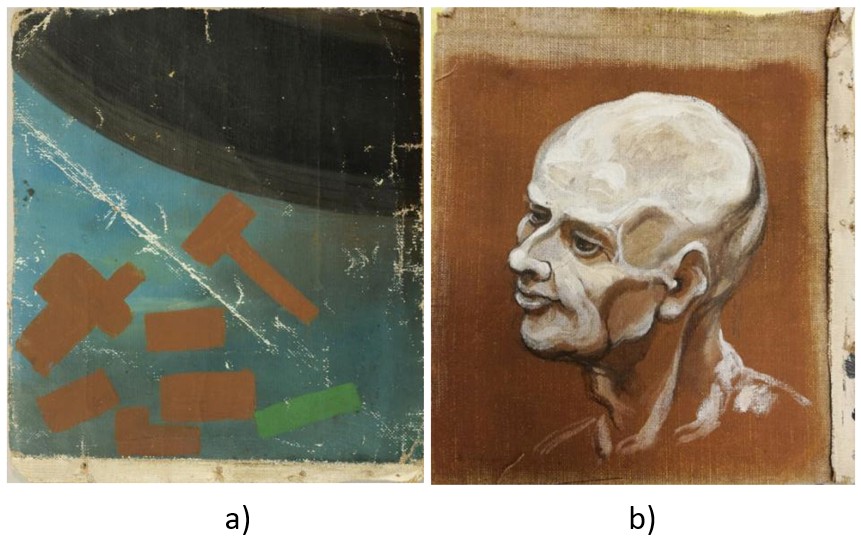
Featured visual: Contextual research figure from âTeraPulse Lx for terahertzTerahertz radiation is electromagnetic energy commonly associated with frequencies around 0.1 to 10 THz, between microwaves and infrared, where many materials reveal distinctive propagation, absorption, and imaging behavior. More imaging of painting on canvasâ. It illustrates a closely related terahertzTerahertz radiation is electromagnetic energy commonly associated with frequencies around 0.1 to 10 THz, between microwaves and infrared, where many materials reveal distinctive propagation, absorption, and imaging behavior. More topic and is not a figure from the publication discussed on this page. Source publication.

Visuals are drawn from the Airtable research archive. Figure numbering, rights and interpretation should be checked against the original publication before republication outside this site.
Separating a thin varnish from paint and copper
Broadband measurements were made in reflection with a photoconductive terahertzTerahertz radiation is electromagnetic energy commonly associated with frequencies around 0.1 to 10 THz, between microwaves and infrared, where many materials reveal distinctive propagation, absorption, and imaging behavior. More time-domain system spanning roughly 100 GHz to 2 THz. A femtosecond near-infrared laser excited a GaAs antenna to generate the pulse, which was focused onto the painting and coherently detected after reflection. The measurement path was purged to reduce water-vapour absorption. Because the recorded waveform contains overlapping contributions from the air-varnish, varnish-paint and paint-copper interfaces, thickness cannot be read directly from a single isolated echo. Instead, the authors represented the painting as a stratified electromagnetic system and calculated how trial combinations of layer thickness and complex refractive index would modify both the amplitude and phase of the reflected field.
The inverse problem minimized the disagreement between measured and simulated transfer functions. In regions without varnish, the best fit gave a paint thickness near 40 micrometres and, for one reported reconstruction, a complex refractive index of 1.94 – 0.064i. Those paint parameters were then used as fixed inputs for nearby coated regions. The varnish solutions fell in a thickness range of approximately 10 to 20 micrometres; a representative fit used an index of 1.48 – 0.070i and a 12 micrometre layer. These values demonstrate the sensitivity of the method to a very thin coating, but they should be understood as model-based estimates. Paint composition can vary over short distances, and the assumption that each layer has constant dielectric properties across the complete band simplifies the behaviour of naturally aged, chemically complex materials.
The residual error was larger when varnish was included than when paint alone was modelled. The paper relates this difference to several effects: the paint parameters transferred from an adjacent location may not be identical, errors accumulate as more interfaces are added, and a non-dispersive model cannot reproduce every feature of a real coating. These limitations matter for conservation use. A thickness map is most reliable when calibration, local material variability and the number of layers are controlled. The technique therefore supplies a quantitative line of evidence rather than a substitute for cross-sections, optical examination or material analysis where those procedures are appropriate and permitted.
Frequency-dependent image contrast and hidden structure
The authors first formed raster images by integrating the reflected magnitude from 200 GHz to 2 THz. Within the spatial resolution and signal-to-noise ratio of that acquisition, removing the varnish did not cause a substantial change in the resulting contrast. Broad forms in the composition could be recognized, but small details remained unresolved. To investigate whether a shorter wavelength would reveal finer structure, selected areas were also illuminated by quantum cascade lasers at 2.5 and 3.8 THz. The 2.5 THz configuration used an uncooled camera and covered a 64 by 48 mm field at video rate, while the 3.8 THz measurements used a focused beam, a pyroelectric detector and raster scanning.
The comparison exposed a practical trade-off. At 2.5 THz, several features hidden or ambiguous in visible light became clearer, while the influence of the coating remained manageable. At 3.8 THz, the varnish affected the image much more strongly and reduced overall contrast. Increasing frequency can improve the diffraction-limited ability to distinguish small structures, but the same change can increase absorption and make the image more sensitive to the surface coating. The optimum band is consequently not universal: it depends on the layer stack, the material losses, the required depth and the scale of the feature under investigation.
For heritage scientists, the principal contribution is this connection between quantitative coating characterization and image interpretation. A dark or blurred region at high frequency may reflect varnish condition as well as an underlying pigment, repair or void. Conversely, a feature observed at 2.5 THz and absent in the visible photograph can motivate a more focused examination with complementary methods. The study does not authenticate the painting, identify every material or prescribe a restoration treatment. It demonstrates a non-contact workflow on one complex object and shows which modelling assumptions and frequency choices must be examined before terahertzTerahertz radiation is electromagnetic energy commonly associated with frequencies around 0.1 to 10 THz, between microwaves and infrared, where many materials reveal distinctive propagation, absorption, and imaging behavior. More contrast is translated into a conservation conclusion.
The collaboration brought together terahertzTerahertz radiation is electromagnetic energy commonly associated with frequencies around 0.1 to 10 THz, between microwaves and infrared, where many materials reveal distinctive propagation, absorption, and imaging behavior. More instrumentation, inverse electromagnetic modelling and conservation access to a historical object. Further work could test reference varnishes at controlled ageing stages, compare dielectric estimates with independent thickness measurements and repeat the protocol across paintings with different supports and layer structures. Such studies would clarify how much of the measured variation is attributable to resin chemistry, oxidation, contamination or the paint beneath. Within those limits, the reported approach offers conservators a way to relate a protective film only tens of micrometres thick to both a numerical layer estimate and the quality of subsurface terahertzTerahertz radiation is electromagnetic energy commonly associated with frequencies around 0.1 to 10 THz, between microwaves and infrared, where many materials reveal distinctive propagation, absorption, and imaging behavior. More imagery.
Bibliographic reference
Recommended citation: Cassar, Q., Koch-Dandolo, C. L., Guillet, J. P., Roux, M., Fauquet, F., Perraud, J. B., & Mounaix, P. (2020). Characterization of varnish ageing and its consequences on terahertzTerahertz radiation is electromagnetic energy commonly associated with frequencies around 0.1 to 10 THz, between microwaves and infrared, where many materials reveal distinctive propagation, absorption, and imaging behavior. More imagery: Demonstration on a painting presumed of the French Renaissance. Journal of Infrared, Millimeter, and TerahertzTerahertz radiation is electromagnetic energy commonly associated with frequencies around 0.1 to 10 THz, between microwaves and infrared, where many materials reveal distinctive propagation, absorption, and imaging behavior. More Waves, 41(12), 1556-1566. https://doi.org/10.1007/s10762-020-00733-y
Publisher: Springer Science and Business Media LLC. Airtable record: receYWFmplgBQV0Uv.