
Research publication · Real-time terahertzTerahertz radiation is electromagnetic energy commonly associated with frequencies around 0.1 to 10 THz, between microwaves and infrared, where many materials reveal distinctive propagation, absorption, and imaging behavior. More illumination
A Versatile Illumination System for Real-Time TerahertzTerahertz radiation is electromagnetic energy commonly associated with frequencies around 0.1 to 10 THz, between microwaves and infrared, where many materials reveal distinctive propagation, absorption, and imaging behavior. More Imaging
A coherent terahertzTerahertz radiation is electromagnetic energy commonly associated with frequencies around 0.1 to 10 THz, between microwaves and infrared, where many materials reveal distinctive propagation, absorption, and imaging behavior. More source can deliver enough power for full-field imaging while also producing fringes that obscure the sample. A fixed Gaussian beam creates another problem: expanding it over a camera lowers power density, but concentrating it leaves much of the field unilluminated. This paper addresses both constraints with fast beam steering. Two galvanometer mirrors move a quantum-cascade-laser beam along controlled trajectories during the camera exposure. The moving interference pattern is averaged in time, while the scan amplitude and trajectory determine how the available power is distributed. The same optical assembly supports full-field imaging, tiled high-signal acquisition, line scanning and tomography.
The platform is described as versatile because illumination is changed electronically rather than by rebuilding the terahertzTerahertz radiation is electromagnetic energy commonly associated with frequencies around 0.1 to 10 THz, between microwaves and infrared, where many materials reveal distinctive propagation, absorption, and imaging behavior. More optics. That flexibility is demonstrated on a banknote feature, a printed alumina microfluidic device, high-density polyethylene samples and a polypropylene pen cap. These examples establish imaging modes and laboratory performance. They do not constitute qualification for banknote authentication, production-line inspection or universal defect detection.
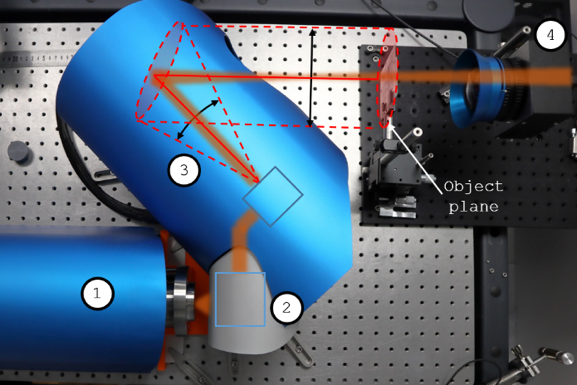
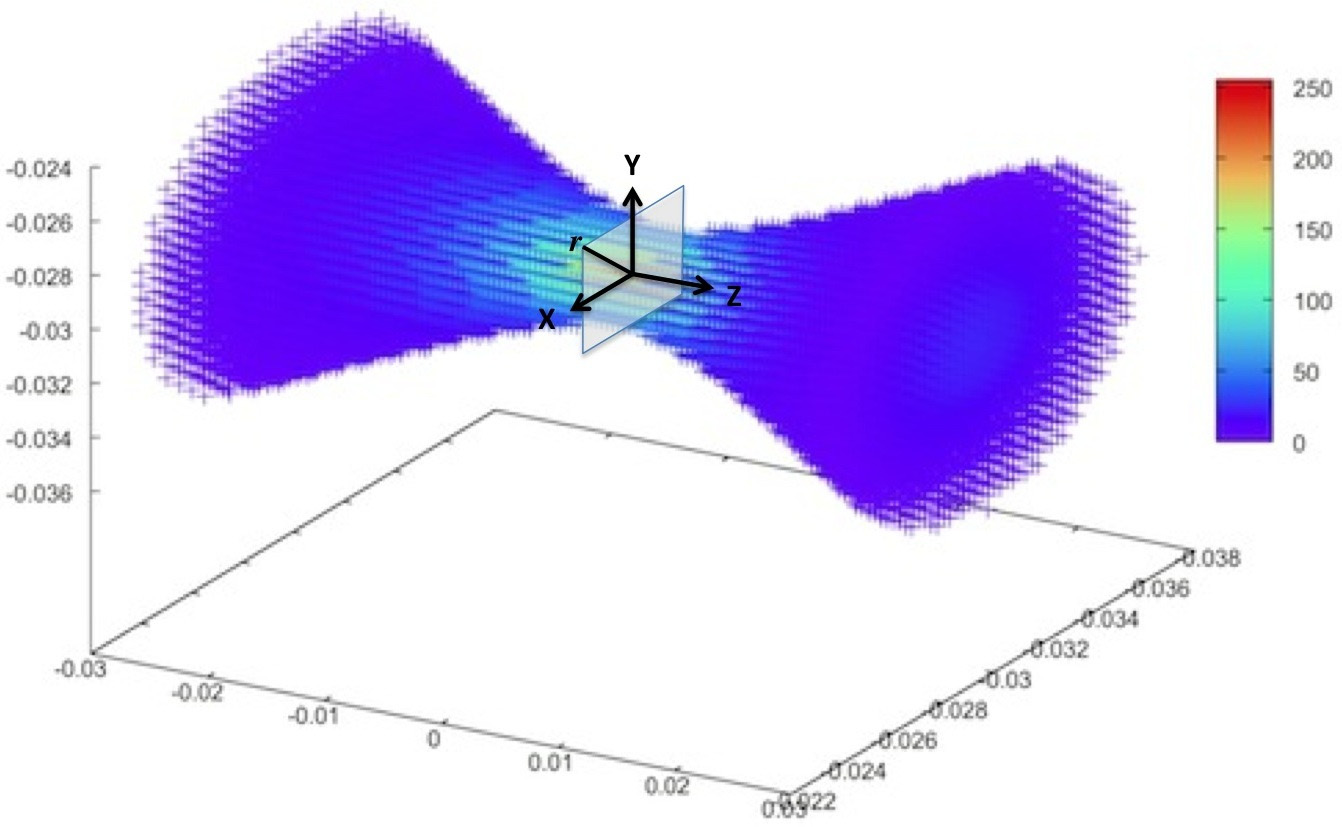
Featured visual: Contextual research figure from âSkeletonization and 3D rendering with real time terahertzTerahertz radiation is electromagnetic energy commonly associated with frequencies around 0.1 to 10 THz, between microwaves and infrared, where many materials reveal distinctive propagation, absorption, and imaging behavior. More tomographyâ. It illustrates a closely related terahertzTerahertz radiation is electromagnetic energy commonly associated with frequencies around 0.1 to 10 THz, between microwaves and infrared, where many materials reveal distinctive propagation, absorption, and imaging behavior. More topic and is not a figure from the publication discussed on this page. Source publication.
Visuals are drawn from the Airtable research archive. Figure numbering, rights and interpretation should be checked against the original publication before republication outside this site.
Using beam motion to average coherence artifacts
The experiments used quantum cascade lasers at 2.5 THz and 3.78 THz, with reported powers of 1.3 mW and 0.1 mW respectively. A roughly 10 mm collimated beam reached a two-axis galvanometer capable of angular motion up to plus or minus 20 degrees and drive frequencies up to 130 Hz. A 152.4 mm focal-length off-axis parabolic mirror converted angular deflection into motion across the sample plane. Driving the two axes sinusoidally at different frequencies produced Lissajous trajectories.
Two microbolometer focal-plane arrays recorded the transmitted field through silicon imaging optics. Their integration times were approximately 20 and 40 ms. When the galvanometer moved the coherent pattern sufficiently fast within that interval, bright and dark fringes swept over multiple locations and their recorded contribution averaged toward a smoother field. Synchronization mattered: a trajectory that samples the field poorly during one exposure can leave structured illumination even if its long-term path appears uniform.
The authors modeled illumination homogeneity through the coefficient of variation of the accumulated beam profile. For a static Gaussian spot with a 40-pixel full width at half maximum, scan amplitude, frequency ratio and relative phase changed both field coverage and average intensity. A steering amplitude near 2.4 degrees produced a modeled coefficient of variation below 0.25 for the selected conditions. Larger sweeps covered more area but diluted the available power, making the trade-off between uniformity, field size and signal explicit.
Measured maps followed the modeled behavior as angular amplitude increased from 0.2 to 4 degrees. Rapid steering removed the visible stationary interference pattern and allowed the system to use the whole QCL output rather than suppress coherence with a lossy diffuser. Because the trajectory is programmable, the beam can fill one broad field, dwell over smaller zones or form a narrow line matched to a moving sample.
One optical platform, four acquisition strategies
In full-field mode at 2.5 THz, the system illuminated a 30 by 30 mm area containing a holographic strip from a 20 euro banknote. Images were recorded at 6.25 Hz. After background normalization and conversion from transmission to absorbance, features were resolved at approximately 250 micrometers, consistent with the optical scale at a 120 micrometer wavelength. This example demonstrates rapid contrast imaging of the tested strip, not a complete authentication method.
An alumina microfluidic chip made by additive manufacturing provided a second target. A 500 micrometer channel was imaged in a single 160 ms exposure. The absorbance map followed the channel geometry, showing how homogeneous illumination can reveal structure in a material that transmits at the operating frequency. Refraction, thickness and composition still affect quantitative interpretation, so the result should be understood as a geometry demonstration on this printed part.
When full-field power density was insufficient, the authors divided a high-density polyethylene target into a 3 by 3 set of smaller illumination zones. Each 5 by 5 mm region received a denser share of the source power and was recorded at 25 frames per second before automatic assembly. Under those conditions, the local signal-to-noise ratio improved by roughly a factor of ten, while power density was four times that of the broad illumination. The gain comes with multiple exposures and depends on accurate registration between tiles.
For an inline-style configuration, one galvanometer axis swept a narrow region at 125 Hz while a polyethylene sample translated perpendicularly at 20 mm s-1. A 25 fps video captured the moving object in under four seconds. Fringes persisted near the scan edges, whereas the central band was more uniform. This laboratory translation test demonstrates compatibility with motion; deployment would still require synchronization, vibration tolerance, positioning control and defect-specific performance measurements.
The final mode used 3.78 THz illumination for tomography of a polypropylene pen cap. A 7 by 7 multi-exposure grid produced each projection in 25 seconds. Thirty-six views from 0 to 175 degrees formed a sinogram in less than 15 minutes, and an ordered-subset convex reconstruction recovered the internal shape and two retaining bumps. Refraction, reflection loss and background nonuniformity generated artifacts, defining limits for quantitative dimensional inspection.
The Bordeaux team shows that illumination control can compensate for limited source power and long coherence without adding a mechanical raster scanner at the detector. Collaboration with industrial partners could now focus on one defined material and defect class, measuring repeatability, probability of detection and the effect of line speed. Lower frequencies may improve penetration but reduce spatial resolution, while adaptive trajectories could allocate power according to the sample. Those are engineering trade-offs to validate, not performance already established by the diverse demonstrations.
The paper’s main result is a reusable illumination architecture. Rapid beam steering smooths coherent artifacts, directs power where it is needed and lets one full-field camera support several measurement modes. The experiments demonstrate that flexibility from video-rate two-dimensional images to a multi-angle reconstruction, while also showing that each mode carries its own balance of coverage, signal, acquisition time and artifact sensitivity.
Publication and citation
Recommended citation: Perraud, J.-B., Chopard, A., Guillet, J.-P., Gellie, P., Vuillot, A., & Mounaix, P. (2020). A versatile illumination system for real-time terahertzTerahertz radiation is electromagnetic energy commonly associated with frequencies around 0.1 to 10 THz, between microwaves and infrared, where many materials reveal distinctive propagation, absorption, and imaging behavior. More imaging. Sensors, 20(14), 3993. https://doi.org/10.3390/s20143993
Publisher: MDPI. Airtable record: recM9oblk1ArPWMBr.