
Research publication · Ultrafast infrared source engineering
Tunable ultrafast infrared generation in a gas-filled hollow-core capillary by a four-wave mixing process
Although this experiment generates near-infrared rather than terahertzTerahertz radiation is electromagnetic energy commonly associated with frequencies around 0.1 to 10 THz, between microwaves and infrared, where many materials reveal distinctive propagation, absorption, and imaging behavior. More radiation, tunable femtosecond pulses are relevant to optical-pump spectroscopy platforms and nonlinear source development. Such a source must balance bandwidth, pulse energy, phase matching and resistance to optical damage. This paper studies four-wave mixing in an argon-filled hollow-core capillary as an alternative to a solid nonlinear crystal. A broadband visible signal and a chirped 800 nm pump generate a near-infrared idler that can be tuned through approximately 1.2 to 1.5 micrometres. Numerical models clarify the roles of gas pressure, pulse chirp and relative delay, while the experiment produces an idler near 1.2 micrometres with a duration around 220 fs at the capillary output. Phase compensation is calculated to permit compression toward 45 fs.
In degenerate four-wave mixing, two pump photons are converted into a signal and an idler while conserving energy: twice the pump frequency equals the sum of the other two frequencies. Efficient conversion also requires phase matching, meaning that the propagation constants of the participating waves remain synchronized over the interaction length. A gas-filled guide offers two controls over this condition. The capillary geometry contributes waveguide dispersion, and gas pressure changes the material dispersion and nonlinear index. Adjusting pressure can therefore move the zero-dispersion wavelength and shift the signal-idler pair without replacing a crystal or changing its orientation.
The hollow core also keeps the strongest field away from solid material, providing a path to higher pulse energies than many small-core solid guides can accept. That advantage is not automatic. Coupling must preserve the desired mode, pulses at widely separated wavelengths travel at different group velocities, and chirp can make different frequency components overlap at different times. The study consequently treats the source as a spatiotemporal propagation problem rather than only a static phase-matching calculation.
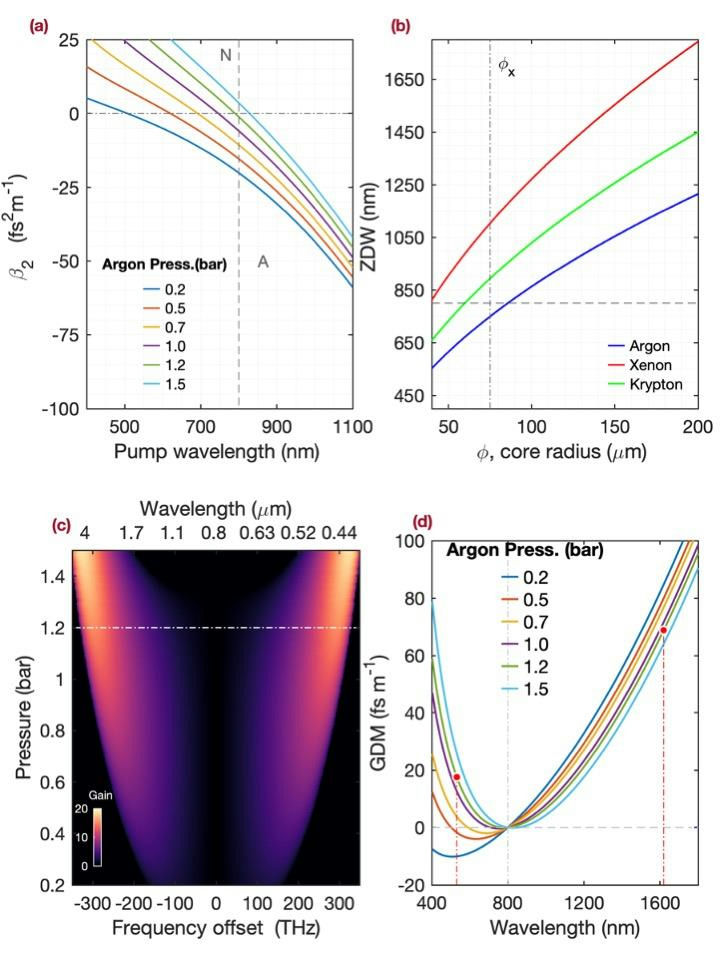
Featured visual: Image 1 from the Airtable record associated with this publication. Consult the original paper for the authoritative figure caption and interpretation. Source publication.
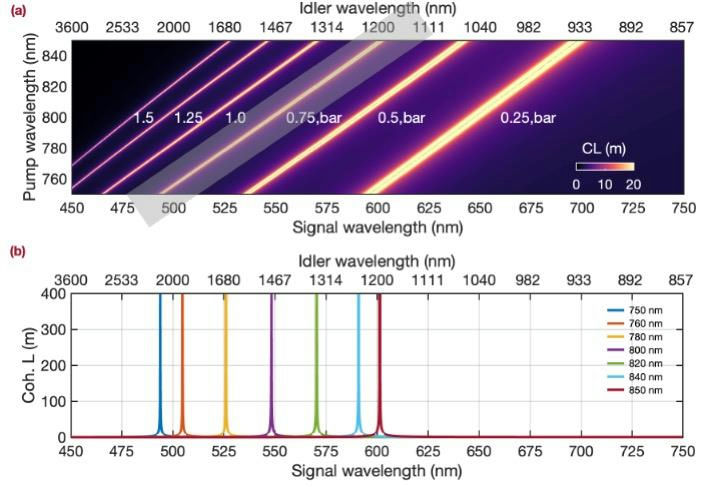
Visuals are drawn from the Airtable research archive. Figure numbering, rights and interpretation should be checked against the original publication before republication outside this site.
Modelling pressure, walk-off and chirped-pulse mixing
The authors used the Marcatili-Schmelzer capillary model to calculate propagation constants and dispersion as functions of wavelength, core size and argon pressure. Analytic gain calculations under an undepleted-pump approximation first identified favourable bands. For a pump around 800 nm with a peak power near 1.6 GW, changing pressure shifted the predicted gain between visible and infrared wavelengths. The calculations indicated gains reaching about 15 dB under selected conditions, but these are model values within the approximation; pump depletion, loss and imperfect coupling in an experiment can reduce the realized conversion.
Group-delay mismatch determines how long femtosecond pulses remain overlapped. For a 75 micrometre core at 1.2 bar, the reported mismatch between the 800 nm pump and a 530 nm signal was about 17.7 fs per metre, corresponding to a walk-off length of roughly 5.6 m for 100 fs pulses. The idler near 1.63 micrometres separated faster, at about 69 fs per metre, with a calculated walk-off length around 1.4 m. Both distances exceed the 60 cm experimental capillary, supporting useful interaction over its length while still making temporal alignment a sensitive control parameter.
A generalized nonlinear Schrodinger equation was then propagated numerically with a split-step Fourier method. The model included frequency-dependent dispersion and Kerr nonlinearity for a 120 fs, 200 microjoule pump. It reproduced the growth of Stokes and anti-Stokes sidebands and showed how higher-order dispersion makes their bandwidths asymmetric. Adding approximately 5,807 fs squared of second-order phase stretched the pump to about 200 fs and produced structured sidebands. In a chirped pulse, instantaneous frequencies arrive at different times, so distinct temporal slices drive idler components at different wavelengths. Relative delay can then select which portions overlap and thereby tune the generated spectrum.
Experimental idler generation and realistic scope
The experiment used a Ti:sapphire system delivering 800 nm pulses of about 100 fs and 1 mJ before the beam was divided into pump and signal arms. The visible signal was centred near 530 nm, and the pump was deliberately chirped. Both were coupled into the 60 cm argon-filled capillary at approximately 1.2 bar. At the output, the team observed the generated idler near 1.2 micrometres and measured a pulse duration of roughly 220 fs. The spectral behaviour followed the main trends predicted by the calculations, supporting the interpretation as pressure- and delay-controlled four-wave mixing.
The output pulse was not transform limited. Its spectral phase retained contributions from the chirped inputs and propagation, so the authors calculated that suitable phase compensation could shorten it to approximately 45 fs. That figure is a compression potential, not the directly measured output duration. Likewise, extension farther into the infrared is supported by the phase-matching model and tuning trends, but the reported experimental result lies in the near-infrared. Reaching 3 to 4 micrometres would require appropriate gas conditions, optical components, diagnostics and control of losses across that band.
The method’s tunability arises from several coupled variables rather than a single pressure dial. Gas species and pressure change dispersion and nonlinearity; core radius changes modal dispersion; pump chirp and relative delay determine temporal overlap; and input spectra define the energy-conserving idler range. Maintaining the fundamental capillary mode is also important because higher-order modes carry different propagation constants and would complicate phase matching. These dependencies are a strength for source design but require systematic optimization for stable operation.
The paper contributes an experimentally anchored model for designing such optimization. Analytic gain offers a rapid map of plausible conditions, while time-domain simulation explains pulse structure that a continuous-wave approximation cannot. The measured 1.2 micrometre idler then tests whether those predictions survive real coupling and propagation. Further work could quantify conversion efficiency and long-term stability, implement the proposed compressor and repeat tuning across the complete predicted range.
Although the work is not itself a terahertzTerahertz radiation is electromagnetic energy commonly associated with frequencies around 0.1 to 10 THz, between microwaves and infrared, where many materials reveal distinctive propagation, absorption, and imaging behavior. More imaging experiment, ultrafast infrared source development is closely connected to spectroscopy platforms that use optical pumping and coherent sampling. The collaboration combines capillary nonlinear optics, pulse propagation and instrumentation expertise. Its verified outcome is a tunable femtosecond near-infrared generation scheme in a gas-filled hollow guide, with measured 220 fs output and a model-based path to shorter pulses. That is a solid source-physics result without requiring claims of a finished mid-infrared product.
Bibliographic reference
Recommended citation: Zurita-Miranda, O., Fourcade-Dutin, C., Fauquet, F., Darracq, F., Guillet, J.-P., Mounaix, P., Maillotte, H., & Bigourd, D. (2022). Tunable ultrafast infrared generation in a gas-filled hollow-core capillary by a four-wave mixing process. Journal of the Optical Society of America B, 39(3), 662. https://doi.org/10.1364/JOSAB.444574
Publisher: Optica Publishing Group. Airtable record: recjy8nsTbsGXjtxL.