
Research publication · Computational terahertzTerahertz radiation is electromagnetic energy commonly associated with frequencies around 0.1 to 10 THz, between microwaves and infrared, where many materials reveal distinctive propagation, absorption, and imaging behavior. More phase imaging
Single-scan multiplane phase retrieval with a radiation of terahertzTerahertz radiation is electromagnetic energy commonly associated with frequencies around 0.1 to 10 THz, between microwaves and infrared, where many materials reveal distinctive propagation, absorption, and imaging behavior. More quantum cascade laser
Intensity cameras provide fast two-dimensional terahertzTerahertz radiation is electromagnetic energy commonly associated with frequencies around 0.1 to 10 THz, between microwaves and infrared, where many materials reveal distinctive propagation, absorption, and imaging behavior. More images, but they do not directly record the phase needed to recover optical path length or surface relief. Multiplane phase retrieval reconstructs that missing information from diffraction patterns measured at several axial positions. Its practical weakness is acquisition: stopping a detector, waiting, averaging frames and moving again can take minutes, and suitable plane positions may have to be chosen in advance. This paper replaces the stop-and-measure sequence with one continuous translation. A microbolometer camera records while moving through the diffracted field of a 2.5 THz quantum cascade laser, after which an iterative algorithm reconstructs a polypropylene phase object. The dense single scan reaches a reported acquisition rate of 1.92 million pixels per second.
Phase is valuable because a transparent object may produce little absorption contrast while still delaying the field. At a known frequency, that delay can be related to refractive index and thickness. Direct coherent detectors can measure the field, but they often require raster scanning or more elaborate interferometry. Lensless phase retrieval uses a simpler intensity sensor and allows diffraction itself to encode the missing information. Each propagation distance supplies a different intensity constraint; an algorithm searches for a complex field that is consistent with all of them.
The experiment used a Lytid TeraCascade 1000 quantum cascade laser emitting near 2.5 THz with approximately 1.3 mW output. An auto-alignment unit selected a chip and supplied a collimated beam with a near-planar wavefront. The sample was a 1.59 mm polypropylene plate whose refractive index was reported as 1.5151 at 2.5197 THz. Two patterned regions, an identification code and a grooved extrusion mark, provided phase structures with different spatial forms. They are controlled targets rather than representative industrial defects, making them suitable for comparing acquisition modes without claiming application-specific detection performance.
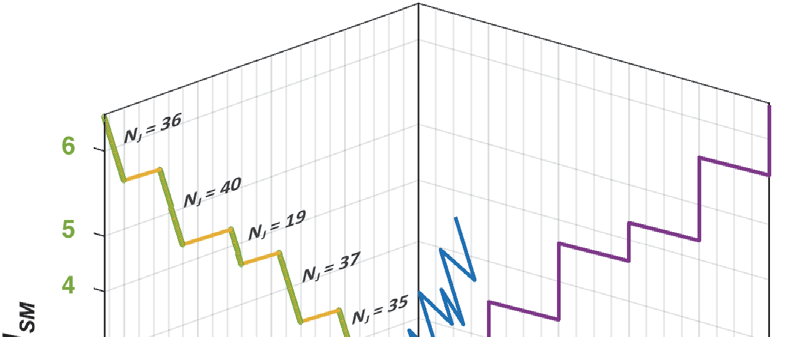
Featured visual: Contextual research figure from âAn algorithm of unordered wavefront propagation in terahertzTerahertz radiation is electromagnetic energy commonly associated with frequencies around 0.1 to 10 THz, between microwaves and infrared, where many materials reveal distinctive propagation, absorption, and imaging behavior. More phase retrieval with dense multiplane data acquisitionâ. It illustrates a closely related terahertzTerahertz radiation is electromagnetic energy commonly associated with frequencies around 0.1 to 10 THz, between microwaves and infrared, where many materials reveal distinctive propagation, absorption, and imaging behavior. More topic and is not a figure from the publication discussed on this page. Source publication.
Visuals are drawn from the Airtable research archive. Figure numbering, rights and interpretation should be checked against the original publication before republication outside this site.
Recording diffraction planes while the camera moves
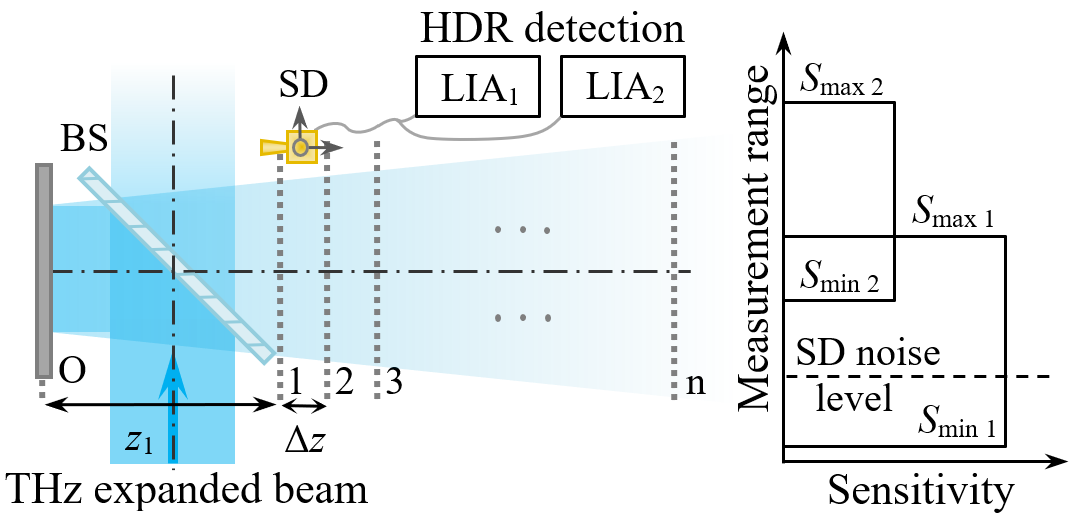
An antenna-coupled microbolometer array with 240 by 320 pixels, a 50 micrometre pitch and a 25 frame-per-second rate recorded the intensity. In conventional stop-motion acquisition, the camera advanced in 2 mm axial steps and averaged about 35 frames at each stationary plane. Mechanical movement alone took approximately 2.184 seconds per step, so a sequence required several minutes. In the on-the-go mode, the detector translated continuously at 10 mm per second while frames were collected. Consecutive images were then separated by about 400 micrometres along the optical axis, producing many closely spaced constraints in a single pass.
The on-the-go rate was calculated as 1.92 million pixels per second, compared with approximately 34,500 pixels per second for the stop-motion procedure. Speed is only useful if motion does not erase the diffraction information. During one 40 ms camera interval, the detector travels about 0.4 mm, so each frame represents a limited axial average. For the tested field and reconstruction, that averaging remained compatible with useful phase recovery. The continuous scan also sampled enough planes that the experiment did not require a preliminary search for a small set of optimal positions.
Processing used a sorted iterative multiple-plane intensity reconstruction algorithm. A trial complex field was propagated from one measured plane to the next with a Fourier-domain free-space transfer function. At each position, the calculated amplitude was replaced by the square root of the recorded intensity while the current phase estimate was retained. Repeating this cycle across sorted planes progressively enforced all measured constraints. The precise distance from the object to the first camera position was not known because of mechanical obstruction, so reconstruction began at an estimated plane and the result was numerically refocused afterward.
Comparable phase recovery with a much shorter acquisition
Both the discrete and continuously acquired data yielded recognizable amplitude and phase maps of the identification code and grooved region. The on-the-go reconstruction preserved the main spatial detail and phase organization seen in the stop-motion result, showing that dense axial sampling could compensate for the lack of per-plane averaging in this experiment. The important outcome is not simply a visually cleaner image. It is the recovery of a complex wavefront from an intensity-only camera while reducing the acquisition overhead associated with repeated mechanical settling.
The method still relies on several controlled conditions. The QCL is narrowband, stable and sufficiently powerful for the sensitive camera. The target is a planar transmissive polymer with known properties, and the detector follows a calibrated straight axial path. Camera noise, source drift, non-uniform pixel response and uncertainty in plane spacing can all affect convergence. Phase retrieval may also produce ambiguous or unstable solutions if the measured planes do not contain enough diversity. Continuous motion removes stops, but it does not remove the need for geometric calibration or algorithmic validation.
The reported pixel rate should therefore be distinguished from a complete inspection throughput. It describes detector data acquisition, not the time required to position a large object, reconstruct the complex field or assess a production part. More complicated samples may scatter strongly, introduce multiple depths or violate the scalar propagation model. Reflection-mode use would require a different geometry, and broadband sources would add frequency-dependent propagation that is absent from this monochromatic experiment.
Further development could combine the continuous trajectory with faster reconstruction, calibrated motion encoders and automatic focusing. The dense stack may also allow algorithms to select informative planes after acquisition rather than before it, reducing computation without sacrificing robustness. Tests on objects with independently measured height profiles would quantify phase-to-thickness accuracy, while repeated scans could separate random noise from motion-dependent bias.
The collaboration joins quantum-cascade-laser instrumentation, microbolometer detection and computational optics. Its verified contribution is a single axial scan that supplies a large multiplane intensity data set and reconstructs the tested polypropylene patterns at quality comparable to a slower stepped sequence. That result advances the acquisition side of quantitative terahertzTerahertz radiation is electromagnetic energy commonly associated with frequencies around 0.1 to 10 THz, between microwaves and infrared, where many materials reveal distinctive propagation, absorption, and imaging behavior. More imaging without claiming real-time operation for arbitrary objects. It shows that detector motion can become part of the measurement design rather than dead time between measurements.
Bibliographic reference
Recommended citation: Chopard, A., Tsiplakova, E., Balbekin, N., Smolyanskaya, O., Perraud, J.-B., Guillet, J.-P., Petrov, N. V., & Mounaix, P. (2022). Single-scan multiplane phase retrieval with a radiation of terahertzTerahertz radiation is electromagnetic energy commonly associated with frequencies around 0.1 to 10 THz, between microwaves and infrared, where many materials reveal distinctive propagation, absorption, and imaging behavior. More quantum cascade laser. Applied Physics B, 128(3). https://doi.org/10.1007/s00340-022-07787-x
Publisher: Springer Science and Business Media LLC. Airtable record: reclnEjZ53Jt4x1OU.