
Research publication · Computational terahertzTerahertz radiation is electromagnetic energy commonly associated with frequencies around 0.1 to 10 THz, between microwaves and infrared, where many materials reveal distinctive propagation, absorption, and imaging behavior. More imaging
TerahertzTerahertz radiation is electromagnetic energy commonly associated with frequencies around 0.1 to 10 THz, between microwaves and infrared, where many materials reveal distinctive propagation, absorption, and imaging behavior. More diffractive imaging with saturated data inpainting
Diffractive imaging seeks more than an intensity map. By recovering the complex wavefield, including its phase, it can reveal surface relief and support quantitative reconstruction even when a detector does not measure phase directly. In terahertzTerahertz radiation is electromagnetic energy commonly associated with frequencies around 0.1 to 10 THz, between microwaves and infrared, where many materials reveal distinctive propagation, absorption, and imaging behavior. More instruments, that inverse problem is often compounded by limited detector dynamic range. Strong specular reflections can saturate central pixels while weaker diffracted features remain close to the noise floor. Recording several gain settings and merging them into a high-dynamic-range dataset can recover the missing information, but it increases acquisition time and assumes that the object remains unchanged between measurements.
This paper introduces an inpainting extension to Single-Beam Multiple-Intensity Reconstruction, called SBMIR-I. It uses intensity patterns acquired at several axial planes, identifies saturated pixels with binary masks and estimates the missing amplitudes as the complex field is propagated through the measurement sequence. The experimental question is deliberately strict: can one saturated acquisition set recover an object wavefield comparable to a separately recorded HDR reference? Tests at 0.287 THz show that the method reconstructs both amplitude and phase where the conventional algorithm fails to converge on the same incomplete data.
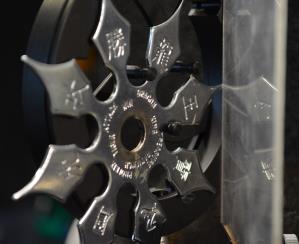
Featured visual: Image 1 from the Airtable record associated with this publication. Consult the original paper for the authoritative figure caption and interpretation. Source publication.
Visuals are drawn from the Airtable research archive. Figure numbering, rights and interpretation should be checked against the original publication before republication outside this site.
Embedding inpainting inside phase retrieval
SBMIR starts from the square root of a measured intensity distribution and an initial phase estimate. The angular-spectrum method propagates that complex field to the next detector plane. At each plane, the usual algorithm replaces the calculated amplitude with the measured one while retaining the current phase. Repeating forward and backward passes gradually enforces consistency across all planes. Saturation breaks this procedure because the clipped amplitude is not a valid constraint: forcing it into the estimate repeatedly can drive the reconstruction away from the actual wavefield.
SBMIR-I separates reliable and saturated pixels. Where the detector has not clipped, the measured amplitude remains the constraint. Inside the masked region, the algorithm keeps the amplitude predicted by propagation from the other planes. The field is then propagated onward, so information distributed across the dataset contributes to filling the missing area. A complete forward and reverse traversal forms an iteration, after which the estimate can be propagated back to the object plane. The approach uses physical consistency between diffraction patterns rather than interpolating a saturated patch solely from its immediate two-dimensional neighbours.
The saturation ratio introduced in the paper expresses how much diffraction-pattern energy falls inside the masked region. In the experiment, the ratio varies from approximately 0.38 to 0.55 across the measurement planes, indicating that the missing central area contains a substantial fraction of the signal. Supplementary numerical work explores more severe cases and reports that reconstruction remains possible at a ratio of 0.95, though with more iterations. That simulated result indicates tolerance under the tested model; it should not be interpreted as a universal guarantee for arbitrary noise, mask geometry or experimental mismatch.
A saturated 27-plane reflection experiment
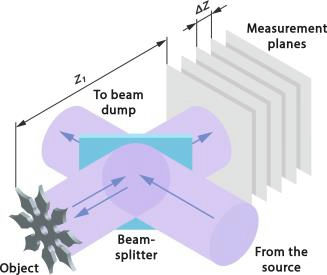
The validation uses a reflective metallic object shaped like a shuriken. A Gunn diode and multiplication chain provide 14 mW at 0.287 THz, and a Schottky-diode receiver scans the reflected field. Twenty-seven intensity planes are recorded, beginning 83 mm from the object and separated by 5 mm. Each plane contains a 240 by 240 grid with a 0.5 mm pitch. This is a substantial acquisition, so the contribution concerns dynamic range and reconstruction fidelity rather than eliminating mechanical raster scanning.
Two lock-in amplifier settings, 20 mV and 500 mV, are used in separate recordings to construct the HDR reference. The input tested by SBMIR-I is only the 20 mV dataset, whose central regions are saturated. Masks are derived from those clipped images, and the algorithm estimates the unavailable values while retrieving the field. After roughly 250 iterations, the reported normalized root-mean-square error reaches an infimum of 0.3 relative to the HDR reconstruction. Amplitude sections and value distributions agree closely with the reference, while ordinary SBMIR applied to the saturated dataset develops distorted profiles and does not converge.
The comparison supports the central claim: when multiple propagation planes contain complementary information, clipped pixels need not make phase retrieval unusable. It does not mean that the inpainted values have been measured, nor that the result is independent of the reference model. The error metric is evaluated against the HDR reconstruction, itself produced from experimental data and algorithmic processing. Performance will depend on accurate plane positions, coherent propagation, mask construction, noise and whether unsaturated regions contain enough diversity to constrain the missing field.
Acquisition benefits and remaining engineering work
Removing the second gain sequence can simplify experiments on objects that move, change or cannot be held in exactly the same state. It can also reduce calibration overhead in a system whose detector clips before weak diffracted features become visible. Because the method relies on wave propagation rather than a terahertz-specific material model, the general principle may be relevant to other coherent spectral ranges. In terahertzTerahertz radiation is electromagnetic energy commonly associated with frequencies around 0.1 to 10 THz, between microwaves and infrared, where many materials reveal distinctive propagation, absorption, and imaging behavior. More non-destructive testingInspection of dielectric, layered, polymer, composite, and manufactured structures without destructive sampling. Non-Destructive Testing: measurement approach and use cases Work begins with the material and the decision that the measurement... More, accurate phase retrieval could support surface-height estimation, material-parameter mapping or later tomographic processing when the sample and measurement geometry are appropriate.
The present demonstration remains controlled and computationally intensive. It uses one metallic target, 27 raster-scanned planes and 250 iterations, and it compares against an HDR acquisition that would not be available during routine use. Dynamic-scene claims therefore require faster detectors or arrays, reduced plane counts, timing benchmarks and tests on non-ideal objects. Automated saturation masks must also remain dependable when clipping is mixed with low signal or detector nonlinearity. Collaboration between computational imaging researchers and instrument designers could address those constraints by optimizing plane placement, stopping criteria and hardware dynamic range together, rather than treating acquisition and reconstruction as independent problems.
Bibliographic reference
Recommended citation: Tsiplakova, E. G., Perraud, J.-B., Guillet, J.-P., Mounaix, P., & Petrov, N. V. (2023). TerahertzTerahertz radiation is electromagnetic energy commonly associated with frequencies around 0.1 to 10 THz, between microwaves and infrared, where many materials reveal distinctive propagation, absorption, and imaging behavior. More diffractive imaging with saturated data inpainting. Optics Letters, 48(21), 5463. https://doi.org/10.1364/OL.499478
Publisher: Optica Publishing Group. Airtable record: rec8yj0fgXmU28Ako.