
Review publication · Three-dimensional terahertzTerahertz radiation is electromagnetic energy commonly associated with frequencies around 0.1 to 10 THz, between microwaves and infrared, where many materials reveal distinctive propagation, absorption, and imaging behavior. More imaging
Review of TerahertzTerahertz radiation is electromagnetic energy commonly associated with frequencies around 0.1 to 10 THz, between microwaves and infrared, where many materials reveal distinctive propagation, absorption, and imaging behavior. More Tomography Techniques
TerahertzTerahertz radiation is electromagnetic energy commonly associated with frequencies around 0.1 to 10 THz, between microwaves and infrared, where many materials reveal distinctive propagation, absorption, and imaging behavior. More imaging can do more than produce a two-dimensional transmission map. Because a coherent THz measurement can preserve amplitude, phase and arrival time, it can also encode depth, refractive index and the position of buried interfaces. Recovering that information requires a tomographic strategy suited to long wavelengths, finite beams and often strong material absorption. This review organizes the principal three-dimensional approaches, explains their assumptions and compares the kinds of object each can address. It is a survey of research methods and applications, not a claim that one universal THz scanner can image every target.
Featured visual: Image 1 from the Airtable record associated with this publication. Consult the original paper for the authoritative figure caption and interpretation. Source publication.
Visuals are drawn from the Airtable research archive. Figure numbering, rights and interpretation should be checked against the original publication before republication outside this site.
From time-domain waveforms to volumetric information
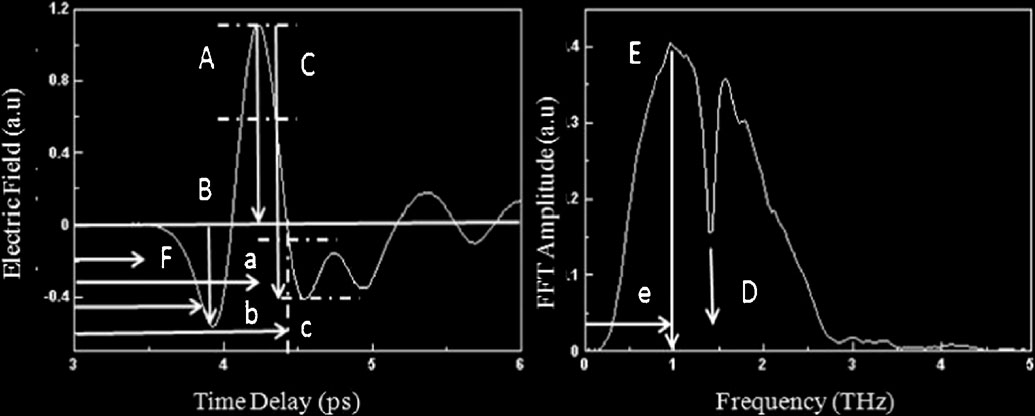
Broadband time-domain spectroscopy generates a short THz pulse and samples its electric field as a function of delay. Fourier transformation gives amplitude and phase over a useful frequency band, while the original waveform separates reflections that arrive at different times. This combination can provide structural and spectroscopic contrast in plastics, ceramicsCeramics applications with terahertz Terahertz and millimeter-wave technologies offer promising non-destructive tools for the characterization and inspection of ceramic materials. Their sensitivity to dielectric properties, internal interfaces, porosity, and structural... More, paper, composites and other dielectric materials. Average power is often only in the microwatt range, however, and most coherent systems acquire images by mechanical raster scanning. Dynamic range and acquisition time are therefore fundamental constraints.
Continuous-wave systems can supply greater power at selected frequencies, but they do not automatically provide the broad spectral and temporal information of THz-TDS. The review treats source, detector and reconstruction as a coupled choice. A method that works for a thin, weakly absorbing sample in transmission may fail on a layered object that is accessible from only one side. Likewise, a technique that extracts interface depth from echo timing may struggle when reflections overlap or the material is strongly dispersive.
The principal tomography families
TerahertzTerahertz radiation is electromagnetic energy commonly associated with frequencies around 0.1 to 10 THz, between microwaves and infrared, where many materials reveal distinctive propagation, absorption, and imaging behavior. More computed tomography follows the familiar rotate-and-project geometry. Transmission measurements are acquired from multiple angles and reconstructed by filtered back-projection or iterative methods such as SART and OSEM. It can yield quantitative attenuation maps when enough signal passes through the sample. Its main limitation is exponential loss through thick or absorbing materials. In addition, a THz beam has a finite Gaussian profile, so realistic reconstruction may need to include beam propagation rather than assume infinitesimal rays.
Tomosynthesis uses a restricted angular range and fewer projections. Shift-and-add or related processing produces a stack of focal planes with lower acquisition burden than full CT. The trade-off is incomplete angular information, which weakens depth resolution and can create characteristic artifacts. Diffraction tomography instead interprets the coherently scattered field to reconstruct refractive-index variation. It can access fine structure in weakly scattering objects, but linearized scattering assumptions and low scattered-field signal limit difficult samples.
Time-of-flight methods derive depth from the delay between reflected pulses. They are naturally suited to layered objects whose interfaces generate resolvable echoes. Multiple reflections, dispersion and complex surface geometry can create false or merged interfaces. Holographic approaches use measured phase and amplitude to numerically refocus a volume, while synthetic-aperture processing combines data from many positions to synthesize a larger aperture and extend the usable depth of field. Both demand accurate phase calibration. Time-reversal methods numerically propagate measured fields backward through a known medium; their quality depends strongly on the propagation model.
The review also discusses frequency-dependent focusing with diffractive optics and related depth-encoding schemes. These methods can reduce mechanical movement, but they exchange generality for assumptions about lens dispersion, bandwidth and object thickness. Across all families, the reconstruction is only as reliable as the physical model and calibration supporting it.
Applications, limits and research priorities
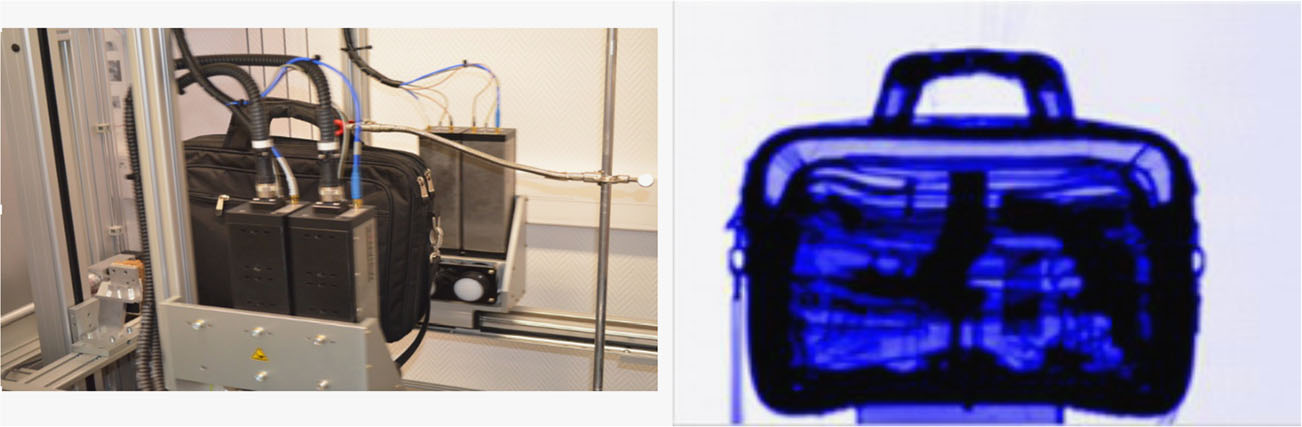
Examples span industrial inspection, security, pharmaceuticals, food products and cultural heritage. THz measurements can map coating thickness, moisture, polymer welds, inclusions or hidden layers when the materials transmit enough radiation and the relevant feature produces measurable contrast. Spectral information can sometimes help distinguish substances, while depth methods can separate interfaces. In heritage science, the non-contact nature of the measurement is attractive for fragile objects. In pharmaceuticals, THz methods have been studied for tablet coatings and solid-state characterization.
BiomedicalTerahertz and millimeter-wave technologies offer promising non-ionizing tools for biomedical tissue analysis, particularly for breast cancer research. Their sensitivity to water content, tissue structure, and dielectric contrast can help distinguish... More examples in the literature remain research investigations. The review does not establish clinical diagnosis, therapeutic benefit or patient-ready imaging, and penetration in water-rich tissue is intrinsically limited. Similarly, security and industrial examples do not by themselves demonstrate regulatory approval, field throughput or a validated probability of detection.
The recurring barriers are modest source power, limited penetration, slow scanning, lack of large coherent arrays, phase stability and reconstruction assumptions that fail in strongly scattering or heterogeneous media. Better emitters and detectors can improve signal, but computation is equally important. Iterative algorithms can include Gaussian beam profiles, refraction or prior knowledge, provided those additions are measured and validated rather than used to force an expected image.
The review emerged from collaboration between LOMA and LaBRI at the University of Bordeaux, combining terahertzTerahertz radiation is electromagnetic energy commonly associated with frequencies around 0.1 to 10 THz, between microwaves and infrared, where many materials reveal distinctive propagation, absorption, and imaging behavior. More optics with image processing and three-dimensional reconstruction. Its enduring contribution is a map of the design space. Instead of asking whether “THz tomography” works in the abstract, it encourages a more precise question: which acquisition geometry, contrast mechanism and inverse model fit the material, depth and resolution required?
Bibliographic reference
Recommended citation: Guillet, J.-P., Recur, B., Frederique, L., Bousquet, B., Canioni, L., Manek-Hönninger, I., Desbarats, P., & Mounaix, P. (2014). Review of TerahertzTerahertz radiation is electromagnetic energy commonly associated with frequencies around 0.1 to 10 THz, between microwaves and infrared, where many materials reveal distinctive propagation, absorption, and imaging behavior. More Tomography Techniques. Journal of Infrared, Millimeter, and TerahertzTerahertz radiation is electromagnetic energy commonly associated with frequencies around 0.1 to 10 THz, between microwaves and infrared, where many materials reveal distinctive propagation, absorption, and imaging behavior. More Waves, 35(4), 382-411. https://doi.org/10.1007/s10762-014-0057-0
Publisher: Springer. Airtable record: recaPNt4dxSgc7lVW.