
Three-dimensional terahertzTerahertz radiation is electromagnetic energy commonly associated with frequencies around 0.1 to 10 THz, between microwaves and infrared, where many materials reveal distinctive propagation, absorption, and imaging behavior. More tomography can reveal the internal organization of polymers and other low-density dielectric objects without cutting them open. Its reconstruction problem is nevertheless more difficult than a direct transfer of X-ray computed tomography would suggest. A terahertzTerahertz radiation is electromagnetic energy commonly associated with frequencies around 0.1 to 10 THz, between microwaves and infrared, where many materials reveal distinctive propagation, absorption, and imaging behavior. More beam diffracts, its intensity varies across the illuminated area, and strongly attenuating regions can drive a detector close to its background level. This 2014 study addresses those constraints through a maximum-likelihood reconstruction method adapted to the physics of a continuous-wave terahertzTerahertz radiation is electromagnetic energy commonly associated with frequencies around 0.1 to 10 THz, between microwaves and infrared, where many materials reveal distinctive propagation, absorption, and imaging behavior. More scanner.
Featured visual: Image 1 from the Airtable record associated with this publication. Consult the original paper for the authoritative figure caption and interpretation. Source publication.
Visuals are drawn from the Airtable research archive. Figure numbering, rights and interpretation should be checked against the original publication before republication outside this site.
Reconstructing a volume with the beam that was actually used
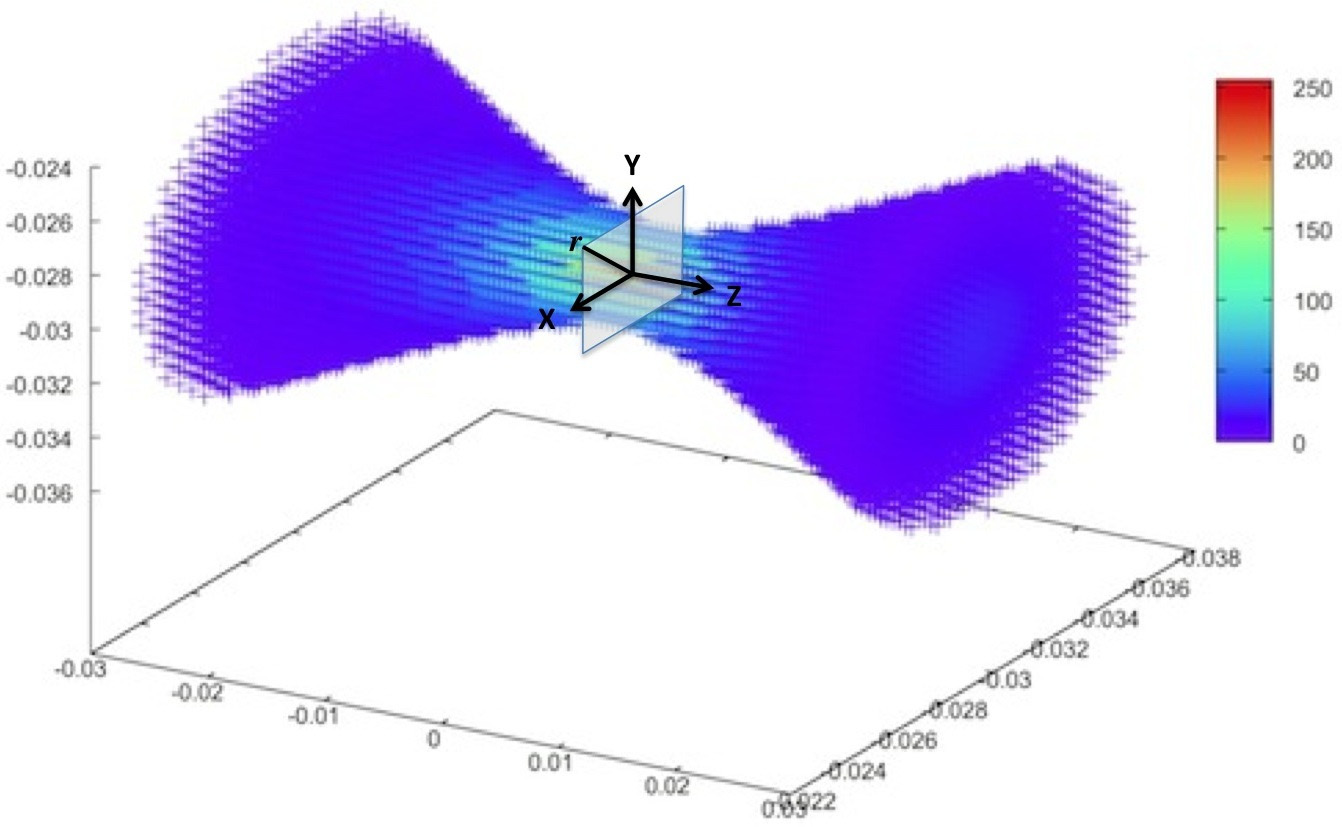
Conventional filtered back-projection treats the measured rays as if they were narrow, uniform and governed by a linear projection model. That approximation is useful, but it becomes fragile in terahertzTerahertz radiation is electromagnetic energy commonly associated with frequencies around 0.1 to 10 THz, between microwaves and infrared, where many materials reveal distinctive propagation, absorption, and imaging behavior. More imaging because a focused beam has a finite waist and expands away from its focal plane. A large object may extend beyond the Rayleigh range, so different parts of the same specimen are interrogated with different beam diameters and intensities. Limited projection counts, detector noise and high attenuation then add streaks, blur and inconsistent voxel values to the reconstructed volume.
The authors reformulated the problem using Maximum Likelihood for Transmission Reconstruction, implemented with an Ordered Subsets Convex algorithm. Instead of reconstructing directly from logarithmic projections, the method estimates the attenuation volume that is most consistent with the measured transmitted signal. Blank measurements acquired without the object define the incident intensity, while dark-field measurements characterize the detector background. Both are included in the forward model rather than treated as incidental corrections. The measured signal is represented statistically and related to the line integral of attenuation through a Beer-Lambert transmission law.
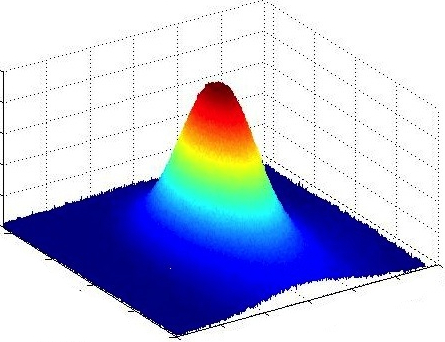
The important terahertz-specific addition is a Gaussian propagation model. The intensity assigned to a voxel depends on its transverse distance from the beam axis and its longitudinal position relative to the waist. In practical terms, the algorithm does not assume that a voxel near the edge of a diverging beam receives the same illumination as one at the focus. Incorporating that geometry into each iterative update allows the reconstruction to compensate for part of the diffraction-induced blur that a pencil-ray model leaves unexplained.
Experimental test and comparative results
The demonstration used a continuous-wave source built from a Gunn diode and frequency tripler operating at 287 GHz with a reported output power of 12 mW. Two PTFE lenses collimated and focused the radiation. The measured beam width at the sample was about 2.3 mm full width at half maximum, and the Rayleigh range was approximately 55 mm. A Schottky diode detected the transmitted radiation; a mechanical chopper and lock-in amplifier provided modulated detection. Translation in two axes and rotation of the specimen were controlled by a motorized stage.
The test object was a spray head approximately 90 mm in size, deliberately large enough for parts of it to lie outside the most favorable focal region. The team acquired 36 projections at 5-degree angular intervals. Each projection contained 156 by 100 samples, and the complete acquisition lasted roughly 62 minutes. Separate blank and dark-field series supplied the calibration values used by the statistical model. These details matter because the paper evaluates a reconstruction process under a finite acquisition budget rather than on an idealized, densely sampled data set.
Reconstructions produced by filtered back-projection, a terahertz-adapted simultaneous algebraic reconstruction technique, and the proposed method were compared on cross-sections and three-dimensional renderings. Filtered back-projection showed pronounced streaking from the limited number of views. The algebraic result reduced some of that structure but retained edge artifacts and spatially inconsistent intensity. The maximum-likelihood reconstruction converged in roughly seven to nine iterations when run with two subsets and produced cleaner sections with more coherent inner and outer boundaries. Its three-dimensional surface could be segmented and inspected without the same degree of preliminary filtering required by the comparison methods.
The result should not be read as a universal guarantee of artifact-free tomography. The authors noted residual holes in some reconstructed regions, and the physical model did not include every possible reflection, refraction or scattering effect. It did, however, show that explicitly representing measured background, illumination statistics and Gaussian propagation can recover information that is otherwise folded into reconstruction artifacts.
Why this matters for terahertz inspection
TerahertzTerahertz radiation is electromagnetic energy commonly associated with frequencies around 0.1 to 10 THz, between microwaves and infrared, where many materials reveal distinctive propagation, absorption, and imaging behavior. More tomography is particularly relevant when the object is made from materials that transmit sub-terahertz radiation but offer limited contrast to other non-destructive techniques. Polymer parts, paper assemblies, soft composites and some cultural-heritage objects fall into this category. For such samples, a reconstruction method is not merely a visualization step: it determines whether an apparent cavity, wall or inclusion is supported by the measurements or created by sparse views and beam propagation.
This work also illustrates the value of collaboration across instrumentation, inverse problems and applied imaging. The contribution is not attributed to a single hardware improvement. It combines scanner calibration, a statistical transmission model, computational optimization and three-dimensional interpretation. The publication record supports that technical collaboration, while the available metadata does not justify stronger claims about deployment or commercial maturity.
The proposed route is extensible. Measurements at several frequencies or intensities could provide additional constraints, while more complete forward models could account for interfaces and material-dependent propagation. Faster acquisition and reconstruction would be needed for high-throughput inspection. Even within those limits, the study establishes a useful principle: terahertzTerahertz radiation is electromagnetic energy commonly associated with frequencies around 0.1 to 10 THz, between microwaves and infrared, where many materials reveal distinctive propagation, absorption, and imaging behavior. More computed tomography improves when reconstruction is designed around the actual beam and detector rather than around an ideal X-ray analogy.
Publication details and citation
Recommended citation: Recur, B., Balacey, H., Bou Sleiman, J., Perraud, J. B., Guillet, J.-P., Kingston, A., & Mounaix, P. (2014). Ordered subsets convex algorithm for 3D terahertzTerahertz radiation is electromagnetic energy commonly associated with frequencies around 0.1 to 10 THz, between microwaves and infrared, where many materials reveal distinctive propagation, absorption, and imaging behavior. More transmission tomography. Optics Express, 22(19), 23299. https://doi.org/10.1364/OE.22.023299
Record ID: recGQt7SZKwxg8IMt
Research themes: terahertzTerahertz radiation is electromagnetic energy commonly associated with frequencies around 0.1 to 10 THz, between microwaves and infrared, where many materials reveal distinctive propagation, absorption, and imaging behavior. More transmission tomography, maximum-likelihood reconstruction, Gaussian beam propagation, computational imaging, non-destructive testingInspection of dielectric, layered, polymer, composite, and manufactured structures without destructive sampling. Non-Destructive Testing: measurement approach and use cases Work begins with the material and the decision that the measurement... More.