
Research publication · Multilayer terahertzTerahertz radiation is electromagnetic energy commonly associated with frequencies around 0.1 to 10 THz, between microwaves and infrared, where many materials reveal distinctive propagation, absorption, and imaging behavior. More signal modeling
Iterative Tree Algorithm to Evaluate TerahertzTerahertz radiation is electromagnetic energy commonly associated with frequencies around 0.1 to 10 THz, between microwaves and infrared, where many materials reveal distinctive propagation, absorption, and imaging behavior. More Signal Contribution of Specific Optical Paths Within Multilayered Materials
A terahertzTerahertz radiation is electromagnetic energy commonly associated with frequencies around 0.1 to 10 THz, between microwaves and infrared, where many materials reveal distinctive propagation, absorption, and imaging behavior. More pulse reflected by a multilayer coating is not one echo. At every interface, part of the field returns toward the detector and part continues into the stack, where it can be reflected and transmitted again. The measured waveform is the coherent sum of a rapidly growing number of such paths. Conventional inverse models can estimate layer thicknesses and dielectric properties by fitting that waveform, but they do not necessarily show which routes carry the useful information. This paper introduces an iterative tree algorithm that labels and calculates the individual reflection-transmission paths, then identifies the small subset that dominates the signal from a four-layer aerospace coating.
The distinction is valuable for both interpretation and computation. A peak in the time trace may contain overlapping contributions rather than correspond uniquely to one interface. Conversely, millions of mathematically possible paths can have amplitudes below the experimental noise. By ranking paths against the measured bandwidth and system sensitivity, the algorithm offers a physically explicit way to simplify a forward model. The study demonstrates this on flat laboratory samples; it does not yet establish real-time defect detection on complex aircraft components.
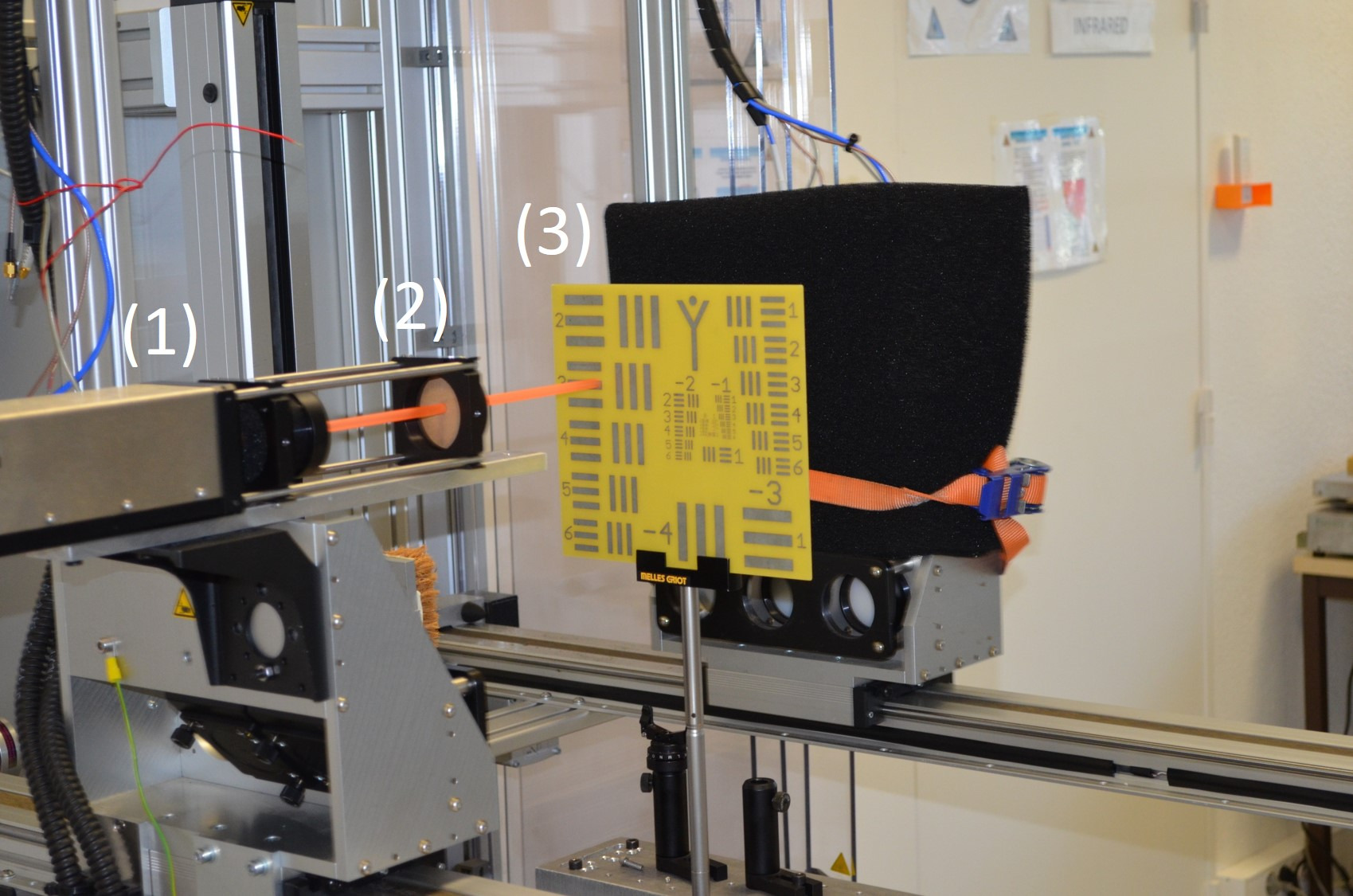
Featured visual: Contextual research figure from âGuided Reflectometry Imaging Unit Using Millimeter Wave FMCW Radarsâ. It illustrates a closely related terahertzTerahertz radiation is electromagnetic energy commonly associated with frequencies around 0.1 to 10 THz, between microwaves and infrared, where many materials reveal distinctive propagation, absorption, and imaging behavior. More topic and is not a figure from the publication discussed on this page. Source publication.
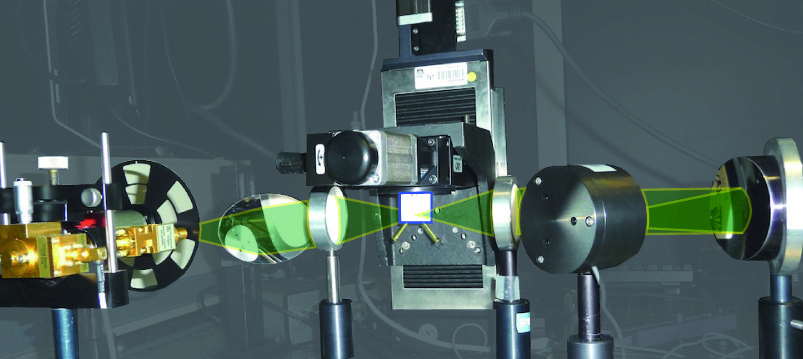
Visuals are drawn from the Airtable research archive. Figure numbering, rights and interpretation should be checked against the original publication before republication outside this site.
Building a propagation tree for a coating stack
The model assumes normal incidence on planar, parallel, dispersive layers. Fresnel reflection and transmission coefficients describe each interface, while a propagation term accounts for phase delay and attenuation through each material. The root of the tree is the air-to-first-layer interaction. Each subsequent level represents another event in which a pulse reaches an interface and divides. Recursive relations update the fields carried by the new reflected and transmitted branches.
Tree depth is controlled by an iteration index. As paths become longer and encounter more partial reflections, their amplitudes generally fall. Iteration can stop when newly generated contributions lie below the experimental noise floor. Only paths that ultimately leave the stack toward the detector are included in the reconstructed reflection waveform. In the geometry analyzed by the authors, these exits occur at odd iteration depths, and the number of available paths grows according to a modified Fibonacci sequence.
Before modeling the complete stack, the team characterized its component coatings: primer, sublayer, top layer and varnish. Each material was deposited on a metallic reflector and measured in reflection with a TPS3000 terahertzTerahertz radiation is electromagnetic energy commonly associated with frequencies around 0.1 to 10 THz, between microwaves and infrared, where many materials reveal distinctive propagation, absorption, and imaging behavior. More time-domain system. An inverse electromagnetic procedure fitted a first-order Debye dielectric model over 0.2-2 THz and estimated layer thickness. The extracted thicknesses were within a few micrometers of optical-microscopy measurements. These fitted dielectric parameters then became inputs to the tree calculation, so their accuracy directly affected every simulated path.
For the four-layer coating, the measured mirror pulse supplied the incident reference. The tree was expanded to 29 iterations, by which point later contributions were below the selected noise criterion. The exhaustive model contained 1,195,750 distinct routes. Summing the outgoing path fields produced a simulated time waveform that followed the experimental reflection closely. Residual differences were associated with uncertainty in dielectric parameters, numerical Fourier-transform effects and manufacturing variation in the actual coating, particularly the top layer.
The tree representation makes each contribution inspectable. A path can be associated with a sequence of interfaces, a propagation delay and a frequency-dependent power. This allows an analyst to determine whether a visible waveform feature depends mainly on a direct surface reflection, a round trip through one layer or a higher-order route crossing several layers. That transparency is the method’s main advantage over a forward function treated as an indivisible black box.
Reducing millions of routes to the paths that matter
Most enumerated branches contributed negligible power in the measured 0.2-2 THz band. The authors ranked them and constructed a reduced signal by adding paths in order of importance. A correlation threshold of 0.999 between the complete and reduced reconstructions was used as the selection criterion. Only 29 higher-order paths were needed, together with four paths from the earliest iterations, to reproduce the relevant waveform. In other words, a set of 33 routes captured the behavior for this stack and measurement, reducing the path count by more than 98%.
The reduction was not exact at all times. Small discrepancies appeared after approximately 32 ps because weak, late paths had been omitted. Whether that matters depends on the inspection question: a late reflection associated with a subtle defect could be unimportant for one fit and decisive for another. The selected subset is therefore specific to the material parameters, geometry, bandwidth, noise and chosen correlation criterion. It should be recalculated rather than assumed transferable to every multilayer product.
A compact path set could accelerate an inverse solver and make parameter sensitivity easier to interpret. It may also help researchers design time gates or spectral windows that emphasize particular interfaces. Those are promising routes toward coating inspection, but the paper does not report a production implementation, a defect-classification study or timing benchmarks for inline operation. A reduced forward model still depends on calibration and on a sufficiently accurate description of each layer.
The assumptions define further limits. Real coatings can be curved, rough, nonparallel or anisotropic, and measurements may use oblique incidence. Such conditions introduce angular spectra, depolarization and lateral propagation not represented by the one-dimensional planar tree. The number of branches also grows combinatorially as more layers are added. Pruning by noise and power is therefore not merely convenient; it becomes necessary, and the pruning rule must avoid discarding a path that carries defect-sensitive information.
The Bordeaux collaboration brings together terahertzTerahertz radiation is electromagnetic energy commonly associated with frequencies around 0.1 to 10 THz, between microwaves and infrared, where many materials reveal distinctive propagation, absorption, and imaging behavior. More measurement, inverse-problem analysis and numerical modeling. The next useful extension would pair the tree with samples containing controlled thickness errors, debonding or inclusions, then test whether changes in selected paths can be tied reliably to those known defects. Work with coating manufacturers could provide realistic process variation and define acceptable false-alarm rates. Until that validation is performed, the algorithm is a research tool for understanding and simplifying signals rather than a qualified aerospace inspection procedure.
The paper succeeds in making a complicated waveform more legible. It shows that an exhaustive optical history can be calculated, that the measured response can be reconstructed from those histories, and that only a small number dominate under the tested conditions. By exposing those routes explicitly, the iterative tree algorithm gives inverse modeling a clearer physical basis and provides a disciplined way to decide which internal reflections deserve computational attention.
Publication and citation
Recommended citation: Cassar, Q., Chopard, A., Fauquet, F., Guillet, J.-P., Pan, M., Perraud, J.-B., & Mounaix, P. (2019). Iterative tree algorithm to evaluate terahertzTerahertz radiation is electromagnetic energy commonly associated with frequencies around 0.1 to 10 THz, between microwaves and infrared, where many materials reveal distinctive propagation, absorption, and imaging behavior. More signal contribution of specific optical paths within multilayered materials. IEEE Transactions on TerahertzTerahertz radiation is electromagnetic energy commonly associated with frequencies around 0.1 to 10 THz, between microwaves and infrared, where many materials reveal distinctive propagation, absorption, and imaging behavior. More Science and Technology, 9(6), 684-694. https://doi.org/10.1109/TTHZ.2019.2937208
Publisher: IEEE. Airtable record: recZnR5GXGmBASukF.