
Conservation decisions benefit from knowing what lies beneath a painting’s visible surface before an intervention begins. This study compares pulsed terahertzTerahertz radiation is electromagnetic energy commonly associated with frequencies around 0.1 to 10 THz, between microwaves and infrared, where many materials reveal distinctive propagation, absorption, and imaging behavior. More time-domain imaging with electronic frequency-modulated continuous-wave imaging on a seventeenth-century oil painting. The two instruments do not deliver interchangeable data: one favors detailed depth analysis, while the other can survey a much larger area in a fraction of the time.
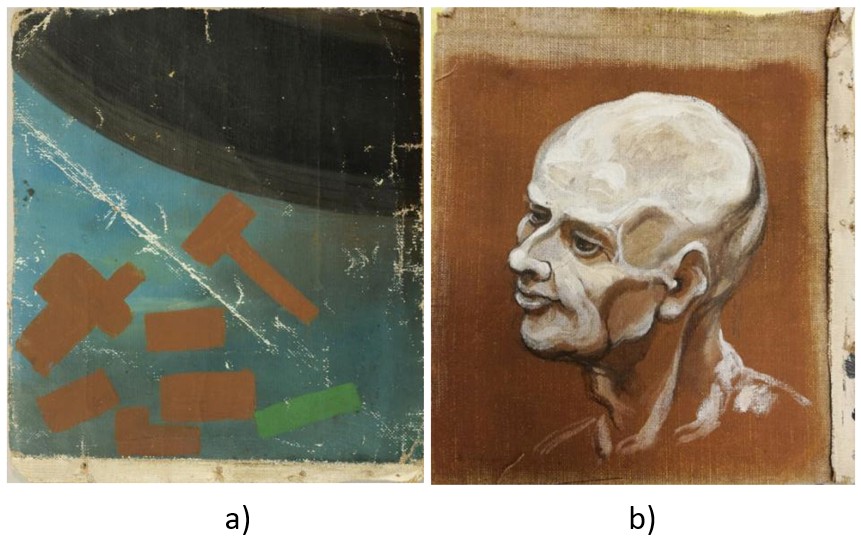
Featured visual: Contextual research figure from âTeraPulse Lx for terahertzTerahertz radiation is electromagnetic energy commonly associated with frequencies around 0.1 to 10 THz, between microwaves and infrared, where many materials reveal distinctive propagation, absorption, and imaging behavior. More imaging of painting on canvasâ. It illustrates a closely related terahertzTerahertz radiation is electromagnetic energy commonly associated with frequencies around 0.1 to 10 THz, between microwaves and infrared, where many materials reveal distinctive propagation, absorption, and imaging behavior. More topic and is not a figure from the publication discussed on this page. Source publication.

Visuals are drawn from the Airtable research archive. Figure numbering, rights and interpretation should be checked against the original publication before republication outside this site.
A painting with a layered restoration history
The object was an oil painting on canvas depicting a young learned woman, attributed to Pierre Mignard and dated to the seventeenth century. Its present oval format concealed evidence of an earlier rectangular configuration. The work had also been relined and repaired, and visible inspection showed cracking and deformation. These characteristics made it a suitable case for asking whether terahertzTerahertz radiation is electromagnetic energy commonly associated with frequencies around 0.1 to 10 THz, between microwaves and infrared, where many materials reveal distinctive propagation, absorption, and imaging behavior. More and millimeter waves could locate voids, tears, support structures and previous interventions without sampling the paint.
The pulsed system was a Teraview TPS 3000 operated in reflection. It generated broadband radiation over approximately 0.1-3 THz and recorded a complete temporal waveform at every position. A 1 mm spatial pitch, 2,048 temporal samples and 50 averages per pixel gave detailed signals but led to an acquisition of roughly 20 hours for an area around 30 by 30 cm. Because the return time of each reflection is preserved, cross-sections can separate interfaces along depth when the echoes are sufficiently distinct.
The frequency-modulated continuous-wave scanner used electronic heads in bands spanning 75-110 GHz and 220-330 GHz. It could cover an area up to 600 by 800 mm, with a pixel dwell time near 240 microseconds and a complete scan in about 25 minutes. Its range information came from the beat signal produced during the frequency sweep. At these frequencies and bandwidths, it offered useful lateral mapping but could not resolve every thin paint or preparation layer along depth.
Defects and support features seen by complementary systems
At 100 GHz, the continuous-wave reflection image reproduced broad features of the figure and exposed a rectangular form inside the present oval perimeter, consistent with a change in stretcher or format. Around 300 GHz, higher spatial detail made several anomalies more apparent, including cracks, local voids and regions associated with canvas damage. Transmission imaging also revealed the wooden frame and small adhesive features linked to the relining process.
The time-domain data added depth discrimination. B-scans, which display reflected amplitude as a function of lateral position and time delay, showed changes of approximately 7-12 ps across surface irregularities. The authors related these delays to a height variation on the order of 0.45 mm. They aligned the dominant surface reflection to compensate for the painting’s uneven position, then examined later echoes for subsurface interfaces.
A dark region to the left of the sitter’s head was investigated in detail. The temporal cross-section contained separated reflections consistent with a local gap or peeling between layers, whereas a comparison region on the opposite side did not show the same echo structure. A repaired tear near the head was visible in conventional photography and X-radiography and was also localized in the terahertzTerahertz radiation is electromagnetic energy commonly associated with frequencies around 0.1 to 10 THz, between microwaves and infrared, where many materials reveal distinctive propagation, absorption, and imaging behavior. More data. The agreement between modalities strengthened the structural interpretation without implying chemical identification of the materials involved.
Each technique therefore answered a different part of the diagnostic question. FMCW imaging rapidly identified areas that deserved attention across the full painting. THz-TDI examined selected lines or zones with finer temporal information and broadband spectral content. The study’s most practical proposal is a staged workflow: begin with the faster electronic survey, then reserve slower pulsed measurements for anomalies where depth information could alter a restoration decision.
Terahertz imaging in conservation practice
TerahertzTerahertz radiation is electromagnetic energy commonly associated with frequencies around 0.1 to 10 THz, between microwaves and infrared, where many materials reveal distinctive propagation, absorption, and imaging behavior. More radiation occupies a useful position among heritage-imaging methods because it can penetrate many non-metallic support and preparation materials while remaining non-ionizing. It is sensitive to interfaces that may be weak in a visible or infrared image. At the same time, the interpretation is shaped by surface relief, refractive index, water content, metallic pigments and the orientation of layers. A dark or bright feature is not automatically a crack, an adhesive or a particular pigment; comparison with cross-sections, known geometry and other modalities remains necessary.
The author list brings together terahertzTerahertz radiation is electromagnetic energy commonly associated with frequencies around 0.1 to 10 THz, between microwaves and infrared, where many materials reveal distinctive propagation, absorption, and imaging behavior. More researchers and a restoration practitioner, which is important for a study concerned with a real artwork rather than a laboratory coupon. The record supports a collaborative diagnostic experiment, but not a claim that terahertzTerahertz radiation is electromagnetic energy commonly associated with frequencies around 0.1 to 10 THz, between microwaves and infrared, where many materials reveal distinctive propagation, absorption, and imaging behavior. More imaging replaces conservator examination, X-radiography or infrared reflectography. Its value lies in adding non-contact structural evidence and helping target further investigation.
The contrast between a 25-minute large-area survey and a roughly 20-hour detailed pulsed acquisition also makes the engineering trade-off unusually concrete. Faster scanners can make routine pre-screening more plausible, while temporal resolution determines whether closely spaced layers can be separated. Future instruments may narrow this gap through broader electronic bandwidths, arrays and improved processing, but the selection of modality will continue to depend on the artwork and the conservation question.
For this painting, the combined approach documented defects, prior modifications and support features before restoration. More broadly, the study shows how terahertzTerahertz radiation is electromagnetic energy commonly associated with frequencies around 0.1 to 10 THz, between microwaves and infrared, where many materials reveal distinctive propagation, absorption, and imaging behavior. More measurements become useful to cultural heritage when they are integrated into a diagnostic sequence, interpreted conservatively and connected to the material history of the object.
Publication details and citation
Recommended citation: Guillet, J.-P., Roux, M., Wang, K., Ma, X., Fauquet, F., Balacey, H., Recur, B., Darracq, F., & Mounaix, P. (2017). ArtTerahertz technology offers a powerful, non-invasive way to explore and preserve works of art and cultural heritage objects. Positioned between infrared and microwaves, terahertz waves can penetrate many non-metallic and... More Painting Diagnostic Before Restoration with TerahertzTerahertz radiation is electromagnetic energy commonly associated with frequencies around 0.1 to 10 THz, between microwaves and infrared, where many materials reveal distinctive propagation, absorption, and imaging behavior. More and Millimeter Waves. Journal of Infrared, Millimeter, and TerahertzTerahertz radiation is electromagnetic energy commonly associated with frequencies around 0.1 to 10 THz, between microwaves and infrared, where many materials reveal distinctive propagation, absorption, and imaging behavior. More Waves, 38(4), 369-379. https://doi.org/10.1007/s10762-017-0358-1
Record ID: recmPPMYgept5v8Zb
Research themes: cultural heritage, painting conservation, THz time-domain imaging, FMCW imaging, non-invasive diagnostics.